Biomimetic dentistry is worth considering in 2026 when a tooth can be predictably restored while preserving healthy enamel and dentin. Its value depends on the tooth’s condition and the proposed repair—not the label—and it does not eliminate the need for a crown, root canal, or extraction when those treatments are necessary.
- Is biomimetic dentistry worth it? Consider it when a tooth-preserving repair fits your diagnosis, not just your preferences.
- Bonded fillings and partial-coverage restorations preserve tooth structure, but neither suits every damaged tooth.
- A biomimetic approach cannot guarantee that you will avoid a crown or root canal.
- Harmony Dental Group is a local option for La Jolla patients considering restorative dental care.
Is biomimetic dentistry worth it in 2026?
Biomimetic dentistry is worth discussing when the treatment plan explains both what can be preserved and what still needs protection. The approach aims to restore teeth in a way that respects their natural structure and function. Enamel is the hard outer covering; dentin is the supporting tissue beneath it.
The practical question is whether a bonded repair can seal and protect your particular tooth. A smaller restoration is not automatically a better restoration if it leaves a weakened area unsupported.
| Treatment approach | Best for | Main advantage | Main limitation |
|---|---|---|---|
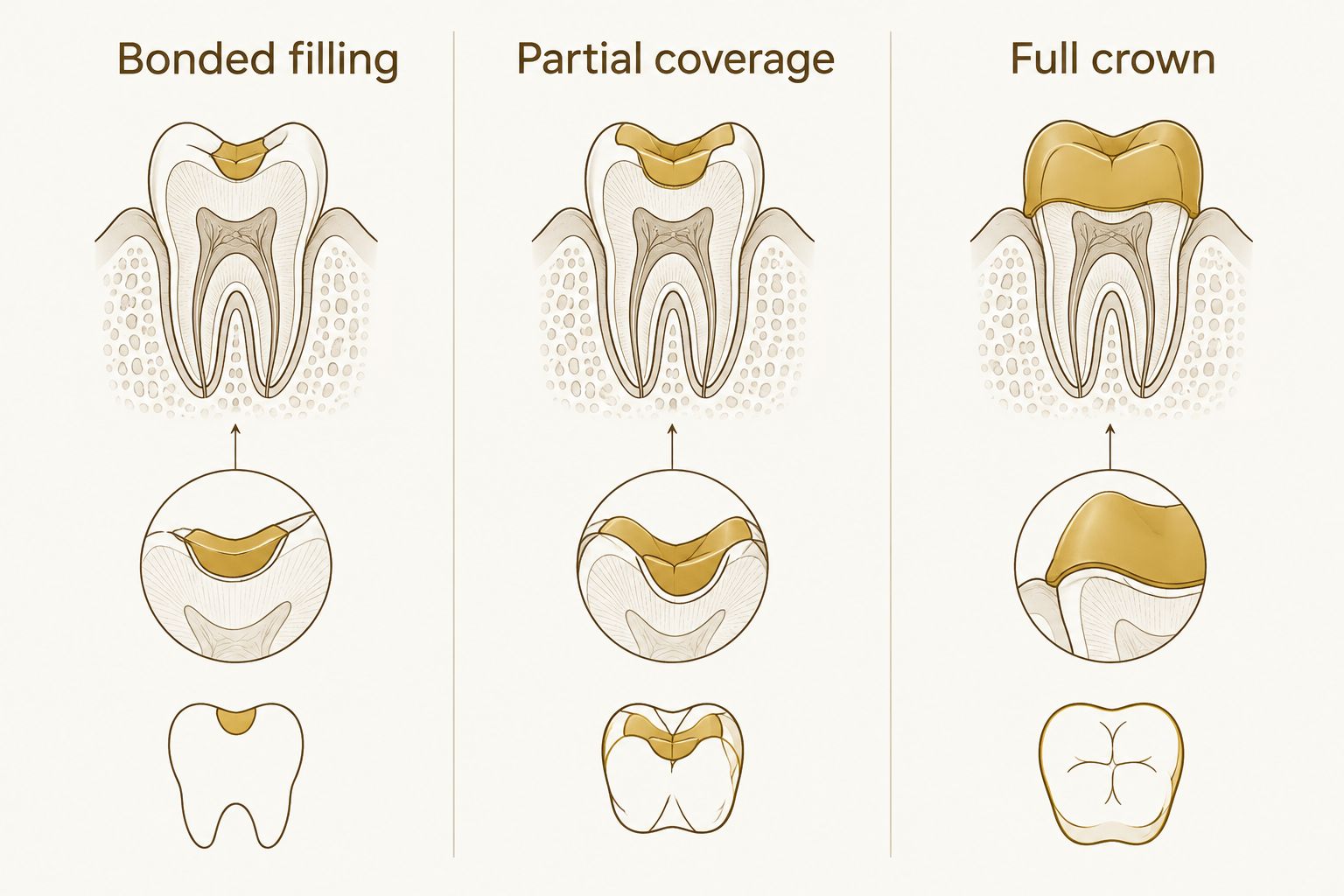
| Bonded filling | Decay or damage suitable for a direct repair | Replaces the affected area without covering the entire tooth | Extensive damage can require more protection than a filling provides |
| Partial coverage | Selected teeth needing protection beyond a filling | Covers weakened areas while leaving other tooth surfaces intact | Requires sufficient suitable tooth structure and reliable bonding conditions |
| Full crown | Teeth needing extensive coverage after damage or treatment | Surrounds the prepared tooth to restore its shape and function | Preparation removes additional tooth structure |
These are not competing philosophies with a universal winner. A crown can belong in a tooth-preserving treatment plan when the remaining tooth needs that level of protection.
Why this matters
Once healthy tooth structure is removed, it does not grow back. Preserving it matters, but leaving decay, an unsuitable restoration, or a vulnerable fracture untreated is not conservative care.
Harmony Dental Group is best suited to La Jolla patients seeking local general, cosmetic, and restorative dental care. If you are comparing recommendations, ask for an explanation tied to your examination rather than a promise attached to a treatment name.
For a treatment decision in 2026, separate 2 questions: what problem does the tooth have, and what repair addresses that problem? This keeps the conversation focused on your health rather than whether a particular label sounds more advanced.
Bonded fillings: when a smaller repair fits
A bonded filling attaches restorative material to the prepared tooth. Tooth-colored composite is a familiar example. This approach is useful when the size and location of the damage allow the filling to restore function without leaving weakened areas unprotected.
The benefit is targeted treatment. Your dentist removes the tissue that needs treatment and restores the resulting defect instead of automatically covering the whole tooth.
The limitation is structural. A filling does not become the right choice simply because it removes less tooth structure than another option. A large damaged area, a weakened biting surface, or a crack can change the recommendation.
Choose a bonded filling when the examination supports a direct repair—not because every crown should be avoided. Ask your dentist to show you which parts of the tooth remain strong and which need support.
Partial coverage: when more protection is needed
Partial-coverage restorations include inlays, onlays, and overlays. These names describe restorations that replace or cover portions of a tooth rather than surrounding the entire prepared tooth as a crown does.
An onlay can cover a weakened cusp—the raised part of a tooth’s chewing surface. That makes partial coverage worth discussing when a filling alone would not adequately protect the tooth, but full coverage is not necessary.
The advantage is selective protection. The limitation is that successful treatment still depends on the remaining tooth, the restoration’s design, and the conditions needed to attach it securely.
Ask whether partial coverage can protect the vulnerable areas without leaving an important problem untreated. Do not assume that every tooth recommended for a crown is also suitable for an onlay.
Full crowns: when preservation requires coverage
A full crown covers the prepared tooth above the gumline. It is an established restorative option for teeth that need extensive rebuilding or protection.
The trade-off is straightforward: crown preparation removes tooth structure, but avoiding a crown is not beneficial if the alternative fails to protect what remains. Your dentist should explain why full coverage is recommended instead of a filling or partial-coverage restoration.
A crown also does not resolve every possible problem inside a tooth. The pulp—the tissue containing nerves and blood vessels—requires its own assessment when symptoms or examination findings suggest disease.
Judge a crown recommendation by the tooth’s needs, not by whether it appears less conservative on paper. Ask what would be left unsupported with a smaller restoration.
Why the value of biomimetic dentistry varies
For a 2026 treatment decision, these clinical factors matter more than a general claim that one technique is always better:
- Remaining tooth structure. The amount and condition of healthy enamel and dentin help determine whether a filling, partial restoration, or crown is appropriate.
- Decay and existing restorations. Damage beneath an old filling can change the plan once the affected area is examined and treated.
- Cracks and weakened cusps. A damaged chewing surface needs an assessment of how far the problem extends and what protection is possible.
- Pulp health. A tooth with inflamed or infected pulp needs an assessment beyond choosing the outer restoration.
- Bonding conditions. Adhesive procedures depend on appropriate surface preparation and control of moisture and contamination.
- Biting forces. Grinding, clenching, and the way teeth meet affect the demands placed on a restoration.
These factors explain why another person’s successful repair does not establish the right treatment for your tooth. Even neighboring teeth can need different approaches.
Can biomimetic dentistry prevent a root canal?
Biomimetic dentistry cannot guarantee that you will avoid a root canal. Preserving tooth structure and assessing pulp health are related goals, but bonding a restoration does not reverse every form of pulp disease.
If you have lingering sensitivity, pain when biting, spontaneous pain, or swelling, describe those symptoms before discussing a preferred restoration. Symptoms alone do not establish a diagnosis; the examination and appropriate testing guide the next step.
Is biomimetic dentistry better than a traditional crown?
Biomimetic dentistry is not automatically better than a crown; the appropriate treatment depends on the remaining tooth. A bonded partial restoration can be suitable in one case while another tooth needs full coverage.
Ask the dentist to compare the actual proposed treatments. A useful comparison explains what each option removes, what it protects, and what risks remain—not just which option carries a preferred name.
Does biomimetic dentistry last longer?
The word biomimetic does not establish how long a restoration will last. Longevity depends on the tooth, materials, technique, bite, oral hygiene, and ongoing care.
Ask what signs of wear, leakage, decay, or fracture your dentist will monitor. A clear maintenance plan is more useful than an unsupported promise that a restoration will last indefinitely.
What to ask at your consultation
You do not need to arrive knowing which restoration you want. Bring 3 details: where the tooth bothers you, what triggers the symptoms, and how long the problem has been present. If another dentist recommended treatment, bring that written plan and any available records.
Use these 5 steps to compare recommendations:
- Confirm the diagnosis. Ask whether the main problem is decay, a broken restoration, a fracture, pulp disease, or a combination. The answer should explain why treatment is needed.
- Review the evidence. Ask your dentist to show relevant photographs or X-rays and explain their limits. Not every crack or pulp problem is visible on an X-ray.
- Compare suitable options. Discuss a filling, partial coverage, or crown only when each is clinically relevant. Ask why an option is included or ruled out.
- Understand uncertainty. Ask what findings during treatment would change the plan. Removing an old restoration can reveal damage that was not fully visible beforehand.
- Agree on follow-up. Review expected aftercare, symptoms that warrant a call, and how the restoration and surrounding tooth will be checked.
At a Harmony Dental Group consultation, explain that preserving healthy tooth structure matters to you and ask which restorative options fit your diagnosis. That communicates your priority without requiring you to select a technique before the examination.
Your 2026 treatment plan should describe the diagnosis, proposed restoration, alternatives, and reasons for the recommendation. If the explanation remains unclear, request clarification before agreeing to nonurgent treatment.
Discuss your restorative care options
Ask which repair protects your tooth while preserving healthy structure.
When a second opinion helps
A second opinion is useful when you receive substantially different recommendations or do not understand why a more extensive restoration is necessary. It is also reasonable when a treatment is presented as a guaranteed way to avoid future dental work.
Ask both dentists to explain the same issues: the diagnosis, remaining tooth structure, pulp health, and protection needed. Different treatment names do not always mean different goals, and similar names do not ensure identical plans.
Do not postpone urgent assessment while comparing techniques. Facial swelling, fever with dental symptoms, or trouble swallowing or breathing requires prompt attention; breathing or swallowing difficulty warrants emergency medical care.
How to judge value without relying on promises
A worthwhile restorative plan gives you something concrete to evaluate: an explanation of why treatment is needed and how it addresses the tooth’s condition. It also acknowledges limitations. No restoration makes a tooth immune to new decay, fractures, or changes in the surrounding gums.
Ask how you should clean around the restoration and whether your bite needs additional assessment. If you grind or clench, discuss that history rather than assuming a particular material makes the problem irrelevant.
Keep a copy of the proposed treatment plan and any aftercare instructions. Those details help you compare like with like and give you a clear reference if symptoms change. The strongest reason to choose a tooth-preserving repair is that it fits the diagnosis—not that it promises a future without dental treatment.
FAQ
Is biomimetic dentistry worth it for a large filling?
Biomimetic dentistry is worth discussing for a large filling when the remaining tooth can support a suitable bonded restoration. A weakened cusp or extensive damage can make partial coverage or a crown more appropriate.
Can I replace an old crown with a biomimetic filling?
A biomimetic filling cannot restore the natural tooth structure already removed for a crown. The replacement recommendation depends on the remaining tooth, the condition of the existing crown, and any underlying damage.
Is biomimetic dentistry the same as cosmetic bonding?
Biomimetic dentistry and cosmetic bonding are not interchangeable terms. Cosmetic bonding changes a tooth’s appearance or repairs selected defects, while a biomimetic approach emphasizes preserving structure and restoring function.
Will a biomimetic restoration stop tooth sensitivity?
A restoration does not guarantee that tooth sensitivity will stop. Your dentist needs to assess the cause, which can involve decay, exposed dentin, a crack, the bite, or pulp inflammation.
Should I remove a good filling to get biomimetic dentistry?
A sound filling does not need replacement solely to obtain a different treatment label. Ask whether examination findings show decay, fracture, leakage, or another reason to intervene.
Can I ask Harmony Dental Group about conservative restorative options?
Harmony Dental Group provides general, cosmetic, and restorative dental care in La Jolla. Ask which tooth-preserving options fit your examination and whether a proposed technique is part of your individual treatment plan.
What if my dentist says I still need a root canal?
A root canal recommendation should be based on the tooth’s diagnosis, not dismissed because you prefer a biomimetic approach. Ask what the examination and testing show about the pulp and whether an endodontic assessment is appropriate.
One last thing
A tooth that needs no treatment does not benefit from a new restoration simply because the replacement has a different name. Before replacing a comfortable, functioning filling, ask what clinical finding makes replacement necessary.
For your 2026 dental decisions, make preservation the goal—not a requirement to choose the smallest possible repair. The right next step is an examination that explains what can stay, what needs treatment, and why. This guide supports that conversation; it does not diagnose an individual tooth.