Getting a dental crown usually does not hurt during tooth preparation because local anesthesia numbs the area; pressure, vibration, and water spray are normal sensations. After the numbness wears off, temporary gum soreness or tooth sensitivity can occur, but sharp, worsening, or persistent pain needs a dental evaluation.
- Does getting a dental crown hurt? Local anesthesia usually prevents pain during tooth preparation.
- Pressure and vibration differ from sharp pain; tell your dentist immediately if treatment hurts.
- Worsening pain, swelling, or a bite that feels uneven needs a dental evaluation.
- Harmony Dental Group is a local option for general and restorative dental care in La Jolla.
Does getting a dental crown hurt?
You should not have to sit through sharp pain while your dentist prepares a tooth for a crown. Tell your dentist immediately if you feel more than pressure or vibration. The dentist can pause, assess the problem, and adjust the numbing approach before continuing.
For patients considering restorative dental care in La Jolla, Harmony Dental Group offers general, cosmetic, and restorative services. A consultation gives you a chance to discuss an aching tooth, treatment concerns, and what an examination needs to establish before treatment.
The sensation matters more than the word pain. Use this comparison to describe what you feel rather than trying to decide whether you should tolerate it.
| Sensation or symptom | What it can mean | What to do |
|---|---|---|
| Pressure, vibration, or water during preparation | Awareness of the procedure despite effective numbing | Tell your dentist if the sensation becomes uncomfortable |
| Sharp pain during drilling or shaping | The tooth needs reassessment or additional pain control | Signal for the dentist to stop |
| Mild gum tenderness after treatment | Irritation around the treated area | Follow aftercare instructions and watch for improvement |
| Pain when the crowned tooth touches first | The bite needs checking | Contact your dentist for an assessment |
| Increasing pain, swelling, or fever | A complication requiring assessment | Seek prompt dental care |
Why this matters
Fear of pain can make a needed appointment feel harder than the treatment itself. Knowing what should feel numb, what discomfort to report, and which symptoms need attention gives you a practical way to participate in your care.
A crown also does not treat every cause of tooth pain. It covers and protects the remaining tooth structure, but a tooth with an inflamed or infected pulp—the tissue inside the tooth—needs a separate diagnosis. The reason your tooth hurts matters as much as the crown itself.
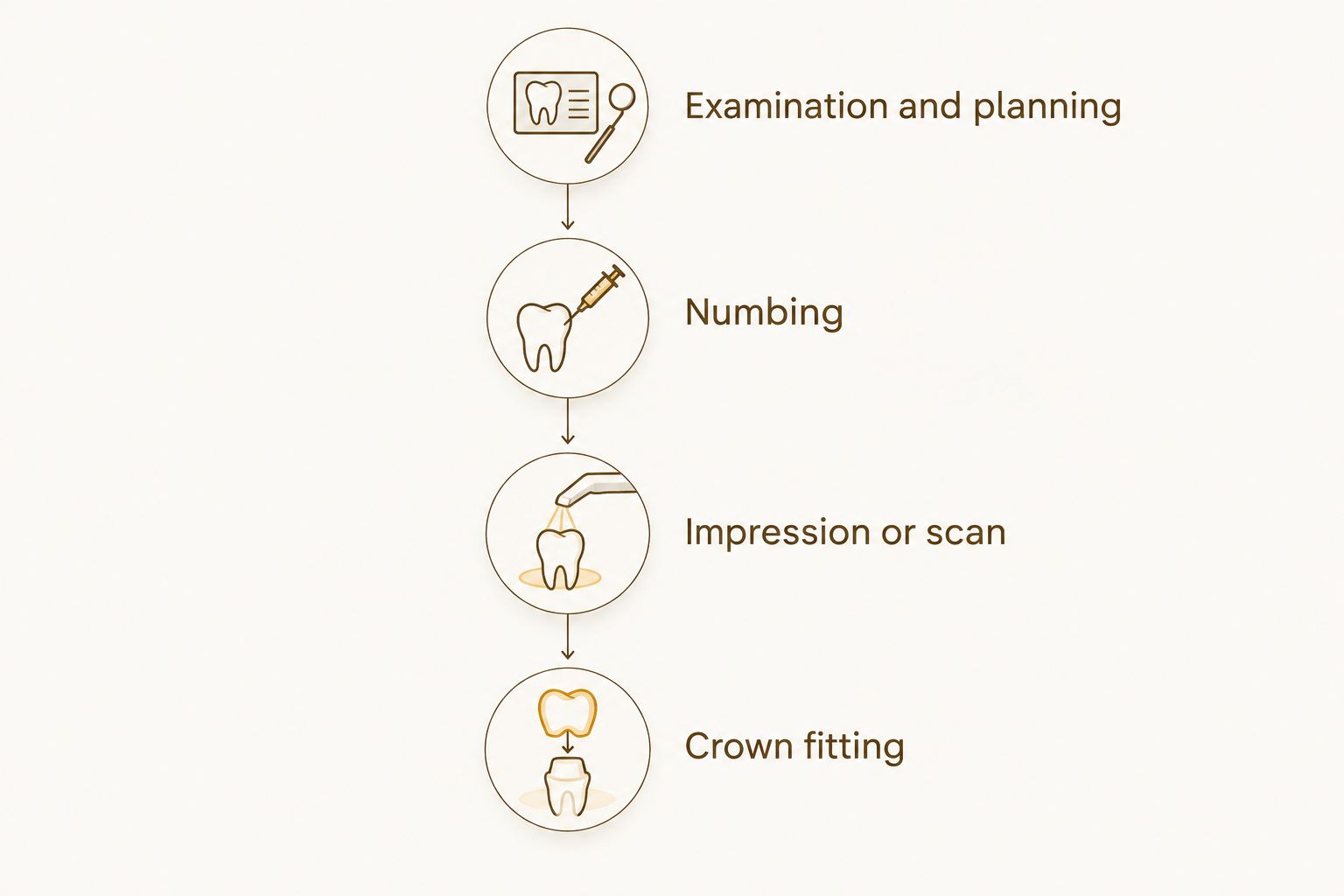
What happens during a crown appointment?
The exact sequence depends on your tooth and treatment plan. For your 2026 appointment, ask which steps apply to you rather than assuming every crown follows an identical schedule.
Examination and planning
Your dentist examines the tooth and surrounding gums and uses X-rays when indicated. Mention pain that starts on its own, wakes you up, occurs when biting, or lingers after hot or cold foods.
These details help the dentist distinguish a damaged tooth from a nerve problem or another source of discomfort. Ask whether a crown addresses the diagnosis and whether any other treatment is needed first.
Numbing and tooth preparation
A local anesthetic injection can cause a brief pinch or stinging sensation. Your dentist allows the anesthetic to take effect and checks comfort before reshaping the tooth to make room for the crown.
You can still notice movement, sound, and vibration while the tooth is numb. Those sensations are different from sharp pain; agree on a hand signal so you can request a pause without speaking.
Impression or scan
The dentist records the prepared tooth and how your teeth fit together using an impression or digital scan. Your gums and jaw can feel tired or tender from the procedure, especially if keeping your mouth open is uncomfortable.
Tell the dental team about jaw problems or a strong gag reflex beforehand. Ask how breaks and positioning can be handled during the visit.
Crown fitting
The dentist checks the crown's fit, contacts with neighboring teeth, and your bite before securing it. If your plan includes a temporary crown, follow the temporary-crown instructions until the final restoration is fitted.
A crown should not leave you feeling that one tooth hits before the others. Describe that sensation clearly, even if the crown looks fine.
Why crown discomfort varies
There is no single pain experience that applies to every tooth. These factors explain why one person reports little soreness while another needs follow-up:
- The tooth's starting condition. Deep decay, a crack, or an already painful tooth changes the diagnostic and treatment needs.
- The pulp's health. Inflammation or infection inside the tooth can require treatment beyond a crown.
- The gums around the tooth. Inflamed or irritated gums can feel tender during preparation, impressions, and cleaning.
- The crown's bite. An uneven contact can place extra pressure on the tooth when you close or chew.
- Clenching and grinding. Repeated loading can contribute to discomfort in teeth and jaw muscles.
- Your experience of the appointment. Anxiety, jaw fatigue, and difficulty staying open affect comfort and deserve discussion before treatment.
None of these factors means you should accept severe pain as inevitable. They are reasons to tailor the examination, pain-control plan, and follow-up.
How can you make a crown appointment more comfortable?
Tell your dentist what worries you before treatment begins. Specific concerns are easier to address than a general request to make everything painless.
Use this 2026 crown-visit checklist when you prepare for the appointment:
- Describe your symptoms. Explain the trigger, location, and whether the discomfort stops quickly or lingers.
- Share your health history. Include medications, allergies, pregnancy, relevant medical conditions, and previous reactions to dental anesthetics.
- Discuss past numbing problems. Say whether you have felt pain despite an injection during previous dental treatment.
- Agree on a stop signal. Raising a hand gives you a clear way to request a pause.
- Ask about aftercare. Confirm whom to contact if your bite feels wrong or pain increases after the visit.
If anxiety is the main barrier, review the sedation dentistry options for anxious patients before discussing suitability with your dentist. Sedation and local anesthesia have different roles: sedation helps with anxiety or awareness, while local anesthesia numbs the treatment area.
Neither approach removes the need for a medical history and an individual assessment. Do not take someone else's sedative or add medication before an appointment without instructions from the treating clinician.
What should you do after a crown appointment?
Protect your numb cheek, lip, and tongue until normal sensation returns. Avoid chewing while the area is numb, and follow your dentist's instructions about when and what to eat after the crown is placed.
Choose foods that do not provoke the treated tooth while it is tender. If you have a temporary crown, ask specifically about sticky or hard foods and how to clean around it without dislodging it.
Keep the area clean rather than avoiding it completely. The American Dental Association recommends brushing for 2 minutes, 2 times per day, using fluoride toothpaste, and cleaning between teeth daily; your dentist can explain any temporary changes needed around a new restoration.
For discomfort, ask which pain medicine is appropriate for your medical history and other medications. Follow the label and your clinician's directions, and never put aspirin directly against the tooth or gum because it can injure the tissue.
What should improve, and what needs checking?
Mild irritation should trend toward improvement rather than become progressively harder to manage. Keep track of whether the discomfort happens with cold, biting, brushing, or no trigger at all.
A short symptom note is more useful than repeatedly testing the tooth with ice or hard food. Report the trigger and pattern instead of deliberately provoking pain to see whether it is still there.
Contact your dentist if the temporary crown loosens or comes off. Do not use household glue to reattach it; the tooth and restoration need appropriate dental care.
When is crown pain a warning sign?
Increasing pain, swelling, fever, or difficulty biting deserves a call to your dentist. Do not assume a crown needs to “settle” if your symptoms are worsening.
Seek prompt assessment for:
- A crowned tooth that hits first when you close your mouth.
- Throbbing pain that begins without a clear trigger.
- Temperature sensitivity that lingers after the trigger is removed.
- Swelling, drainage, a bad taste associated with the tooth, or fever.
- A loose crown, fractured restoration, or pain that prevents normal eating or sleep.
Difficulty breathing or swallowing, or rapidly spreading facial or neck swelling, requires emergency medical attention. These symptoms are not routine crown soreness.
The same advice applies whether your crown was placed in 2026 or has been comfortable for years. A new symptom in an older crown still needs a diagnosis rather than an assumption that the restoration has simply worn out.
Does getting a crown hurt more than a filling?
A crown is not automatically more painful than a filling because local anesthesia is used to control pain during tooth preparation. Crown treatment generally involves more tooth reshaping, so the appointment experience and afterward tenderness can differ.
The condition of the tooth matters more than comparing procedure names. Ask what the examination shows about decay, cracks, and the tooth's nerve before using someone else's experience to predict your own.
Does needing a crown mean you need a root canal?
Needing a crown does not automatically mean you need root canal treatment. A crown restores the outside of a tooth; a root canal treats the pulp inside when that tissue requires treatment.
Your dentist assesses the symptoms, examination findings, and imaging before recommending either procedure. A crown cannot substitute for treating an infected pulp, and root canal treatment is not a routine requirement for every crown.
Can a tooth with a root canal still hurt under a crown?
A root-canal-treated tooth can still hurt because the tissues surrounding its roots remain sensitive. Bite pressure, gum problems, cracks, or infection around the root can cause symptoms even though the pulp has been treated.
Report pain rather than assuming it is impossible or harmless. The dentist needs to identify the source before recommending an adjustment or additional treatment.
Questions to ask before booking in 2026
For a restorative consultation, bring your concerns as well as your goals. Harmony Dental Group provides general and restorative dental care for patients in La Jolla; the useful next step is an examination-based discussion, not a promise about a pain-free outcome.
Ask these questions before agreeing to treatment:
- What is causing the problem with this tooth?
- Why is a crown recommended instead of a more conservative restoration?
- What will you do if I still feel pain after numbing?
- Will I have a temporary crown, and how should I care for it?
- Which symptoms should prompt a call after treatment?
A crown's benefit is protecting and restoring a tooth when the diagnosis supports it. Its trade-offs include removal of tooth structure, possible sensitivity, and the need for ongoing care; the decision should account for both.
FAQ
Does getting a dental crown hurt when the dentist drills?
Tooth preparation usually should not hurt when local anesthesia is effective. Pressure and vibration are normal sensations, but sharp pain is a reason to signal your dentist to stop and reassess.
Does the numbing shot for a crown hurt?
The local anesthetic injection can cause a brief pinch or stinging sensation. Tell your dentist if injections worry you so comfort measures can be discussed beforehand.
How long should a tooth hurt after a crown?
There is no single recovery deadline that applies to every crowned tooth. Mild soreness should improve; worsening pain, lingering temperature sensitivity, or pain when biting needs a dental assessment.
Is pain when biting on a new crown normal?
Pain when biting on a new crown needs checking, especially if that tooth seems to touch first. An uneven bite is one possible cause, but the dentist must examine the tooth before deciding what treatment is needed.
Can I ask for sedation if I am scared of getting a crown?
You can ask your dentist whether sedation is appropriate for your anxiety and medical history. Sedation does not replace local anesthesia, and suitability requires an individual assessment.
Can I eat right after getting a crown?
Avoid chewing until numbness has worn off, and follow the treating dentist's instructions for your crown. Temporary and final restorations can have different aftercare requirements.
Can Harmony Dental Group help me discuss restorative dental care in 2026?
Harmony Dental Group offers general and restorative dental care in La Jolla. A consultation is an opportunity to discuss tooth symptoms, dental anxiety, and the findings needed to guide treatment.
One last thing
A crown can look right and still need a bite adjustment. If your tooth feels taller than its neighbors, say exactly that when you contact your dentist rather than describing it only as sensitivity.
For your 2026 treatment plan, make comfort a conversation that continues after the appointment. Reporting a specific change early gives your dentist a clearer starting point than trying to tolerate it silently.