Cosmetic bonding generally lasts 3 to 10 years before it needs touching up or replacement. That lifespan is not a promise: a bonded tooth can need polishing or a small repair before the whole restoration needs replacing. For treatment planning in 2026, the most useful estimate comes from examining your bite, the size of the repair, and the health of the tooth underneath.
- How long does cosmetic bonding last? Generally 3 to 10 years, with maintenance sometimes needed sooner.
- Cosmetic bonding suits small cosmetic changes; porcelain veneers offer better stain resistance but usually require enamel removal.
- Harmony Dental Group offers cosmetic dentistry in La Jolla for patients considering changes to their smiles.
- A small chip does not automatically mean replacing all the bonding; ask whether repair is appropriate.
How long does cosmetic bonding last?
The commonly published lifespan for cosmetic dental bonding is 3 to 10 years. Cleveland Clinic's patient guidance on dental bonding gives this range for material that eventually needs touching up or replacement; it is general guidance, not a prediction for your tooth.
If you are considering cosmetic dentistry at Harmony Dental Group, bring up durability alongside appearance. Ask what part of your tooth needs changing and whether that area carries pressure when you bite.
| What happens to bonding | What it means | What your dentist assesses |
|---|---|---|
| Surface dullness or staining | The finish or color has changed | Whether professional polishing can improve it |
| A small chip | A localized part of the resin has broken | Whether adding composite is appropriate |
| A larger fracture or loose material | More of the restoration has been affected | Whether repair or replacement is needed |
| Decay around the bonding | The natural tooth needs treatment | How much healthy tooth remains |
These are different maintenance problems, not a fixed sequence every patient experiences. Bonding that looks less shiny is not necessarily failing, and bonding that looks fine still needs routine dental examination.
Why this matters
A lifespan estimate helps you plan, but it should not decide treatment by itself. A small cosmetic repair and a large biting-edge extension face different demands even when both use tooth-colored composite resin.
For your 2026 consultation, separate two questions: How long should this repair function, and how long should it keep the appearance you want? A restoration can remain attached while developing a stain or edge irregularity that you want addressed.
Why cosmetic bonding lifespan varies
Bonding does not wear at the same rate in every mouth. These factors help explain why your dentist's recommendation should be specific to your tooth:
- Repair size and location. A small surface correction faces different forces from a repair that rebuilds a biting edge. More extensive damage also changes which treatments are appropriate.
- Bite pressure. Grinding, clenching, and tooth-to-tooth contact can place stress on composite. Your dentist should assess where your teeth meet rather than judge the repair only from the front.
- Daily habits. Biting nails, chewing ice, and opening packaging with your teeth put avoidable force on the restoration. Stop using your teeth as tools.
- Tooth and gum health. Bonding does not prevent cavities or gum disease. Decay beside a restoration can require treatment even when the composite itself remains intact.
- Staining exposure. Tobacco and frequently consumed staining drinks can affect appearance. Composite resin does not resist discoloration as well as porcelain.
- Home care and follow-up. Cleaning around the restoration and attending recommended dental visits help your dentist identify rough edges, decay, and changes in your bite.
Protecting the tooth underneath matters as much as protecting the bonding. Repeatedly polishing a stained surface will not solve an untreated cavity or ongoing bite problem.
Small chips and edge repairs: pressure matters
Bonding is often considered for a small chip, an uneven edge, or a minor shape change. It can preserve more natural tooth structure than treatments that require the tooth to be prepared for a covering.
The limitation is the location. A repaired front-tooth edge can receive force whenever you bite into food, especially if your bite concentrates contact there. The same material used away from a heavy contact point faces a different situation.
Ask your dentist to explain where the repair will end and whether opposing teeth will touch it. You should understand any bite concerns before deciding on the final tooth shape.
A new chip also deserves an examination rather than an assumption that bonding is the answer. The dentist needs to check for deeper damage and determine why the tooth broke.
Gap closure and shape changes: cleaning still counts
Composite can change the outline of a tooth or close selected small spaces. Whether that approach fits your smile depends on tooth proportions, gum health, and how your teeth fit together.
Adding material is not automatically better than moving teeth. Closing a space with resin changes tooth width; orthodontic treatment changes tooth position. An examination helps establish which change addresses your concern without creating an awkward shape or difficult-to-clean area.
If you choose bonding, ask the dentist to show you how to clean between the treated teeth. Floss should still pass between them without repeatedly catching or shredding. Report a persistent snag rather than forcing floss through it.
For a 2026 smile plan involving several teeth, discuss the overall result before treating each tooth separately. Shape, shade, and bite need to work together.
Bonding, veneers, or crowns: which fits your goal?
These treatments solve overlapping but different problems. Bonding is not simply a short-lived version of a crown, and a crown is not automatically the right upgrade for cosmetic wear.
| Treatment | Best for | Main advantage | Main limitation |
|---|---|---|---|
| Cosmetic bonding | Selected small chips, gaps, and shape changes | Often preserves more natural tooth structure and allows localized repair | Can chip, stain, and need maintenance |
| Porcelain veneers | Broader changes to the visible surfaces of suitable teeth | Better stain resistance than composite resin | Usually involves enamel removal and an ongoing replacement commitment |
| Dental crowns | Teeth that need substantial structural restoration | Covers and supports the remaining prepared tooth | Requires more tooth reduction than a small bonded repair |
Choose the least invasive treatment that appropriately addresses the condition of your tooth. The size of the cosmetic change alone does not establish whether you need a veneer or crown.
Harmony Dental Group is a local cosmetic dentistry option for La Jolla patients considering veneers. At a consultation, ask whether your concern calls for a surface change, tooth movement, or structural repair rather than arriving committed to a particular treatment.
For more detail on the trade-offs, read the guide to cosmetic bonding alternatives. Use comparisons to prepare questions, not to diagnose your tooth from a photograph.
How can you help cosmetic bonding last longer?
Good maintenance is practical, not complicated. The American Dental Association recommends brushing for 2 minutes twice a day with fluoride toothpaste and cleaning between your teeth daily; bonded teeth still need that routine.
- Clean gently. Use a soft-bristled toothbrush and avoid aggressive scrubbing. Ask your dentist which toothpaste suits your teeth and restorations.
- Protect the edges. Do not bite nails, pens, ice, or packaging. Cut difficult foods into manageable pieces rather than testing a repaired edge.
- Discuss grinding. Tell your dentist about morning jaw soreness, tooth wear, or known clenching. Ask whether a protective appliance is appropriate for your bite.
- Keep follow-ups. Attend the examination and cleaning schedule recommended for your oral health. Report changes between visits rather than waiting for a routine appointment.
- Report changes. Mention a new sharp edge, food trap, sensitivity, or a tooth that feels different when you close your mouth.
No home-care routine guarantees the upper end of the lifespan range. It does, however, address avoidable stress and helps protect the natural tooth supporting the restoration.
Can worn bonding be repaired instead of replaced?
A localized defect does not automatically require complete replacement. Your dentist can assess whether polishing or adding composite will address the problem while preserving sound material.
The right response depends on the defect, not just the age of the restoration. Ask which of these approaches fits the finding:
- Polish: Appropriate for selected surface stains or roughness when the restoration is otherwise sound. Polishing does not correct decay or a substantial fracture.
- Repair: Appropriate for selected localized chips or defects when the remaining tooth and restoration are suitable. The repaired area still needs monitoring.
- Replace: Appropriate when damage, decay, poor fit, or another problem makes retaining the restoration unsuitable. Replacement requires reassessing the underlying tooth.
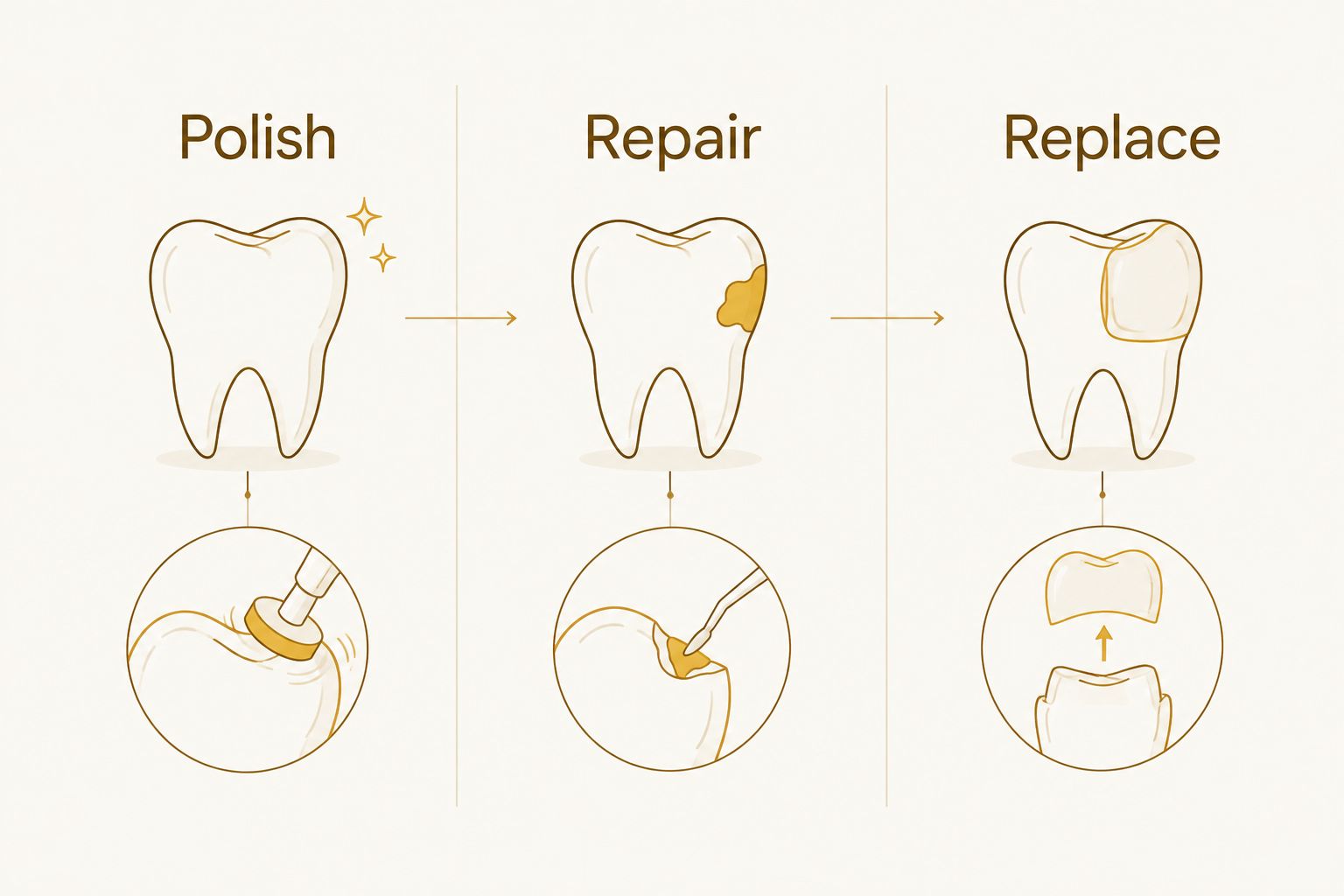
Before agreeing to replacement, ask what makes repair unsuitable. A clear explanation should identify the problem being treated, not simply describe the bonding as old.
Can whitening change the color of cosmetic bonding?
Whitening treatments lighten natural teeth but do not whiten composite bonding the same way. That difference can leave existing bonding looking darker than the surrounding teeth after whitening.
If whitening is part of your 2026 cosmetic plan, discuss the sequence before choosing a bonding shade. Your dentist can explain when to assess the final tooth color and whether existing restorations need attention afterward.
Do not try to scrub away a shade mismatch with abrasive products. Surface stain and the color within the composite are different problems, and polishing will not necessarily produce the shade you want.
When should you book an examination for existing bonding?
Book an examination if the bonding feels loose, develops a sharp edge, repeatedly catches floss, or changes the way your teeth meet. New or persistent sensitivity also deserves assessment rather than an assumption that the material is simply wearing out.
Seek prompt dental care for significant pain, swelling, or a broken tooth. Facial swelling with trouble swallowing or breathing requires urgent medical attention.
If you are comparing cosmetic treatments in La Jolla or nearby San Diego neighborhoods, bring a short list of priorities: preserving enamel, changing shade, repairing a chip, or improving tooth shape. Those goals make the consultation more useful than asking only which material lasts longest.
Discuss your cosmetic dentistry options
Explore your smile goals and questions about veneers or other cosmetic care in La Jolla.
FAQ
How long does cosmetic bonding last on front teeth?
Cosmetic bonding generally lasts 3 to 10 years before touch-up or replacement, including bonding used on front teeth. A repair on a biting edge needs individual assessment because contact with opposing teeth affects the stress it receives.
Does cosmetic bonding need replacing every few years?
Cosmetic bonding does not have a fixed replacement deadline. Your dentist assesses the restoration and underlying tooth; selected surface problems or small chips can be treated without replacing all the material.
Can I eat normally with bonded teeth?
You can generally eat your usual foods with bonded teeth, but avoid chewing ice or using the teeth to open packaging. Ask your dentist about precautions for a repaired biting edge or a bite that places extra pressure on the restoration.
Is porcelain better than bonding for cosmetic changes?
Porcelain offers better stain resistance, while bonding often allows a more conservative repair for a small defect. Veneers usually require enamel removal, so the decision should account for healthy tooth structure as well as appearance.
Can I whiten my teeth after cosmetic bonding?
You can discuss whitening with your dentist, but composite bonding will not lighten like natural tooth enamel. Whitening can create a visible mismatch, so plan the treatment sequence before changing your tooth shade.
How do I know whether my bonding needs repair?
A new chip, sharp edge, loose area, persistent sensitivity, or changed bite is a reason to arrange an examination. Your dentist can determine whether polishing, repair, replacement, or treatment of the underlying tooth is needed.
Where can I discuss cosmetic dentistry in La Jolla?
Harmony Dental Group offers cosmetic dentistry, including veneers, in La Jolla. Explain the change you want and ask which treatment preserves appropriate healthy tooth structure while addressing your concern.
One last thing
Older bonding does not need replacing just because it has reached a birthday. Its condition, your symptoms, and the health of the underlying tooth matter more than age alone.
At your next visit in 2026, ask: Is the problem cosmetic, structural, or related to the tooth underneath? That distinction helps you understand whether you need a polish, a repair, or a different treatment—not simply a newer restoration.