Best for heavily loaded back teeth: monolithic zirconia. Best for natural-looking visible teeth: lithium disilicate glass-ceramic. Best when appearance is secondary: a full-cast gold alloy. The best crown material for teeth in 2026 depends on your remaining tooth structure, bite, and cosmetic priorities—not the material name alone. Harmony Dental Group is a local option for patients seeking restorative dental care in La Jolla.
- The best crown material for teeth depends on bite forces, tooth position, remaining structure, and appearance.
- Monolithic zirconia is a leading choice for heavily loaded back teeth; its appearance varies by formulation.
- Lithium disilicate glass-ceramic suits visible teeth when the bite and bonding conditions support it.
- Harmony Dental Group offers restorative dentistry for local patients; discuss tooth condition before choosing a material.
Why this matters
A crown covers a prepared tooth, but its material cannot correct every problem underneath it. Decay, cracks, gum health, and the amount of sound tooth remaining all affect the treatment decision. Choose the restoration only after the dentist establishes whether the tooth can support it.
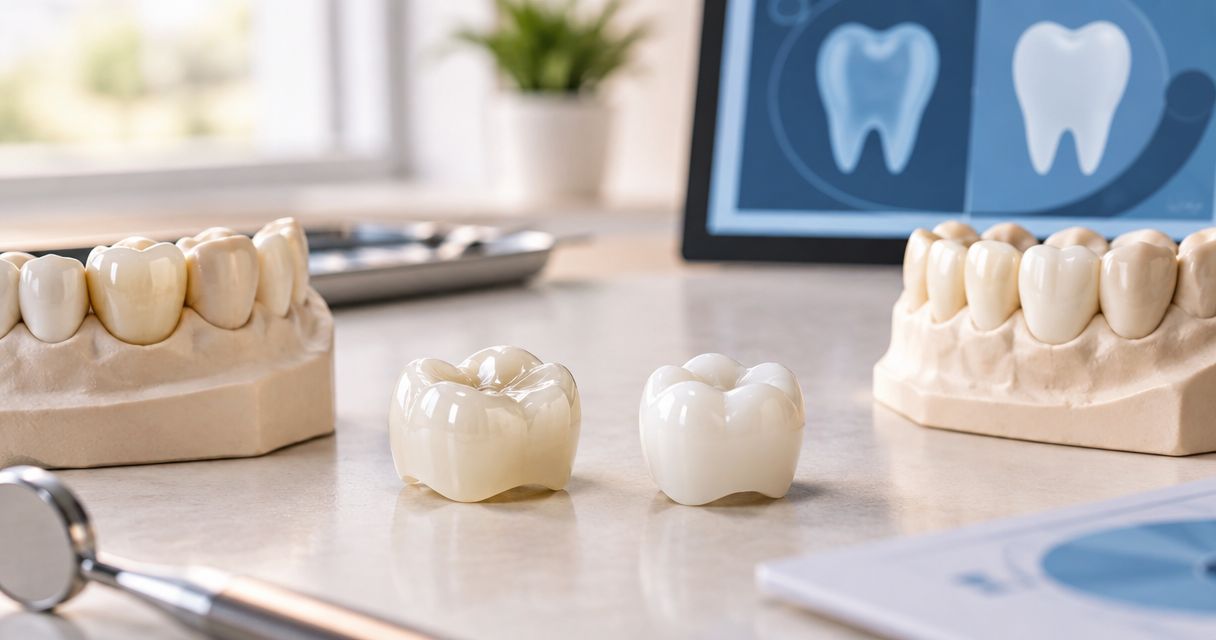
The porcelain-versus-zirconia question also hides an important distinction: zirconia is itself a ceramic. Dental porcelain, lithium disilicate, and zirconia do not behave identically, even though patients often hear them grouped together as tooth-colored crowns.
For your 2026 appointment, ask for the exact material and construction—not simply an assurance that the crown is ceramic. That answer makes the trade-offs easier to understand.
What makes the best crown material for teeth?
Use these criteria to judge a recommendation before comparing the options:
- Tooth position: A visible front tooth places different demands on appearance than a molar carrying substantial chewing forces.
- Bite and grinding: Heavy contact, clenching, and grinding affect material selection. No crown material removes the need to assess your bite.
- Remaining tooth structure: The preparation must provide appropriate support and retention. A stronger material does not make a severely compromised tooth sound.
- Appearance and masking: Translucency helps imitate enamel, while opacity helps conceal a dark underlying tooth. These goals can compete.
- Construction and surface finish: A one-piece crown differs from a framework covered with porcelain. Adjusted ceramic surfaces need appropriate finishing and polishing.
- Bonding and maintenance: Different materials require different surface treatments and cementation decisions. You still need to clean the tooth at the crown margin.
The best material is the one that meets the tooth's clinical requirements without adding an unnecessary compromise. A front-tooth appearance advantage is not automatically a back-tooth durability advantage.
Crown materials at a glance
These rankings describe distinct clinical use cases, not a universal winner. Suitability still requires an examination.
| Material | Best for | Standout feature | Key limitation |
|---|---|---|---|
| Monolithic zirconia | Heavily loaded back teeth | A one-piece ceramic construction without a separate porcelain veneer | Translucency varies; appearance needs careful selection |
| Lithium disilicate glass-ceramic | Visible teeth with suitable support and bite | Tooth-colored ceramic with useful optical and adhesive properties | Not the default for every heavy-load situation |
| Full-cast gold alloy | Less-visible teeth where metal appearance is acceptable | No porcelain layer to chip; conservative preparation is possible | Metallic appearance |
| Porcelain-fused-to-metal | Masking a dark underlying tooth when metal is acceptable | An opaque layer can conceal the metal framework and underlying color | Veneering porcelain can chip; metal can become visible |
| Layered zirconia | Appearance-focused cases needing a zirconia framework | Porcelain layering over a zirconia core | The porcelain veneer remains a potential chipping site |
1. Monolithic zirconia: best for heavily loaded back teeth
Monolithic zirconia crowns are made from zirconium dioxide ceramic without a separate veneering porcelain layer. That construction removes the veneer-to-framework interface found in layered crowns. It does not make the crown unbreakable.
For a molar, the dentist must balance strength, available clearance, and appearance. Zirconia formulations differ: increasing translucency can change mechanical properties, so the word zirconia alone does not identify a specific performance profile.
Monolithic zirconia pros:
- Avoids chipping of a separate porcelain veneer because there is no veneer.
- Offers a tooth-colored option for load-bearing teeth.
- Includes formulations selected for different strength and appearance requirements.
Monolithic zirconia cons:
- Some formulations look more opaque than natural enamel.
- A rough or inadequately polished surface can wear the opposing tooth.
- Material choice does not address grinding, poor fit, or inadequate tooth support.
Best for: A back tooth where chewing load is a central concern and the dentist confirms an appropriate zirconia formulation.
Ask what happens if the bite needs adjustment after placement. The answer should include appropriate surface finishing, not just removing a high spot.
Verdict: Hold until the dentist confirms the formulation, preparation, and bite; prioritize monolithic zirconia for a high-load back tooth.
2. Lithium disilicate: best for natural-looking visible teeth
Lithium disilicate is a glass-ceramic used for tooth-colored restorations. Its optical properties make it useful when matching neighboring teeth matters. It also supports adhesive bonding with material-specific surface treatment.
A front tooth still needs more than a good shade match. The dentist must assess the underlying tooth color, available restorative space, remaining structure, and contact with the opposing teeth. A dark foundation can affect the final appearance of a translucent restoration.
Lithium disilicate pros:
- Offers translucency useful for matching natural enamel.
- Can be adhesively bonded using established glass-ceramic protocols.
- Avoids a metal framework and its associated appearance concerns.
Lithium disilicate cons:
- Heavy loading and limited restorative space require careful assessment.
- A dark underlying tooth can complicate shade matching.
- Bonding depends on appropriate preparation, surface treatment, and moisture control.
Best for: A visible tooth where appearance is a priority and the clinical conditions support the restoration.
If you are comparing porcelain versus zirconia in 2026, ask whether porcelain means lithium disilicate or a porcelain layer over another framework. Those are different constructions with different failure considerations.
Verdict: Hold until the dentist checks support and bite; prioritize lithium disilicate when natural-looking appearance is the main requirement.
3. Full-cast gold alloy: best when appearance is secondary
A full-cast gold alloy crown is a metal restoration rather than a tooth-colored ceramic. Dental gold alloys contain other metals; they are not simply pure gold shaped into a crown. Their composition matters if you have a known metal sensitivity.
Full-cast metal can permit conservative tooth preparation, depending on the restoration design and clinical situation. It also avoids the porcelain chipping issue because there is no porcelain layer. The visible trade-off is straightforward: the crown looks metallic.
Full-cast gold alloy pros:
- Has no veneering ceramic to chip.
- Can support conservative preparation in suitable cases.
- Provides an established option for posterior restorations.
Full-cast gold alloy cons:
- Does not match the color of natural teeth.
- Alloy composition needs review when metal sensitivity is a concern.
- Conservative preparation still needs enough space and appropriate retention.
Best for: A less-visible back tooth when preserving tooth structure matters and you accept a metallic restoration.
Do not choose full-cast gold solely because someone calls it permanent. The tooth beneath any crown remains vulnerable to decay and other dental disease.
Verdict: Hold until alloy composition and preparation are confirmed; consider full-cast gold when tooth-colored appearance is not a requirement.
4. Porcelain-fused-to-metal: best for masking a dark foundation
A porcelain-fused-to-metal crown combines a metal framework with an outer porcelain layer. An opaque ceramic layer conceals the metal before the visible porcelain is added. That construction can also help manage a dark underlying tooth.
This is not a universal solution for discoloration. The dentist must balance masking, available space, and the appearance you want. An all-ceramic restoration can also provide masking, depending on its material and opacity.
Porcelain-fused-to-metal pros:
- Combines a metal framework with a tooth-colored exterior.
- Uses an opaque layer to conceal the framework.
- Provides an established alternative when metal is acceptable.
Porcelain-fused-to-metal cons:
- The outer porcelain can chip and expose metal.
- A metal edge can become visible, particularly with gum recession.
- The framework and opaque layer can limit a translucent appearance.
Best for: A dark underlying tooth when masking is important and the patient accepts the possibility of visible metal.
Ask whether the proposed margin placement allows healthy gums and practical cleaning. Hiding a crown edge should not take priority over tissue health.
Verdict: Hold until masking needs and margin design are reviewed; consider porcelain-fused-to-metal when its appearance compromises are acceptable.
5. Layered zirconia: best for appearance-focused framework cases
Layered zirconia uses a zirconia framework covered with veneering porcelain. The outer layer allows detailed shaping and characterization, while the framework supports the restoration. It is not the same construction as monolithic zirconia.
The distinction matters because the porcelain veneer can chip even when the zirconia core remains intact. Choosing a zirconia framework does not eliminate the mechanical limitations of the outer ceramic.
Layered zirconia pros:
- Allows porcelain characterization over a tooth-colored framework.
- Avoids a metal core.
- Gives the dentist and laboratory another way to balance framework support and appearance.
Layered zirconia cons:
- The veneering porcelain introduces a potential chipping site.
- Adequate space is needed for the planned layers.
- Heavy bite contacts require careful design and assessment.
Best for: An appearance-focused restoration where the dentist identifies a reason to use a zirconia framework with porcelain layering.
Ask why layering is necessary for your tooth. The answer should identify a specific appearance or design requirement, rather than treating extra layers as an automatic upgrade.
Verdict: Hold until the dentist explains the benefit of layering; skip it when a separate porcelain veneer adds no necessary advantage.
How these materials are ranked
This 2026 guide ranks materials by clinical use case: chewing load, appearance, tooth conservation, masking, and crown construction. It does not rank practices, report product testing, or assign a lifespan to an individual crown.
Monolithic zirconia leads the high-load slot; lithium disilicate leads the visible-tooth appearance slot. Full-cast gold, porcelain-fused-to-metal, and layered zirconia address different compromises rather than filling interchangeable places on a leaderboard.
Which crown material should you choose?
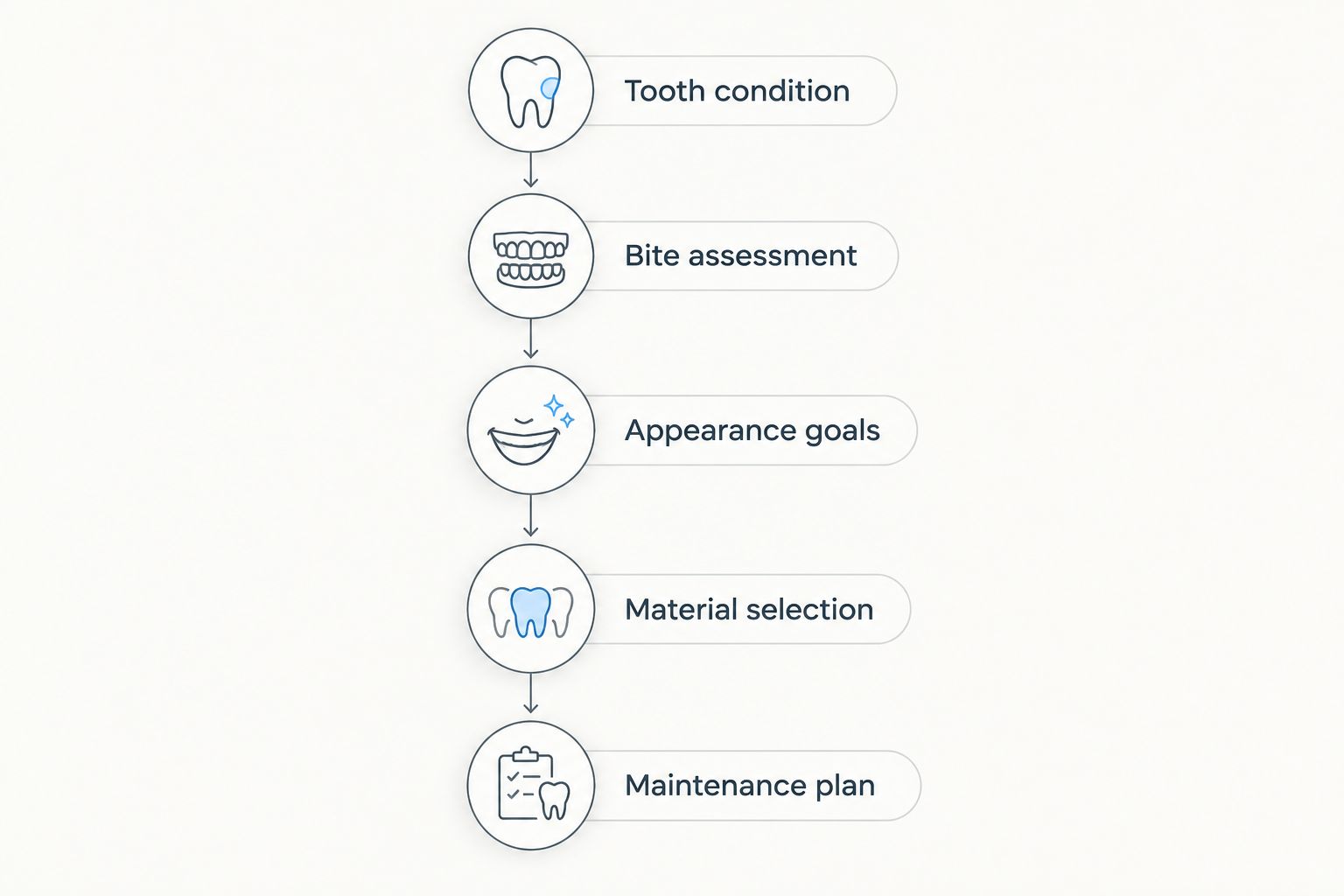
Start with the tooth, not a request for a specific ceramic. Use this sequence during your dental discussion:
- Tooth condition: Establish whether decay, cracks, and remaining structure permit a crown.
- Bite assessment: Identify heavy contacts, grinding, and the space available for the restoration.
- Appearance goals: Explain what you want to match and whether metal appearance is acceptable.
- Material selection: Ask for the exact material, construction, and reason it fits your tooth.
- Maintenance plan: Confirm cleaning, follow-up, and any recommended approach to grinding.
For an undecided reader, discuss monolithic zirconia first for a heavily loaded molar and lithium disilicate first for a visible tooth. These are starting points for an examination, not treatment instructions.
Harmony Dental Group provides general, cosmetic, and restorative dentistry in La Jolla. Bring your appearance priorities and any history of grinding to the discussion so the recommendation addresses the tooth rather than just the material name.
Discuss your restorative dental options
Review your tooth condition, bite, and appearance priorities with Harmony Dental Group.
Protect the tooth beneath the crown
A crown does not prevent decay where the restoration meets the tooth. Cleaning the margin matters regardless of whether you choose zirconia, lithium disilicate, or metal.
For your 2026 home-care routine, American Dental Association guidance recommends brushing with fluoride toothpaste for 2 minutes per session, completing 2 brushing sessions per day, and cleaning between teeth 1 time per day. These recommendations concern routine oral hygiene; your dentist can adapt cleaning methods to your restoration and gum condition.
Tell the dentist if floss catches, food repeatedly packs beside the crown, or your bite feels uneven. Persistent pain also needs assessment. Changing materials without identifying the underlying problem is not a treatment plan.
FAQ
What's the best crown material for teeth?
The best crown material for teeth depends on tooth position, bite forces, remaining tooth structure, and appearance. Monolithic zirconia is a leading option for heavily loaded back teeth, while lithium disilicate is a strong consideration for visible teeth when clinical conditions support it.
Is zirconia better than porcelain for a back tooth?
Monolithic zirconia often suits a heavily loaded back tooth because it avoids a separate porcelain veneer. The dentist still needs to select the formulation, provide appropriate thickness, and assess the bite; zirconia is not unbreakable.
Which crown material looks most natural on a front tooth?
Lithium disilicate is a common choice when natural-looking translucency is a priority. The underlying tooth color, restoration thickness, shade selection, and laboratory work also affect the final appearance.
Are zirconia crowns and porcelain crowns the same thing?
No; zirconia and dental porcelain are different ceramic materials. A zirconia crown can be monolithic or covered with porcelain, so ask for both the material and the construction.
Can a crown chip if it has a zirconia core?
Yes, the porcelain covering a layered zirconia crown can chip even when the core stays intact. Monolithic zirconia avoids that separate veneer, although the restoration can still develop other problems.
Is a gold crown still a reasonable choice?
A full-cast gold alloy crown remains a reasonable option for a less-visible tooth when metal appearance is acceptable. Discuss preparation requirements and alloy composition, particularly if you have a known metal sensitivity.
What should I ask Harmony Dental Group about restorative treatment?
Ask Harmony Dental Group to explain the tooth's condition, bite considerations, and available restorative options. If a crown is recommended, request the exact material and construction, the reason for choosing them, and the maintenance plan.
One last thing
A polished surface matters as well as the material label. If your dentist adjusts a ceramic crown's bite, ask how the adjusted surface will be finished and polished. A strong ceramic with a rough surface is not the same clinical result as a properly finished restoration.
For your 2026 decision, leave with an explanation of why the crown fits your tooth—not just a name on a treatment plan.