Instead of repeatedly reading your insurance card while searching for an emergency dentist, gather your member details and have the dental office check eligibility, network status, and treatment benefits while discussing an appointment. To verify dental insurance for a same-day emergency dentist in San Diego, contact the office and your insurer in parallel; insurance verification does not guarantee payment or a same-day appointment.
- To verify dental insurance, same-day emergency dentist San Diego searches should lead to an office call and insurer confirmation.
- Harmony Dental Group offers emergency dental care in La Jolla; confirm appointment timing and insurance arrangements directly.
- Active coverage, network participation, and treatment benefits are separate checks; none guarantees claim payment.
- Breathing or swallowing difficulty requires immediate emergency medical care, not an insurance verification call.
Why this matters
An insurance card identifies your plan. It does not establish whether a particular dentist participates in your network or whether your plan covers the treatment you need. Confusing those questions creates avoidable surprises when you are already uncomfortable.
Harmony Dental Group is a local option for La Jolla patients seeking emergency dental care. Contact Harmony Dental Group to discuss your symptoms, appointment timing, and insurance questions. Confirm those arrangements directly rather than treating a search result as an appointment confirmation.
For a visit in 2026, use your current plan information. An older card or an employer benefits summary does not establish that your coverage is active on the appointment date.
Do not delay emergency medical care for insurance verification. Trouble breathing or swallowing, rapidly spreading facial or neck swelling, or bleeding that does not stop requires immediate medical assessment. A dental insurance call is not the next step in those situations.
Before you start
- Gather your identification and plan details. Have your name, date of birth, insurer, member ID, group number if provided, subscriber details, and the member-services contact printed on your card. Use the insurer's secure member account if you need to retrieve a digital card.
- Prepare your symptom and health summary. Explain where it hurts, when it started, and whether you have swelling, bleeding, a broken tooth, or an injury. Bring a medication list and relevant health information; the dentist needs these separately from your insurance details.
- Check the hidden obstacle: the exact network. An office accepting insurance does not necessarily mean the treating dentist participates in your specific plan. Ask about the actual provider and location, and confirm dependent coverage when the policy belongs to someone else.
You do not need to determine your own diagnosis before calling. Describe what you feel and what happened; the dental team determines which examination and treatment are appropriate.
Your appointment and symptom details
The first task is to establish where you can receive appropriate care. Keep scheduling and insurance questions together, but do not let an unanswered benefits question hide a symptom that needs urgent attention.
- Call the dental office and describe the problem first. State whether you have pain, swelling, bleeding, trauma, or a damaged tooth. Explain any breathing or swallowing difficulty immediately rather than waiting for insurance questions.
- Ask whether an emergency assessment is possible that day. Confirm the appointment date, arrival instructions, and whether the visit is for evaluation, treatment, or both. An emergency examination does not establish that every needed procedure will happen during that visit.
- Ask how the office handles insurance verification. Find out what information the office needs, how to send it securely, and whether staff can request benefits information before you arrive. Do not assume a particular online form or booking system exists.
- Read back your member information. Confirm the spelling of names, date of birth, member ID, and subscriber relationship. A small mismatch can prevent a correct eligibility response.
Expected result: You have a confirmed appointment or a clear scheduling answer, the office has your symptom summary, and you know how to provide your insurance details.
If that office cannot assess you that day, ask what care pathway it recommends. The guide to emergency dental care options in San Diego provides related reading, but a webpage cannot confirm appointment timing or determine the urgency of your symptoms.
Your eligibility and network checks
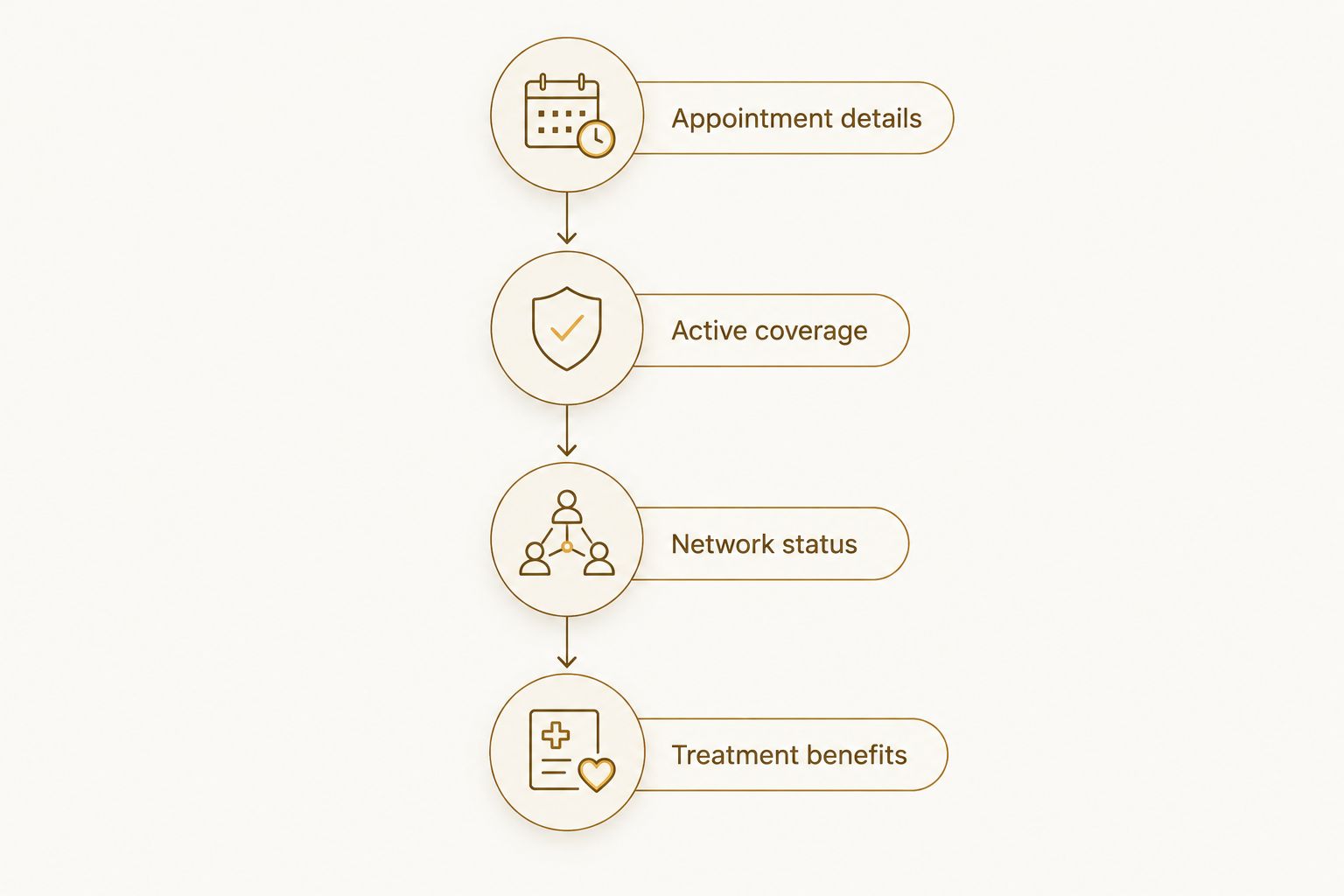
For a 2026 emergency visit, verify coverage for the actual date of service. Keep eligibility, network status, and benefits as 3 separate checks rather than accepting a single statement that your insurance is accepted.
- Contact your insurer using the number on your current card. Identify yourself and ask whether the patient has active dental coverage on the appointment date. Confirm the dependent's eligibility separately when applicable.
- Identify the exact plan and network. Ask the office which provider will treat you and what identifying information your insurer needs. Give the insurer the provider and location details rather than relying only on the practice name.
- Confirm participation with the insurer. Ask whether that provider participates in your specific network at that location. If the insurer and office give different answers, request clarification before describing the visit as in-network.
- Record the answer and its source. Keep the date, representative's name if given, and 1 reference number if the insurer supplies one. Save a secure message or written confirmation when available.
Expected result: You know whether coverage is active and whether the insurer identifies the treating provider as participating in your network. You have not yet established coverage for every procedure.
A current card and a successful eligibility response are useful, but neither replaces treatment-level verification. The distinction matters when an examination leads to recommendations that were not known during your initial call.
The following sequence keeps the questions separate. Finish each check with a recorded answer or a clearly identified unresolved question.
Your treatment benefits and visit record
The dentist determines the diagnosis and treatment recommendation. Your insurer applies the plan's rules to the services submitted. Before the examination, you can clarify general benefits; after it, you can ask more specific questions using the proposed procedure information.
- Ask about the initial assessment. Have the office identify the planned examination and any proposed imaging. Ask the insurer about applicable limitations, exclusions, and relevant benefit categories without guessing procedure codes yourself.
- Check the plan's remaining benefits. Ask about deductible status, annual benefit limits, waiting periods, and frequency restrictions where applicable. If your benefit period follows the calendar year, confirm the remaining benefits for 2026; do not assume every plan resets in January.
- Ask whether an authorization or referral applies. Clarify the requirements for the proposed service and provider. If documentation is needed, ask who submits it and whether the office can distinguish the immediate assessment from later treatment planning.
- Request a written treatment estimate after the examination. Ask the office to separate the proposed procedures, expected insurance contribution, and your estimated responsibility. Clarify what remains unverified before consenting to treatment.
- Confirm claim handling. Ask whether the office submits the claim or whether you must submit documentation yourself. Keep the treatment plan and any instructions securely with your appointment record.
Expected result: You understand the proposed care, the benefits information available, and the unresolved insurance questions. You also know who handles the claim.
A benefits estimate is not a payment guarantee. Final claim processing depends on the services performed, submitted documentation, and plan terms. Ask which parts of the estimate rely on assumptions so you can distinguish confirmed information from a preliminary calculation.
Choose the verification route that fits your visit
Use 2 coordinated calls when possible: one to the dental office and one to your insurer. Each answers a different question. This is a workflow recommendation, not a promise about response time.
| Verification route | Best for | Advantage | Limitation |
|---|---|---|---|
| Office-led verification | Patients coordinating a specific appointment | Connects benefit questions with the provider and proposed services | Depends on office procedures and the insurer's response |
| Patient-led insurer call | Patients confirming eligibility and network details | Lets you ask the insurer about your exact plan directly | Does not establish the diagnosis or confirm an appointment |
| Coordinated verification | Patients with conflicting or incomplete answers | Lets the office and insurer resolve the same provider or treatment question | Requires keeping both parties' information consistent |
Use coordinated verification when answers conflict. Do not choose the more reassuring answer and discard the other one. Ask both parties to identify the exact plan, provider, location, and service behind their response.
Harmony Dental Group offers emergency dental care, but its insurance arrangements and same-day scheduling need direct confirmation. The practical benefit is a local care option; the limitation is that a practice description alone cannot establish your plan's benefits or appointment timing.
Recheck benefits when your treatment plan changes
An emergency assessment can lead to a treatment plan that differs from what you discussed during the scheduling call. Repeat the treatment-benefit check whenever the proposed care, provider, appointment date, or plan changes.
- Treatment change: Ask the office for the revised procedure information and a revised written estimate. Do not apply an examination benefit to a different procedure.
- Provider change: Confirm network participation for the clinician who will actually perform the next service, including a specialist referral.
- Plan change: Supply your updated card and verify the new effective date. A previous insurer's answer does not transfer to a new plan.
- Date change: Recheck rules tied to the service date or benefit period. A 2026 eligibility response does not establish coverage for a later benefit period.
Keep urgent treatment decisions clinical. Ask the dentist what needs attention now, what can be planned later, and what risks come with delaying recommended care; do not decide solely from an insurance category.
Troubleshooting insurance verification
The insurer cannot find your membership
Compare the member ID, subscriber name, date of birth, and dependent relationship with the enrollment record. If you recently changed employment or plans, ask the insurer or benefits administrator to confirm the effective date and enrollment status.
The office accepts insurance, but network status is unclear
Ask the office whether it means it submits claims, participates in your network, or both. Then have the insurer check the exact treating provider and location. These statements are not interchangeable.
The insurer cannot confirm a treatment benefit yet
Ask the office what procedure information is available before the examination and what must wait for a diagnosis. After the assessment, request an updated check using the actual proposed care rather than a general description such as tooth pain.
Two sources give different benefit information
Record each answer and ask which plan document, benefit period, or procedure it refers to. Request clarification through the insurer's member-services process and ask the office to update its estimate when the discrepancy is resolved.
Verification remains unfinished before the appointment
Tell the office which questions remain open and ask how it handles an assessment under those circumstances. Confirm the office's financial consent process directly. Do not interpret unfinished verification as either confirmed coverage or an automatic reason to postpone urgent assessment.
Customize your workflow
Build a small visit record you can reuse: appointment confirmation, current insurance details, provider information, benefit responses, and the proposed treatment plan. Keep sensitive information in a secure location rather than an ordinary shared note or public message.
For your 2026 dental records, separate the clinical plan from the insurance response. That makes it easier to see what the dentist recommends and what your plan has actually confirmed.
If you feel anxious, tell the office before the visit. Ask how the team explains examinations and consent, and discuss your concerns without assuming a particular medication or sedation option is appropriate.
Discuss your emergency dental visit
Ask about symptoms, appointment timing, and the insurance details needed for verification.
FAQ
How do I verify dental insurance for a same-day emergency dentist in San Diego?
Call the dental office to discuss your symptoms and appointment timing, then contact your insurer to confirm active coverage and network participation. Ask the office to check benefits for the proposed services; verification does not guarantee payment.
Can I get an emergency dental appointment before insurance is verified?
Ask the dental office whether it can assess you while verification is unfinished. Appointment timing and financial consent depend on the office's arrangements, so confirm both directly.
Does accepting my insurance mean the dentist is in-network?
No. Accepting insurance can mean the office submits claims without participating in your specific network. Confirm the treating provider and location with your insurer.
What information should I have ready when I call?
Have your current member ID, insurer, subscriber details, date of birth, and group number if provided. Also prepare a short symptom summary and your medication list for the dental team.
Does Harmony Dental Group offer emergency dental care?
Harmony Dental Group offers emergency dental care in La Jolla. Contact the practice directly to confirm appointment timing, insurance arrangements, and whether it can assess your symptoms.
Will my dental insurance cover all treatment during an emergency visit?
An emergency visit does not establish coverage for every recommended procedure. Benefits depend on your plan and the services performed, and a preliminary estimate is not a payment guarantee.
Should I wait for insurance verification if my face is swelling?
Do not wait for insurance verification if swelling affects breathing or swallowing or spreads rapidly across your face or neck; seek immediate emergency medical care. For other dental swelling, contact a dentist promptly for assessment.
One last thing
The most useful final question is: what remains unverified? It separates a confirmed appointment from active eligibility, and active eligibility from treatment benefits. Write down the answer before you leave the call so an incomplete check does not become an assumed guarantee.