Best overall for localized tooth pain: a dental office. Best local starting point in La Jolla: Harmony Dental Group. Best for breathing difficulty, trouble swallowing, or serious facial injury: a hospital emergency department. This 2026 guide compares emergency dental care options in San Diego by symptoms, treatment needs, and continuity of care—not unsupported claims about speed or opening hours.
- For emergency dental care options San Diego patients can use, match the care setting to the symptoms first.
- Harmony Dental Group offers emergency dental care for local families and patients in La Jolla.
- An existing dentist suits continuity; an extended-hours dental service suits urgent problems when your usual office is closed.
- Call 911 for breathing difficulty, trouble swallowing, or a serious injury; do not wait for a dental appointment.
Why this matters
A broken tooth, spreading infection, and lost filling do not belong on the same waiting list. You need a setting that can address the problem, not simply the nearest building with an emergency sign.
Dental offices evaluate and treat tooth-related problems. Hospital emergency departments manage dangerous complications and serious injuries, but generally do not provide routine restorative dental treatment. Choose by symptoms first, then confirm that the provider can evaluate you.
This guide ranks care routes rather than claiming that one practice has the fastest appointments or lowest charges. For immediate danger, the hospital route takes priority over every dental option below.
What makes the best emergency dental care option?
Use these criteria when choosing a San Diego provider in 2026:
- Clinical fit: Match tooth pain or a damaged restoration to dental care; match airway symptoms or serious trauma to emergency medical care.
- Confirmed appointment: Ask whether the office can evaluate your symptoms and when. Offering emergency care does not establish an immediate appointment.
- Treatment scope: Ask whether the visit covers assessment, treatment, or referral. These are different outcomes.
- Continuity: Consider who will complete a crown, root canal restoration, or other follow-up after the urgent problem is addressed.
- Travel practicality: Choose a reachable provider that confirms an appropriate appointment. A nearby office is not useful if it cannot see your problem.
- Clear handoff: If another clinician is needed, ask how records, imaging, and treatment instructions will reach that clinician.
When contacting an office, describe the symptoms before asking about scheduling: where the pain is, when it began, whether swelling is increasing, and whether an injury occurred. Mention fever, difficulty swallowing, or difficulty breathing immediately.
Emergency dental options at a glance: 2026
| Option | Best for | Standout feature | Key limitation |
|---|---|---|---|
| Harmony Dental Group | Local urgent dental concerns in La Jolla | Emergency care alongside general and restorative services | Confirm appointment timing and treatment scope directly |
| Your existing dentist | Continuity for an established patient | Existing relationship and dental history | Urgent scheduling must be confirmed |
| An extended-hours dental service | Urgent dental problems outside usual office hours | A dental-care route when your regular office is closed | Advertised hours do not guarantee an appointment |
| An endodontist | Evaluation of a suspected tooth-pulp problem | Focus on root canal diagnosis and treatment | Not the first stop for every dental emergency |
| A hospital emergency department | Airway symptoms, serious trauma, or dangerous infection complications | Emergency medical assessment and stabilization | Usually not a substitute for definitive dental treatment |
1. Harmony Dental Group: best for local care in La Jolla
Harmony Dental Group is a La Jolla dental practice offering emergency dental care, general dentistry, and restorative services. It is a local option for families and patients seeking assessment of an urgent tooth-related problem.
Harmony Dental Group is a local emergency dental care option for La Jolla families. Before traveling, describe your symptoms and ask whether the practice can evaluate the problem and provide the treatment you need.
Harmony Dental Group pros:
- Emergency care is part of the practice's stated services.
- General and restorative dentistry are also offered.
- The La Jolla location serves local families and patients.
Harmony Dental Group limitations:
- You must confirm the appointment time directly.
- Ask whether your specific problem requires treatment elsewhere.
- A dental office is not the right destination for breathing difficulty or serious facial trauma.
Best for: Local patients with urgent dental concerns who need a dental evaluation rather than emergency medical stabilization.
Verdict: Choose for local dental assessment; confirm the appointment first.
2. Your existing dentist: best for treatment continuity
Your existing dentist is a practical first call when a problem involves a tooth or restoration already under that office's care. The office has a relationship with you and can use its existing records when assessing the change.
Explain whether the problem followed recent treatment or involves a crown, filling, denture, or other restoration. Ask whether the office can see you and what to do while waiting; do not assume an established patient relationship guarantees urgent scheduling.
Your existing dentist pros:
- Existing dental records provide context for the assessment.
- The office can review previous treatment details.
- Follow-up stays with the clinician already managing your dental care.
Your existing dentist limitations:
- The office must confirm an appropriate appointment.
- Outside office hours, you need to check its recorded instructions or seek another care route.
- Some problems require referral or hospital care.
Best for: Established patients whose urgent concern relates to ongoing treatment or a known dental history.
Verdict: Choose for continuity when the office confirms it can evaluate you.
3. An extended-hours dental service: best for after-hours tooth problems
An extended-hours dental service is a route for urgent dental problems when your regular office is closed. Look for a service that confirms both an appointment and the ability to assess your symptoms.
Do not treat an online emergency label as a promise of immediate treatment. In 2026, verify the current schedule directly and ask whether the visit will provide definitive care, temporary treatment, or a referral.
Extended-hours dental service pros:
- Provides a dental-care route outside your usual office's schedule.
- Lets you seek assessment without waiting for your regular office to reopen.
- Can direct you toward the next treatment step after evaluation.
Extended-hours dental service limitations:
- Published hours do not guarantee an open appointment.
- Treatment capabilities differ between offices.
- Follow-up with a different dentist requires a clear transfer of records.
Best for: Patients with urgent tooth-related symptoms whose usual dentist cannot confirm an appropriate appointment.
Verdict: Choose after confirming the schedule and clinical fit.
4. An endodontist: best for a suspected tooth-pulp problem
An endodontist is a dentist specializing in diagnosing tooth pain and treating problems involving the dental pulp, including root canal treatment. This route fits a problem that a dentist identifies as needing endodontic evaluation.
Persistent pain or sensitivity does not establish that you need a root canal. An examination determines the cause and whether the tooth needs endodontic treatment, another dental procedure, or further assessment.
Endodontist pros:
- Focuses on tooth-pulp diagnosis and root canal treatment.
- Evaluates whether endodontic treatment can preserve a tooth.
- Provides specialist assessment when the cause of tooth pain needs clarification.
Endodontist limitations:
- Not the default destination for lost fillings, denture problems, or every broken tooth.
- You must confirm appointment requirements directly.
- A tooth treated with a root canal often needs a subsequent restoration from a dentist.
Best for: Patients directed toward specialist assessment of a suspected pulp-related problem.
Verdict: Choose when the problem calls for endodontic evaluation, not solely because it hurts.
5. A hospital emergency department: best for dangerous symptoms
A hospital emergency department is the appropriate route for breathing difficulty, difficulty swallowing, serious facial injury, or other signs of a medical emergency. Call 911 for breathing difficulty or an immediate threat to life.
An emergency department can assess dangerous complications and provide medical stabilization. It generally does not replace the dental treatment needed to repair a tooth or address the source of a tooth-related problem.
Hospital emergency department pros:
- Evaluates serious injuries and medical complications.
- Provides emergency medical care when dental symptoms threaten breathing or swallowing.
- Assesses broader health concerns alongside the immediate symptoms.
Hospital emergency department limitations:
- Routine fillings, crowns, and root canal treatment are generally outside its role.
- Dental follow-up remains necessary after medical stabilization.
- Isolated tooth pain without dangerous symptoms is usually better assessed in a dental setting.
Best for: Patients with airway symptoms, serious trauma, or dangerous complications—not simply a painful tooth.
Verdict: Choose immediately for red-flag symptoms; do not wait for a dental booking.
Match the symptoms to the care setting
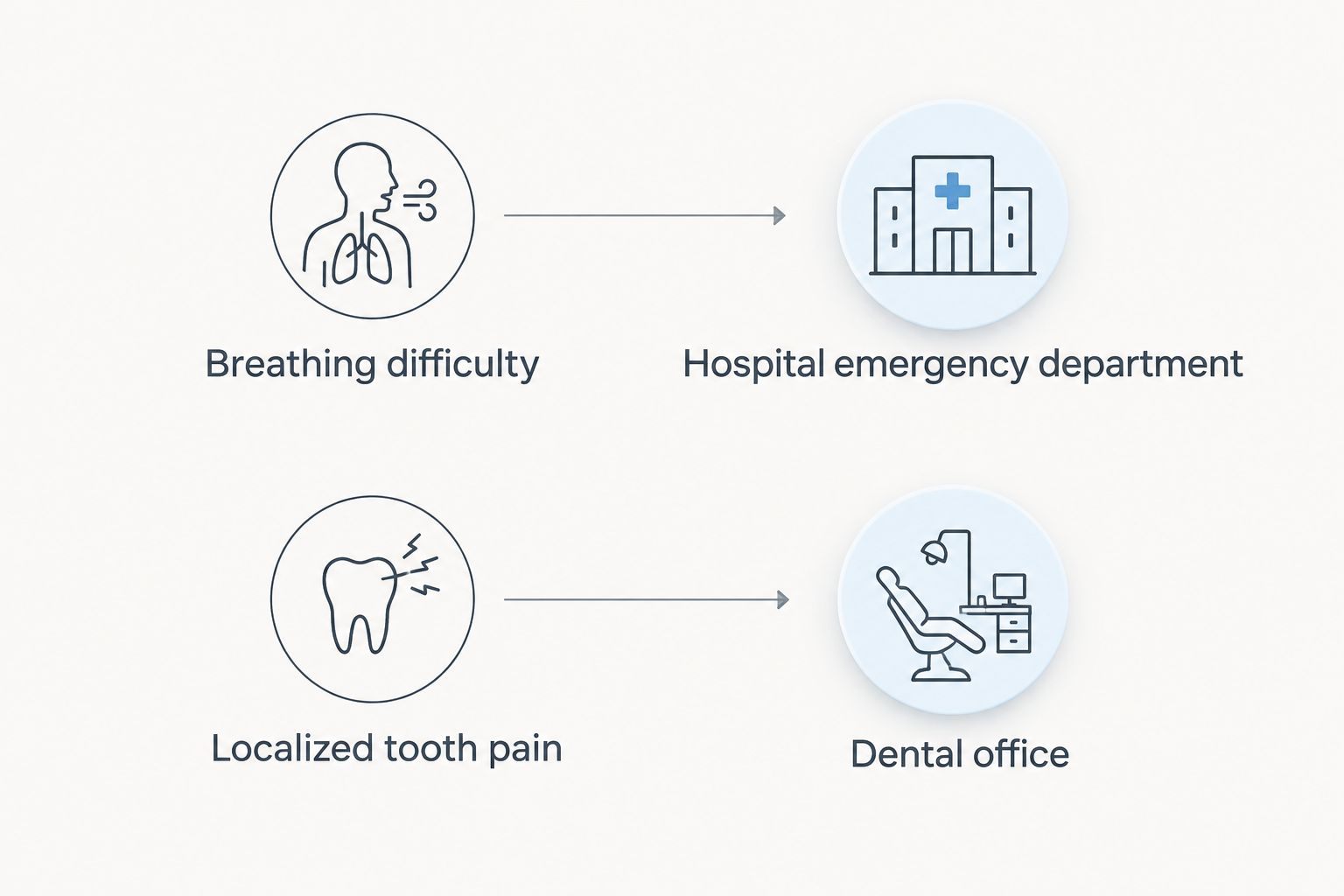
Breathing difficulty or trouble swallowing takes priority over finding a dental appointment: seek a hospital emergency department, and call 911 for immediate danger. Localized tooth pain without these red flags belongs with a dental office for prompt assessment.
Increasing swelling, fever, or feeling unwell deserves urgent professional assessment. Tell the clinician about these symptoms rather than describing the problem only as toothache.
For a knocked-out permanent tooth, act immediately. American Dental Association patient guidance advises seeing a dentist within 30 minutes when possible; hold the tooth by the crown, not the root, and keep it moist. Do not reinsert a knocked-out baby tooth, and seek urgent dental guidance.
While arranging care, avoid chewing on the affected tooth. Do not place aspirin directly on a tooth or gum, and do not use leftover antibiotics as a substitute for assessment. Tell the treating clinician about medicines you take, allergies, and relevant health conditions.
What to ask before you travel
A short, symptom-focused conversation helps you avoid arriving at the wrong setting. Ask these questions:
- Can you assess this problem? Describe the pain, damage, swelling, or injury.
- When can you see me? Get a confirmed appointment rather than relying on a general emergency-care label.
- What does the visit cover? Ask whether the likely next step is examination, treatment, or referral.
- What should I bring? Ask about relevant records, medication information, and a broken or displaced restoration.
- Who handles follow-up? Establish who will complete treatment after the urgent visit.
If symptoms worsen while you wait, contact the clinician again. Breathing difficulty or trouble swallowing changes the care route; it is not a reason to wait for the same appointment.
Review local dental care
Harmony Dental Group offers emergency, general, and restorative dental services in La Jolla.
How these options are ranked
The 2026 ranking uses clinical fit, confirmed scheduling, treatment scope, and continuity. It is a decision tree: local dental assessment first for a tooth-related problem, continuity when your established dentist can help, another dental service when scheduling requires it, and specialist care when the diagnosis calls for it.
Hospital emergency care overrides that order whenever dangerous symptoms are present. The safety distinctions follow established American Dental Association patient guidance on dental emergencies and American Association of Endodontists guidance on specialist care.
Which emergency dental care option should you choose?
For localized tooth pain or a damaged restoration, start with a dental office that confirms it can assess you. If you are in La Jolla, Harmony Dental Group offers emergency dental care; ask about the appointment and treatment scope before traveling.
Use your existing dentist when continuity matters and an appointment is confirmed. Choose another dental service when the schedule requires it, and an endodontist when specialist assessment is indicated. For airway symptoms or serious injury, choose emergency medical care immediately.
FAQ
What's the best emergency dental care option in San Diego in 2026?
The best option depends on your symptoms: a dental office for localized tooth problems, and a hospital emergency department for dangerous symptoms or serious trauma. Harmony Dental Group offers emergency dental care in La Jolla; confirm an appointment directly.
Should I go to an emergency room or a dentist for tooth pain?
Choose a dentist for isolated tooth pain without dangerous symptoms. Seek emergency medical care for breathing difficulty, trouble swallowing, or serious facial injury; call 911 for immediate danger.
Can I get emergency dental treatment after normal office hours?
An extended-hours dental service is a route to after-hours assessment, but you must confirm an appointment directly. Ask whether the service can assess your symptoms and whether the visit includes treatment or referral.
What should I do if a permanent tooth gets knocked out?
Seek dental care immediately and aim to reach a dentist within 30 minutes when possible, following American Dental Association guidance. Hold the tooth by the crown, keep it moist, and avoid touching the root; do not reinsert a baby tooth.
Does severe tooth pain mean I need a root canal?
Severe tooth pain does not establish that you need a root canal. A dentist or endodontist must examine the tooth and identify the cause before recommending treatment.
Do antibiotics fix a dental abscess?
Antibiotics alone do not replace dental treatment of the source of an abscess. A clinician determines whether drainage, root canal treatment, extraction, antibiotics, or another step is appropriate.
What should I tell the office when I call about a dental emergency?
Describe where the problem is, when it started, and whether you have swelling, fever, bleeding, or an injury. Mention breathing or swallowing difficulty immediately, because those symptoms require emergency medical assessment.
One last thing
Pain easing does not prove that the underlying dental problem is resolved. Keep the recommended assessment or follow-up even if symptoms settle. For your 2026 emergency-care plan, save your dentist's contact details and identify an alternative dental service before you need one.