
Best overall: a fixed-term practice installment plan with clear written terms, when offered. Best for a planned early payoff: a true zero-interest promotional plan; best for longer repayment: a fixed-rate personal loan. This 2026 guide compares dental payment arrangements by total repayment, deadline risk, flexibility, and who controls the agreement.
- Dental payment plan options compared: prioritize written repayment terms, not the smallest monthly payment.
- Harmony Dental Group patients should confirm which dental financing arrangements the practice accepts before applying.
- True zero-interest financing and deferred-interest financing have different payoff consequences.
- A fixed-rate personal loan suits predictable repayment; staged treatment avoids borrowing only when clinically appropriate.
Why this matters
Dental treatment and dental financing are separate decisions. A treatment recommendation explains what your teeth need; a financing agreement explains what you owe and when. Accepting one does not mean you should accept the other without review.
Harmony Dental Group provides general, cosmetic, and restorative dental care in La Jolla, San Diego. Before financing treatment, ask the practice which payment arrangements it accepts, then request the lender's terms separately. A payment method being accepted does not establish that its borrowing terms fit your household.
For Harmony Dental Group patients, the best dental payment arrangement is one that fits the treatment plan without hiding repayment obligations. Use this 2026 comparison to shortlist an arrangement, not to assume a particular financing program is offered.
What makes the best dental payment arrangement
Judge each option against these criteria before comparing monthly payments:
- Total repayment: Include interest and mandatory financing fees. A smaller installment does not establish a smaller overall obligation.
- Deadline risk: Check whether a missed promotional deadline triggers deferred interest or another consequence.
- Payment predictability: Distinguish a fixed installment from a variable-rate balance or changing minimum payment.
- Clinical fit: The payment schedule must support necessary care. Financing should not dictate an unsafe treatment delay.
- Contract control: Identify who owns the balance, who handles disputes, and what happens if treatment changes.
- Early repayment: Ask whether additional payments reduce principal and whether a prepayment penalty applies.
For your 2026 decision, request 3 documents: the treatment plan, the payment agreement, and the repayment schedule. These are a practical review checklist, not a guarantee that every provider uses separate forms. If the information appears in a combined document, make sure each part is identifiable.
Dental payment plan options compared at a glance
The ranking below assigns each arrangement a distinct use case. Availability, approval, and contract terms require confirmation with the practice or lender.
| Option | Best for | Standout feature | Key limitation |
|---|---|---|---|
| Fixed-term practice installment plan | Direct, scheduled repayment | Payment agreement with the practice when offered directly | Terms and eligibility are practice-specific |
| True zero-interest promotional financing | Paying off a balance before a known deadline | No interest during the stated promotional period | Requires attention to the deadline and post-promotion terms |
| Fixed-rate personal loan | Longer, predictable repayment | Fixed repayment schedule for an agreed term | Interest and fees add to the obligation |
| Existing credit card | Flexible payments without opening another account | Uses an existing credit line | Minimum payments do not establish an efficient payoff schedule |
| Clinically approved staged treatment | Avoiding a new financing agreement | Separates care into appropriate treatment phases | Not suitable for delaying urgent or time-sensitive care |
1. Practice installment plan: best for direct repayment
A practice installment plan spreads an agreed balance across scheduled payments when the dental office offers that arrangement. Confirm whether the practice administers the plan itself or refers you to an outside lender; those are different contracts.
A written, fixed-term agreement earns the default recommendation because you can evaluate the schedule alongside the treatment plan. That recommendation does not mean every practice plan is interest-free or preferable to a loan.
Practice installment plan pros:
- The payment schedule can be discussed alongside the proposed treatment.
- A fixed agreement gives you defined payment dates and an endpoint.
- A directly administered plan keeps payment questions with the practice.
Practice installment plan cons:
- Not every dental practice offers direct installments.
- Fees, deposits, and eligibility depend on the agreement.
- Changes to treatment require clarity about how the balance changes.
Best for: You want scheduled repayment through the practice and can meet the written terms.
Ask what happens if treatment is postponed, modified, or stopped. Also identify whether late payments create fees, interrupt the arrangement, or move the balance into another collection process. Do not rely on a verbal description of those consequences.
Verdict: Buy into a practice installment plan only after confirming the full schedule and obligations in writing.
2. Promotional financing: best for a planned early payoff
Promotional dental financing provides a defined period with special interest terms. The decisive distinction is between true zero-interest financing and deferred-interest financing: deferred interest can be charged from the purchase date if you fail to satisfy the promotional conditions.
Do not treat the phrases no interest and no interest if paid in full as interchangeable. Read the actual agreement, including late-payment conditions and what happens to the remaining balance after the promotional period.
Promotional financing pros:
- True zero-interest terms remove interest during the stated promotional period.
- A clear deadline gives you a specific payoff target.
- A separate financing account can keep the treatment balance identifiable.
Promotional financing cons:
- Deferred-interest terms create a consequential payoff deadline.
- The required minimum payment is not necessarily enough to clear the balance before that deadline.
- Post-promotion terms can differ from the introductory terms.
Best for: You already have a realistic plan to clear the balance before the promotional deadline.
For a 2026 application, review 2 payoff scenarios: repayment before the deadline and repayment after it. Ask the lender to explain the interest consequences in each scenario. Build your payment schedule around clearing the balance, rather than assuming the minimum payment achieves that goal.
Verdict: Buy only when you understand the promotion and can meet its payoff conditions; skip deferred interest without a dependable payoff plan.
3. Fixed-rate personal loan: best for longer repayment
A fixed-rate personal loan provides a lump sum that you repay through an agreed schedule. You can use an eligible loan for dental treatment, subject to the lender's permitted uses and the practice's accepted payment methods.
The main advantage is predictability, not an automatic financing bargain. Compare the annual percentage rate, fees, total repayment, and any early-payment restrictions before choosing a lender.
Fixed-rate personal loan pros:
- A fixed interest rate avoids rate changes during the agreed loan term.
- Scheduled installments provide a defined repayment endpoint.
- Financing is separate from the dental practice's own payment arrangements.
Fixed-rate personal loan cons:
- Interest and lender fees add to the amount you repay.
- Approval and offered terms depend on the lender's assessment.
- You still owe the lender if a treatment dispute occurs.
Best for: You need a longer repayment schedule and prefer a fixed obligation over a revolving balance.
Compare loan offers using the same amount borrowed and repayment term. Otherwise, a lower installment can simply reflect a longer commitment. Confirm whether the lender deducts a fee before releasing funds, because the amount received must cover the payment you intend to make.
Verdict: Buy a fixed-rate personal loan when its written repayment terms fit better than the available practice or promotional arrangements.
4. Existing credit card: best for payment flexibility
An existing credit card uses a credit line you already have, provided the practice accepts it and sufficient credit remains. Unlike a fixed installment agreement, a revolving balance does not automatically create a defined payoff endpoint.
This option fits a borrower who wants payment flexibility and will set a deliberate repayment schedule. Rewards are secondary; they do not erase interest or justify carrying a balance without a plan.
Existing credit card pros:
- An existing account avoids a separate financing application.
- You can make additional payments against the balance.
- Account statements let you track payments and remaining debt.
Existing credit card cons:
- Variable interest rates can change the borrowing obligation.
- Paying only the minimum can extend repayment.
- Combining dental debt with other purchases makes progress harder to track.
Best for: You have suitable existing card terms and want flexibility without opening another account.
Set 1 written repayment plan before charging treatment. Record the intended payment, the expected payoff date, and whether new purchases will continue on the account. Use the card agreement's terms to calculate repayment rather than guessing from the minimum shown on a statement.
Verdict: Hold unless the existing card's terms and your repayment discipline support a clear payoff plan.
5. Staged treatment: best for avoiding new borrowing
Staged treatment divides dental care into clinically appropriate phases. It is not a loan or an installment contract; it changes when approved treatment takes place rather than financing a completed procedure.
Ask the dentist which steps are urgent, which depend on healing, and which can safely wait. Cosmetic preferences and active dental disease do not carry the same timing considerations.
Staged treatment pros:
- Clinically appropriate phases let you plan payment around treatment milestones.
- Paying each phase directly avoids a new borrowing agreement.
- The sequence makes clinical priorities explicit.
Staged treatment cons:
- Urgent problems cannot safely be postponed merely to avoid borrowing.
- Some procedures require a coordinated sequence rather than independent phases.
- Waiting can change treatment needs, so reassessment matters.
Best for: Your dentist confirms that separate treatment phases are appropriate and you want to avoid financing.
Ask for a written sequence that identifies urgent care, later treatment, and required follow-up. Do not create your own schedule by selecting procedures from an estimate. The dentist needs to explain which steps depend on others.
Verdict: Buy into staged treatment only with clinical approval; skip self-directed delays for urgent care.
Check the agreement before you apply
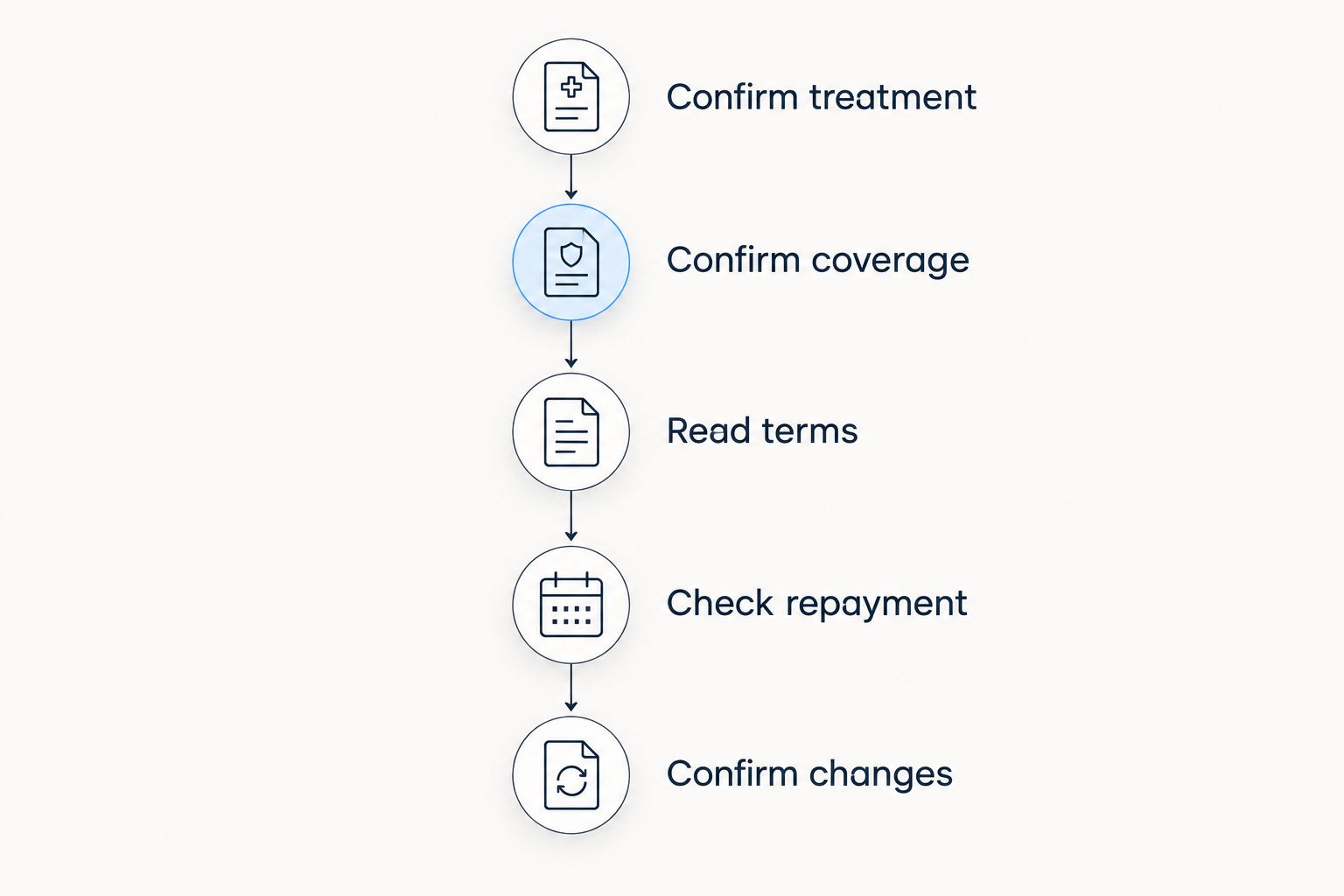
Use this sequence to turn a shortlist into a decision:
- Confirm treatment. Ask what is necessary now and what can safely be scheduled later.
- Confirm coverage. Ask your insurer about applicable benefits, exclusions, and remaining patient responsibility.
- Read terms. Identify the lender, interest structure, fees, payment dates, and default consequences.
- Check repayment. Make sure the proposed obligation fits alongside essential household expenses.
- Confirm changes. Ask how refunds, treatment revisions, and early payments affect the balance.
Dental insurance is not a payment plan. If you have coverage, clarify its role before borrowing; an expected benefit is not the same as a finalized claim payment.
Bring these questions to your 2026 discussion with Harmony Dental Group and any lender. Keep the clinical recommendation separate from the credit decision so you can evaluate both clearly.
How the options are ranked
This ranking prioritizes understandable obligations, predictable repayment, and compatibility with the treatment schedule. It does not rank lenders, compare approval rates, or claim that any named practice offers a particular financing program.
The practice plan takes the default slot only when its written terms are suitable. Promotional financing, personal loans, credit cards, and staged care each serve a different repayment need.
Which dental payment arrangement should you choose?
Start with a written practice installment plan if one is offered, then compare it against a fixed-rate loan and any genuine zero-interest offer. Choose the agreement whose total obligation and payment schedule you can meet, not the one with the most appealing introductory description.
If avoiding debt is your priority, ask about clinically approved staged treatment. If treatment is urgent, get the dental assessment first rather than delaying care while searching for financing.
FAQ
What's the best dental payment plan option in 2026?
A written, fixed-term practice installment plan is the starting option when it is offered and its terms fit your budget. Compare its total repayment and deadline consequences against a fixed-rate loan or a true zero-interest promotion before agreeing.
Does Harmony Dental Group offer dental payment plans?
Confirm accepted payment arrangements directly with Harmony Dental Group before applying for financing. Ask whether any arrangement is administered by the practice or by a separate lender, then request the written terms.
Is zero-interest dental financing the same as deferred interest?
No, true zero-interest financing and deferred-interest financing have different conditions. Deferred interest can be charged from the purchase date if you fail to meet the promotional conditions, so read the agreement rather than relying on the headline.
Is a personal loan better than a credit card for dental care?
A fixed-rate personal loan fits borrowers who need predictable installments and a defined repayment endpoint. An existing credit card offers flexibility, but its interest terms and your payment schedule determine whether it is suitable.
Can I split dental treatment into phases instead of borrowing?
You can split treatment into phases only when your dentist confirms that the sequence is clinically appropriate. Do not postpone urgent care or separate procedures that need to be completed together.
Will dental insurance cover the entire financed balance?
Do not assume dental insurance will cover the entire balance. Confirm applicable benefits, exclusions, and patient responsibility with your insurer before deciding how much to finance.
What should I check before signing a dental financing agreement?
Check total repayment, interest terms, fees, payment dates, promotional deadlines, and early-payment rules. Also identify who owns the debt and how treatment changes or refunds affect the agreement.
One last thing
A minimum payment is not a payoff plan. That distinction matters most with promotional financing: satisfying the monthly minimum does not establish that you will clear the balance before a deadline.
For your 2026 treatment decision, write down the payoff date alongside the treatment schedule. If you cannot explain both without relying on a sales summary, wait to sign the financing agreement and request clarification.