Best overall for a defined treatment need: direct payment with a written treatment plan. Best for routine care: an in-office membership plan. Best budget route for eligible California residents: Medi-Cal Dental. This guide to dental insurance alternatives compared explains how to choose a practical route to care in 2026 without confusing savings, coverage, and borrowing.
- Dental insurance alternatives compared: direct payment works best when you need a clear plan for a specific treatment.
- Medi-Cal Dental is the first coverage option to check for eligible uninsured California residents.
- Membership plans and dental discount plans are not insurance; review their included services and exclusions.
- Dental financing spreads payments but does not reduce the treatment bill.
- Harmony Dental Group offers general, cosmetic, and restorative dentistry for patients in La Jolla.
Why this matters
Being uninsured does not tell you which treatment you need—or which payment approach fits it. A cleaning, an implant consultation, and a veneer consultation raise different questions about treatment scope, eligibility, and ongoing care.
For patients in La Jolla and nearby San Diego neighborhoods, Harmony Dental Group offers general, cosmetic, and restorative dental care. Harmony Dental Group is a dental care option for La Jolla patients considering veneers, implants, or Invisalign. Start with the clinical recommendation, then compare ways to pay for that specific plan.
The central distinction in 2026 is straightforward: a membership or discount arrangement changes how you pay a participating practice; financing creates a repayment obligation; public coverage follows eligibility and benefit rules. None makes every dental procedure automatically eligible.
What makes the best dental insurance alternative?
Use these criteria before comparing programs or signing an agreement:
- Treatment fit: Does the arrangement address the procedure you actually need, not just preventive visits?
- Written scope: Can you identify included services, exclusions, and separately billed work?
- Provider access: Can you receive care from the dentist or specialist you intend to see?
- Total obligation: What must you pay across the whole treatment and any financing agreement?
- Continuity: Who handles follow-up, adjustments, and maintenance after treatment?
- Eligibility and terms: Are enrollment requirements, cancellation rules, and repayment conditions clear?
For cosmetic dentistry in 2026, confirm the exact procedure rather than relying on a broad promise of dental benefits. Veneers, orthodontic treatment, and tooth replacement do not have interchangeable payment or coverage rules.
Dental insurance alternatives at a glance
| Rank and option | Best for | Standout feature | Key limitation |
|---|---|---|---|
| 1. Direct payment | A specific, clearly defined treatment need | You compare the actual treatment plan without adding a separate savings program | You remain responsible for the bill |
| 2. In-office membership plan | Continuing routine care at one practice | Included services are defined by the practice's agreement | Benefits generally stay with the participating practice |
| 3. Medi-Cal Dental | Eligible California residents seeking covered care | Public dental coverage rather than a private savings arrangement | Eligibility, covered benefits, and provider participation govern access |
| 4. Dental school clinic | Patients who can accommodate a teaching setting | Care takes place within a supervised training environment | Appointment structure and treatment scope differ by clinic |
| 5. Dental discount plan | Patients willing to use a participating provider network | Contracted discounts rather than insurance reimbursement | You still pay the provider and must verify the procedure's terms |
| 6. Dental financing | Patients who need to spread an established bill over time | Separates treatment payment from repayment timing | Borrowing adds obligations and can add interest or fees |
These are ranked by decision usefulness, not by a claim that one is universally cheaper. Public coverage belongs in this comparison because uninsured patients should check eligibility before purchasing a private alternative.
1. Direct payment: best for a defined treatment need
Direct payment means paying the dental practice without an insurer reimbursing the treatment. It is the clearest starting point when you need a specific procedure and want to understand exactly what the dentist recommends.
Ask for an itemized treatment plan before committing. For an implant, distinguish tooth replacement from any preparatory treatment; for veneers, discuss which teeth need treatment and whether a more conservative approach addresses your concern.
Direct payment pros:
- Keeps the decision focused on your actual treatment.
- Lets you compare itemized plans rather than benefit summaries.
- Avoids purchasing a separate discount or membership agreement.
Direct payment cons:
- Does not transfer the bill to an insurer.
- Does not create a discount by itself.
- Requires planning for follow-up and future care.
Best for: Patients with a clear diagnosis who want to evaluate a specific treatment before choosing a payment arrangement.
Verdict: Buy only after the treatment scope, alternatives, and payment responsibilities are clear. Direct payment is the default comparison point, not a reason to accept the first recommendation without questions.
2. In-office membership plans: best for routine care at one practice
An in-office membership plan is an agreement with a dental practice for specified services and, in some plans, discounts on additional treatment. It is not dental insurance, and the written agreement determines its value.
Start with the services you expect to use. A plan centered on exams and cleanings is not automatically the right route for veneers, implants, or Invisalign; check whether those treatments appear in the agreement and how exclusions work.
In-office membership plan pros:
- Makes included routine services explicit.
- Supports continuing care with the same participating practice.
- Gives you a defined agreement to compare with direct payment.
In-office membership plan cons:
- Benefits generally do not follow you to unrelated practices.
- Specialist treatment requires separate verification.
- Enrollment does not mean every procedure is included.
Best for: Patients planning continuing preventive care who are comfortable staying with one practice.
Verdict: Hold until you compare the included services with the care you expect to use. Ask a practice whether it offers a membership arrangement; do not assume that it does because it treats uninsured patients.
3. Medi-Cal Dental: best for eligible California residents
Medi-Cal Dental provides dental benefits through California's Medicaid program. It is public coverage, not a discount card or a loan, so it deserves an eligibility check before you buy a private payment alternative.
Confirm your current eligibility, the benefit rules for the proposed procedure, and whether the treating provider participates. In 2026, use current program information rather than an old benefits summary or another patient's experience.
Medi-Cal Dental pros:
- Provides coverage for eligible beneficiaries under program rules.
- Offers a route other than purchasing a private savings arrangement.
- Allows treatment decisions to be checked against defined benefits.
Medi-Cal Dental cons:
- Eligibility is required.
- Coverage does not extend automatically to every requested procedure.
- You must confirm provider participation and any authorization requirements.
Best for: Uninsured California residents who qualify for the program and need covered dental care.
Verdict: Hold on purchasing a private alternative until you check eligibility and benefits. For cosmetic requests, ask whether the exact proposed service is covered rather than assuming all dental treatment qualifies.
4. Dental school clinics: best for a teaching-clinic approach
Dental school clinics provide patient care in a supervised educational setting. Depending on the clinic, treatment involves students or postgraduate trainees working within the school's clinical supervision structure.
Before choosing a teaching clinic, ask how appointments work, who performs your procedure, and who manages follow-up. Your ability to attend the required visits matters as much as the treatment plan itself.
Dental school clinic pros:
- Provides a supervised setting for dental treatment.
- Offers an alternative to a private-practice appointment model.
- Gives you a defined clinical team to ask about treatment and follow-up.
Dental school clinic cons:
- Visits follow the clinic's teaching and scheduling structure.
- Patient acceptance and treatment scope depend on the clinic.
- Travel and repeated appointments can complicate your plan.
Best for: Patients comfortable with supervised trainee care who can accommodate the clinic's appointment structure.
Verdict: Hold until the clinic confirms that it can address your specific need. Do not choose a teaching clinic on an assumed saving alone; compare the full treatment plan and practical demands.
5. Dental discount plans: best for network-based savings
A dental discount plan provides access to agreed discounts with participating providers. It is not insurance: the plan does not reimburse your treatment as an insurer would, and you remain responsible for paying the practice.
Verify the dentist's participation before enrolling. Then ask about the exact procedure, specialist involvement, and whether the agreement applies to all parts of the proposed treatment.
Dental discount plan pros:
- Offers a contractual savings arrangement rather than an insurance claim.
- Lets you evaluate participating providers before enrolling.
- Can be compared directly with a written treatment estimate.
Dental discount plan cons:
- The provider must participate in the plan.
- You still pay for treatment under the agreement's terms.
- A broad discount statement does not establish your final obligation.
Best for: Patients willing to choose a participating provider after verifying procedure-specific terms.
Verdict: Buy only after the provider confirms participation and the treatment-specific agreement. A plan is not useful simply because its marketing mentions implants or cosmetic dentistry; the applicable terms must match your care.
6. Dental financing: best for spreading an established bill
Dental financing lets you repay a treatment expense over time through a lender or a practice's payment agreement. Financing changes payment timing, not the amount of dental work you need. It belongs after the diagnosis and written plan, not before them.
Compare the repayment obligation, interest terms, fees, and consequences of late payment. Some promotional arrangements use deferred interest, so ask what happens if the balance is not cleared within the promotional period.
Dental financing pros:
- Separates treatment payment from repayment timing.
- Provides a schedule for an established expense.
- Lets you compare repayment structures before signing.
Dental financing cons:
- Approval and terms depend on the financing arrangement.
- Interest and fees can increase your total obligation.
- A manageable installment does not prove the treatment is affordable overall.
Best for: Patients with an agreed treatment plan and room in their budget for the repayment obligation.
Verdict: Skip any agreement you do not fully understand. Use the dental care payment plan comparison to organize questions before accepting financing.
How to choose before booking treatment
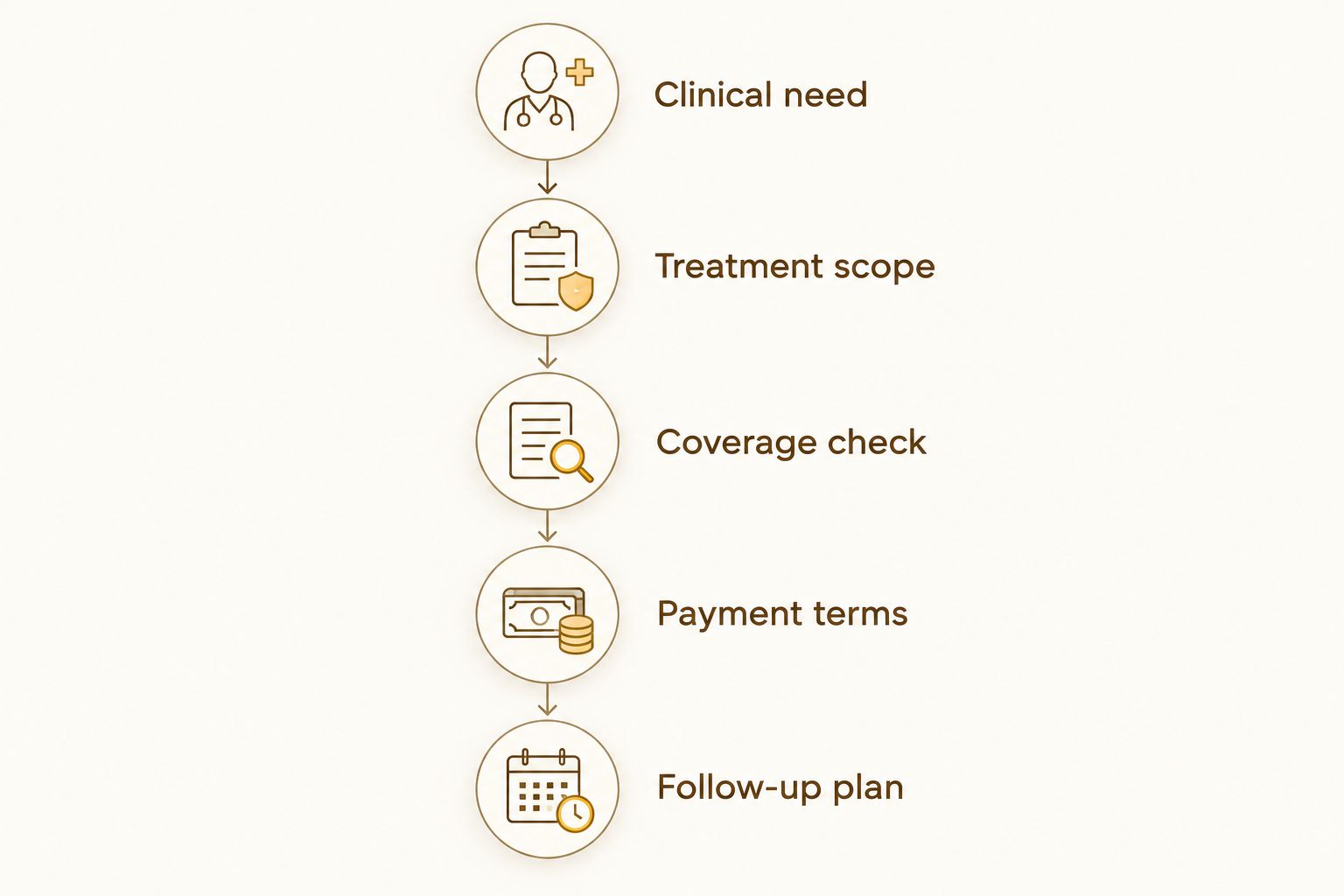
Follow this sequence for a clearer decision:
- Clinical need: Ask what needs treatment and why.
- Treatment scope: Request an itemized plan and discuss reasonable alternatives.
- Coverage check: Check public eligibility and procedure-specific benefits.
- Payment terms: Compare direct payment, savings arrangements, and borrowing.
- Follow-up plan: Establish who handles maintenance and complications.
This order keeps a payment offer from becoming the reason you choose a procedure. For La Jolla patients, Harmony Dental Group offers veneers, implants, and Invisalign; discuss suitability before deciding how to pay for treatment.
Bring your questions to the consultation rather than trying to settle every clinical detail beforehand. Ask which recommendations protect oral health, which address appearance, and which depend on another procedure being completed first.
How these alternatives were ranked
The 2026 ranking prioritizes treatment clarity, written terms, provider access, and continuity of care. Direct payment is the baseline for comparing a defined treatment; membership plans address continuing routine care; Medi-Cal Dental addresses eligible patients' coverage needs.
The remaining options serve distinct situations: teaching-clinic care, participating-network discounts, and repayment over time. This is a decision guide, not a measured ranking of savings or clinical outcomes.
Which dental insurance alternative should you choose?
For an undecided patient, start with a written treatment plan and check Medi-Cal Dental eligibility before buying a separate arrangement. That gives you something concrete to compare.
Choose a membership for its included routine services, a discount plan for verified treatment terms, or financing for a repayment schedule you understand. Harmony Dental Group can be your starting point for a dental consultation in La Jolla; no payment arrangement substitutes for determining which treatment fits your needs.
FAQ
What's the best dental insurance alternative if I'm uninsured?
Direct payment with an itemized treatment plan is the clearest starting point for a specific dental need. Eligible California residents should also check Medi-Cal Dental before buying a private savings arrangement.
Is a dental membership plan the same as insurance?
No, a dental membership plan is an agreement for specified services or discounts, not dental insurance. Review the participating practice, included treatments, exclusions, and cancellation terms.
Are dental discount plans better than paying directly?
A dental discount plan is useful only when its verified terms improve your arrangement for the treatment you need. Compare the provider's itemized plan with the enrollment obligations and procedure-specific discount terms.
Can Medi-Cal Dental help uninsured patients in San Diego?
Medi-Cal Dental provides dental benefits to eligible California residents, including eligible San Diego patients. Confirm your eligibility, the proposed procedure's benefits, and the treating provider's participation.
Can I use these alternatives for veneers or Invisalign?
Payment alternatives can help you organize payment for veneers or Invisalign, but they do not automatically provide coverage or discounts. Ask about the exact treatment and distinguish cosmetic services from other dental care.
What should I check before financing dental implants?
Check the complete implant treatment plan and the financing agreement before signing. Ask about preparatory procedures, follow-up, interest, fees, and the consequences of missing payments.
What should I bring to a dental consultation in 2026?
Bring your dental concerns, relevant medical information, and questions about treatment alternatives and payment responsibilities. Request an itemized plan so you can compare payment options against the same scope of care.
One last thing
A smaller installment and a smaller treatment bill are different things. Before signing, ask: What is my total obligation, and what dental care does it include? If those answers are unclear, pause the payment decision—not necessary evaluation of your dental health.