Best starting option for mild dental anxiety: nitrous oxide. Best for selected patients who want medication without an initial IV: oral sedation. Best for adjustable sedation during treatment: IV sedation; reserve general anesthesia for cases that require unconsciousness. This 2026 guide explains the trade-offs—not which medication you should take without a clinical assessment.
- Sedation dentistry options compared: nitrous oxide is a starting option for mild anxiety, not a solution for every patient.
- Oral sedation avoids an initial IV but cannot be adjusted as quickly as IV sedation.
- IV sedation allows medication adjustment during treatment; sedation depth depends on the drugs and clinical plan.
- General anesthesia causes unconsciousness and requires a different level of airway management and recovery support.
Why this matters
Dental anxiety can lead you to postpone treatment. The right plan addresses both the dental problem and the reason treatment feels difficult: needles, gagging, pain, loss of control, or a previous experience.
Sedation reduces anxiety or awareness; local anesthesia controls pain in the treatment area. These are different jobs, and dental treatment often needs both. Feeling relaxed does not mean a tooth is numb.
Harmony Dental Group is a local option for La Jolla patients seeking general dental care before choosing a sedation approach. Ask which methods the practice provides, who administers them, and whether your needs require referral.
What makes the best sedation dentistry option?
Use these criteria to compare options in 2026. The strongest choice is the least intensive approach that supports safe, effective treatment for your individual needs.
- Anxiety fit: Match the approach to your actual trigger, not simply the label “nervous patient.”
- Sedation depth: Establish whether you will remain responsive, become less aware, or be unconscious.
- Adjustability: Ask how the clinician changes the medication effect during treatment.
- Medical suitability: Review health conditions, medications, pregnancy, substance use, and previous anesthesia reactions.
- Recovery requirements: Confirm escort, driving, work, and supervision instructions before booking.
- Clinical safeguards: Identify the administrator, monitoring plan, emergency equipment, and ability to manage deeper-than-intended sedation.
Route and depth are not interchangeable. The American Society of Anesthesiologists describes 4 depth levels: minimal sedation, moderate sedation, deep sedation, and general anesthesia. An oral medication or IV does not, by itself, tell you which level is planned.
Sedation dentistry options compared at a glance
These 4 approaches address different needs. The table ranks them by their decision role, not by a promise that one method is safer for every patient.
| Option | Best for | Standout feature | Key limitation |
|---|---|---|---|
| Nitrous oxide | Mild anxiety with a preference to remain responsive | Inhaled gas can be adjusted during treatment | Requires breathing through a nasal mask; insufficient for some patients |
| Oral sedation | Selected patients anxious about initial IV placement | Medication is taken by mouth | Effect varies and is less readily adjusted after swallowing |
| IV sedation | Patients needing medication adjustment during treatment | Direct administration allows titration | Requires IV placement and a planned recovery arrangement |
| General anesthesia | Selected cases requiring unconsciousness | Patient is unconscious during treatment | Requires anesthesia-level airway management and recovery care |
Nitrous oxide, oral sedation, and IV sedation describe delivery methods. General anesthesia describes a state of unconsciousness. That distinction is central to understanding what a clinician is proposing.
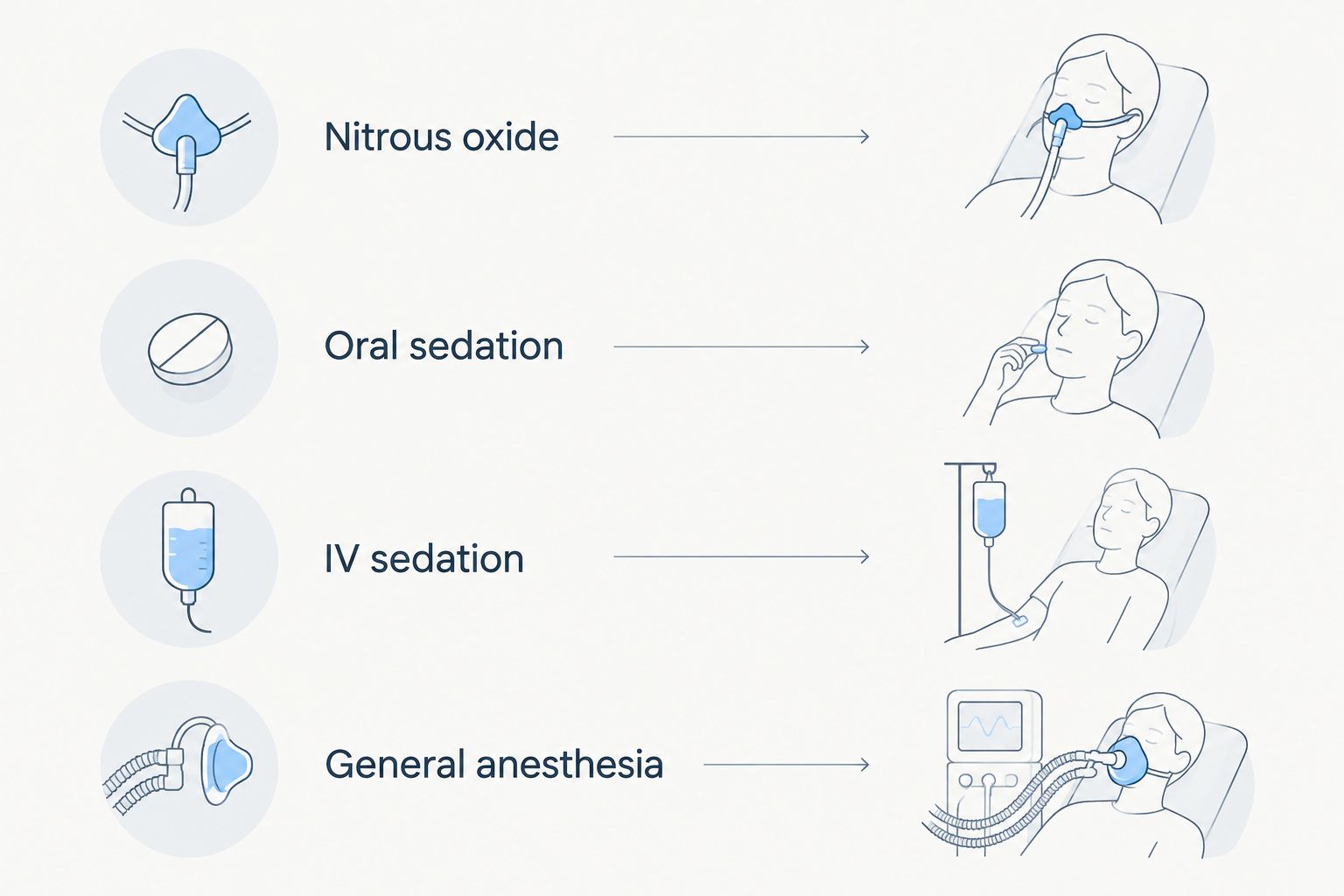
1. Nitrous oxide: best for mild dental anxiety
Nitrous oxide is administered with oxygen through a nasal mask. You generally remain responsive when it is used for minimal sedation, and the clinician can adjust the inhaled concentration during treatment.
Nitrous oxide wears off relatively quickly after administration stops. That makes it a useful first discussion for someone who wants help relaxing without automatically choosing a deeper sedation plan.
Nitrous oxide pros:
- The clinician can adjust the inhaled concentration.
- Administration does not require a needle.
- Minimal sedation preserves your ability to respond.
- Recovery is generally shorter than with longer-acting sedative medications.
Nitrous oxide cons:
- Nasal congestion or difficulty tolerating the mask can interfere with delivery.
- Nausea and other adverse effects are possible.
- Severe anxiety can persist despite nitrous oxide.
Best for: Patients with mild anxiety who can tolerate a nasal mask and want to remain engaged with the dental team.
Nitrous oxide does not replace local anesthetic injections when a procedure needs numbness. If injections are your main fear, ask how the team will manage that step rather than assuming the gas eliminates it.
Verdict: Hold until the clinician confirms suitability; nitrous oxide is the first option to discuss for mild anxiety.
2. Oral sedation: best for selected patients avoiding an initial IV
Oral sedation uses a prescribed medication taken by mouth. Depending on the medication, dose, and individual response, it can produce different depths of sedation; swallowing a tablet does not guarantee only light relaxation.
The effect is less readily adjusted once the medication has been swallowed. You need explicit instructions about when to take it, what to avoid, and how to reach the appointment safely.
Oral sedation pros:
- Medication administration does not require an initial IV.
- It can reduce anxiety before dental treatment begins.
- Some medications reduce memory of the procedure.
Oral sedation cons:
- Absorption and individual response vary.
- Additional medication does not take effect immediately.
- Sedation can persist after the dental procedure ends.
Best for: Medically suitable patients whose anxiety includes IV placement and who can follow medication and escort instructions.
Oral sedation does not guarantee a needle-free visit. You can still need local anesthetic injections, and the clinical plan can require additional access or monitoring.
For a 2026 appointment, disclose all prescription medicines, over-the-counter products, supplements, alcohol use, and recreational substances. Do not add sleep medication, an extra sedative dose, or alcohol to make the prescribed medicine “work better.”
Verdict: Hold until prescribed for your specific treatment; oral sedation is not a self-medication strategy.
3. IV sedation: best for medication adjustment during treatment
IV sedation delivers medication directly into a vein. A qualified clinician can administer incremental doses and adjust the medication effect as treatment progresses.
IV sedation is not automatically general anesthesia. Your planned depth determines how responsive you are expected to remain, which monitoring is required, and what airway support must be available.
IV sedation pros:
- Medication can be titrated during treatment.
- Administration bypasses gastrointestinal absorption.
- It can support treatment when lighter approaches do not adequately address anxiety.
IV sedation cons:
- IV placement introduces a needle-related step.
- Sedative medications can impair breathing and protective responses.
- Recovery and transportation require advance planning.
Best for: Selected patients who need an adjustable sedation plan and can receive treatment in an appropriately equipped setting.
Ask what “IV sedation” means in your case. A useful answer identifies the intended depth, the administrator, the person monitoring you, and the plan if you become more deeply sedated than intended.
Memory loss is not a reliable measure of sedation depth. Remembering little afterward does not establish that you were unconscious during the procedure.
Verdict: Hold until the team confirms medical suitability, intended depth, monitoring, and recovery arrangements.
4. General anesthesia: best for selected cases needing unconsciousness
General anesthesia produces unconsciousness. Patients are not arousable even with painful stimulation, and airway or breathing support is often required.
A clinician can recommend it when the treatment needs, patient factors, or inability to tolerate other approaches justify that level of care. It is not the default upgrade for anyone who feels nervous.
General anesthesia pros:
- It eliminates conscious awareness during treatment.
- It can allow necessary care when less intensive approaches are inadequate.
- It provides an option for selected patients unable to cooperate with treatment while conscious.
General anesthesia cons:
- It requires anesthesia-level airway management and monitoring.
- It brings a more involved recovery process.
- It is not appropriate for every patient or every treatment setting.
Best for: Patients whose clinical assessment establishes a need for unconsciousness during dental treatment.
For general anesthesia in 2026, ask where treatment will occur and who provides the anesthesia. Office-based, surgical-center, and hospital arrangements differ; the location must match the patient's needs and the planned care.
Do not choose general anesthesia solely to guarantee no memory. Discuss whether a less intensive plan can accomplish the necessary dental treatment safely.
Verdict: Hold unless the clinical team establishes a clear indication for unconsciousness.
How the options are ranked
This ranking prioritizes anxiety fit, intended depth, adjustability, medical suitability, recovery, and clinical safeguards. Nitrous oxide comes first as a discussion point for mild anxiety, not as a universal winner.
Oral sedation, IV sedation, and general anesthesia each occupy a different decision slot. No ranking can replace a health review or establish that a particular dental office provides every method.
Harmony Dental Group offers general, cosmetic, and restorative dental services. Confirm sedation services directly rather than inferring them from the availability of implants, veneers, or emergency care.
Which sedation option should you choose?
For mild anxiety, start by discussing nitrous oxide and a clear communication plan. If that approach does not match your anxiety or treatment needs, ask the clinician to explain why oral sedation, IV sedation, or general anesthesia is appropriate.
Describe the obstacle precisely:
- Needle fear: Ask how local anesthetic injections and any IV placement will be managed.
- Loss of control: Discuss a stop signal, explanations before each step, and the ability to pause.
- Gagging: Explain when it happens and what triggers it.
- Previous pain: Ask how numbness will be checked before treatment begins.
- Difficulty cooperating: Request an individualized assessment rather than choosing a sedation label yourself.
Sedation should support a treatment plan, not replace one. You still need to understand the dental diagnosis, alternatives, and what will be done while you are sedated.
Before you book in 2026
Get written instructions covering medications, eating and drinking, transportation, and recovery. Follow your treating team's directions; do not apply a fasting rule from another patient's appointment.
Ask 2 transportation questions: who must take you home, and who must stay with you afterward? Requirements depend on the planned medication, sedation depth, and your individual circumstances.
Tell the team about sleep apnea, breathing problems, pregnancy, and previous sedation or anesthesia complications. Report a new illness or a change in medication before the appointment.
Discuss your dental treatment needs
Ask which sedation methods are offered and whether your anxiety or medical history requires referral.
FAQ
What's the best sedation dentistry option for anxiety?
Nitrous oxide is a starting option to discuss for mild anxiety, while more substantial anxiety requires an individualized assessment. The best choice depends on your health, treatment needs, anxiety triggers, and intended sedation depth.
Is oral sedation better than IV sedation?
Oral sedation avoids initial IV administration, while IV sedation allows medication titration during treatment. Neither is universally better; the clinician must match the route and depth to the patient and procedure.
Will I be asleep during IV sedation?
IV sedation does not automatically mean you will be unconscious. Ask whether the planned level is moderate sedation, deep sedation, or general anesthesia and what responsiveness to expect.
Does sedation dentistry mean I won't need numbing injections?
Sedation does not replace local anesthesia for procedures that require numbness. Discuss injection anxiety separately so the dental team can plan both anxiety management and pain control.
Can I drive home after dental sedation?
Do not drive unless your treating clinician's discharge instructions explicitly permit it. Oral sedation, IV sedation, and general anesthesia require advance transportation planning, and nitrous oxide discharge decisions depend on recovery and any other medications used.
Can I take my own anxiety medicine before the dentist?
Do not change your dose or take extra anxiety medicine for the appointment without instructions from the treating team. Provide a complete medication list so the clinician can assess interactions and coordinate the plan.
Does Harmony Dental Group offer every sedation option?
Confirm specific sedation services directly with Harmony Dental Group. The practice provides general, cosmetic, and restorative dental care, but those services do not establish which sedation methods are offered or who administers them.
One last thing
Ask about responsiveness, not just whether you will remember the appointment. Sedation depth is defined by how you respond and how breathing and circulation are affected—not by how much you recall afterward.
For your 2026 appointment, request a plain-language answer to this question: what level of sedation is planned, and what happens if I become more deeply sedated than intended? That answer is more useful than a promise that treatment will feel easy.