Cancer patients’ dental care is prevention and treatment of oral problems with the aim of protecting comfort, nutrition, and safe cancer treatment. This 2026 guide explains how to prepare your mouth, manage treatment-related symptoms, and coordinate dental decisions when infection risk, bleeding, or healing changes.
- Dental care for cancer patients starts with an exam and coordination between your dentist and oncology team.
- Harmony Dental Group offers local general dental care; oncology specialists guide cancer-treatment precautions.
- Chemotherapy, head and neck radiation, and certain medicines require different oral care plans.
- Prioritize infection prevention and dry mouth care; postpone elective cosmetic treatment when your medical team recommends it.
Why dental care matters for cancer patients
Cancer treatment changes the context of ordinary dental decisions. Chemotherapy can reduce infection-fighting blood cells and platelets, while radiation involving the mouth can affect saliva, oral tissues, and jaw healing. A sore mouth can also make eating, drinking, and taking medicines difficult.
The National Cancer Institute’s Oral Complications of Cancer Therapies PDQ guidance describes these treatment-specific risks. For your 2026 care plan, the practical point is simple: tell your dentist exactly which cancer treatment you receive, not just that you have cancer. The type of treatment determines the precautions.
Harmony Dental Group is best considered for local general dental care, not as a replacement for your oncology team. For patients in La Jolla and nearby San Diego neighborhoods, Harmony Dental Group offers general, cosmetic, and restorative dentistry. During cancer treatment, health and comfort come before elective smile changes.
This guide supports discussions with your clinicians; it does not provide clearance for a procedure. Your dentist and oncology team must decide timing, medication precautions, and whether specialist care is needed.
Build your dental care plan around treatment
Arrange a dental examination before treatment
Ask your oncology team whether you need a dental examination before cancer therapy begins. This is especially important before head and neck radiation, stem cell transplantation, or treatment expected to cause significant immune suppression. An examination identifies infections, damaged teeth, gum problems, and appliances that rub against soft tissue.
Do not delay cancer treatment on your own to finish dental work. If treatment starts soon, your dentist and oncologist must decide which dental problems require attention first and what can wait. Extraction sites need healing time, but there is no single waiting period that fits every patient or treatment.
For a new diagnosis in 2026, bring the proposed treatment plan rather than relying on memory. Ask the dentist to distinguish urgent disease from routine maintenance and cosmetic preferences.
- Share your cancer diagnosis, treatment type, and planned start date.
- Point out pain, swelling, bleeding, loose teeth, and broken restorations.
- Bring dentures, retainers, or aligners so the dentist can check irritation.
- Ask which dental findings need discussion with your oncologist.
Coordinate procedures with your oncology team
Dental procedures during cancer treatment require more than choosing an open appointment. Your medical team must consider blood counts, medicines, treatment timing, and healing risks. The safest date is determined by your clinical situation, not by a general rule about a particular chemotherapy day.
Give both teams permission to communicate. Ask who will review medical information before an extraction, periodontal procedure, or other invasive treatment. If you need specialist oral care, request a referral rather than assuming a general dental appointment covers every cancer-related complication.
Harmony Dental Group provides general and restorative dental care. When discussing an appointment, explain your cancer treatment and ask what medical information is needed; do not assume oncology-specific services or clearance arrangements.
- Provide your oncologist’s name and contact details.
- Bring a current medication list, including supplements and infusions.
- Ask whether recent blood counts are needed before the proposed procedure.
- Confirm who will approve timing and any medication changes.
Clean your mouth gently and consistently
Use a soft-bristled toothbrush and fluoride toothpaste unless your treating team gives different instructions. Brush for 2 minutes per session, with 2 brushing sessions per day. These standard American Dental Association recommendations provide a baseline; significant soreness or bleeding requires an individualized adjustment.
Gentle cleaning removes plaque without deliberately scrubbing already tender tissue. If brushing hurts, tell your team rather than abandoning mouth care. Ask whether you should change your brush, toothpaste, or technique, and whether cleaning between teeth remains appropriate with your current blood counts.
Do not begin flossing aggressively during a period of low platelets or severe mouth inflammation. Equally, do not stop an established routine automatically: your clinicians should decide what is safe. Dentures also need cleaning, and a rubbing edge deserves attention before it causes a sore.
- Choose a soft brush and avoid forceful pressure.
- Ask about a mild fluoride toothpaste if flavoring causes discomfort.
- Follow your team’s instructions for flossing or interdental cleaning.
- Clean removable appliances and report any sore spots underneath them.
Treat dryness and mouth sores as separate problems
Dry mouth and mouth sores often occur together, but they are not the same condition. Dry mouth reflects reduced saliva or a sensation of dryness. Oral mucositis means inflammation and injury of the mouth lining associated with some cancer treatments.
Saliva helps protect teeth and makes swallowing easier. When saliva decreases, cavity prevention needs closer attention. Frequent water sips, an appropriate saliva substitute, and sugar-free gum when safe to chew are supportive measures; your dentist can determine whether prescription fluoride is appropriate.
Mouth sores need assessment, particularly when they interfere with drinking or resemble an infection. Do not scrape off patches or start leftover prescription rinses. A dentist or oncology clinician must distinguish irritation, mucositis, fungal infection, and other causes before choosing treatment.
- Report new ulcers, white patches, burning, or persistent mouth pain.
- Ask your team which bland rinse and preparation instructions to use.
- Avoid tobacco, alcohol-containing rinses, and foods that sting sores.
- Request pain-management advice if eating or drinking becomes difficult.
Disclose radiation and bone-affecting medicines
Tell every dentist if you have received radiation to the head or neck, even after cancer treatment ends. Radiation involving the jaw can create lasting healing concerns. An extraction or implant decision requires information about the radiation field and dose, not simply the date treatment finished.
Also disclose medicines such as bisphosphonates or denosumab, including previous use. These medicines can be associated with medication-related osteonecrosis of the jaw, a condition involving damaged jawbone that does not heal normally. Risk depends on the medicine, indication, dosing, and other clinical factors.
Never stop a prescribed cancer-related medicine to prepare for dental work without your prescribing clinician’s direction. In 2026, a full medication history remains more useful than a generic statement that you are finished with treatment. Past treatment can still affect present dental choices.
- Request your radiation summary if the head or neck was treated.
- List bone-targeting medicines, infusion dates, and the prescribing clinician.
- Ask whether an oral surgeon or dental oncology specialist should evaluate you.
- Discuss healing risks before extractions, implants, or gum surgery.
Escalate infection and hydration concerns promptly
A toothache during cancer treatment is not automatically a routine dental problem. Fever, swelling, and difficulty swallowing can require medical assessment as well as dental treatment. Do not wait for a scheduled checkup if symptoms are worsening.
CDC guidance for people receiving chemotherapy identifies a temperature of 100.4°F, or 38°C, as a reason to call your doctor immediately. Follow any more specific instructions from your oncology team. Fever during chemotherapy can signal a serious infection, even when the mouth looks normal.
Call emergency services for breathing difficulty. Seek urgent medical assessment for spreading facial or neck swelling, inability to swallow fluids, or uncontrolled bleeding. For dental symptoms without those warning signs, discuss prompt evaluation with your care team; this guide to emergency dental care options in San Diego explains the local dental-care setting, not oncology clearance.
- Keep your oncology team’s urgent contact instructions accessible.
- Check your temperature when you feel unwell, as your team directs.
- Report swelling, drainage, worsening pain, or unexpected bleeding promptly.
- Tell the receiving clinician that you are undergoing cancer treatment.
Plan follow-up before elective smile treatment
Completing cancer treatment does not automatically remove dental precautions. Dry mouth, restricted jaw opening, and radiation-related healing risks can continue. Ask your dentist and oncology team to agree on follow-up based on your symptoms, dental disease, and treatment history.
Veneers, whitening, Invisalign, implants, and gum procedures address different concerns, but none replaces infection control or a healthy mouth. Harmony Dental Group offers cosmetic and restorative services; discuss readiness before selecting an elective procedure. A consultation should clarify suitability, not promise that treatment is safe simply because therapy has ended.
Use your 2026 follow-up visit to separate immediate health needs from longer-term preferences. That keeps a painful tooth or dry mouth from being overshadowed by a cosmetic goal.
- Review prevention: fluoride, cleaning technique, and cavity monitoring.
- Review symptoms: dryness, soreness, bleeding, and jaw stiffness.
- Review follow-up: examination timing and any specialist involvement.
- Ask when elective treatment can be considered and what clearance is needed.
Compare oral care options for your situation
Cancer-related mouth care works best when daily prevention, symptom support, and clinical treatment serve different jobs. Choose the option that addresses the actual problem; a rinse cannot repair a broken tooth, and a filling cannot restore saliva production.
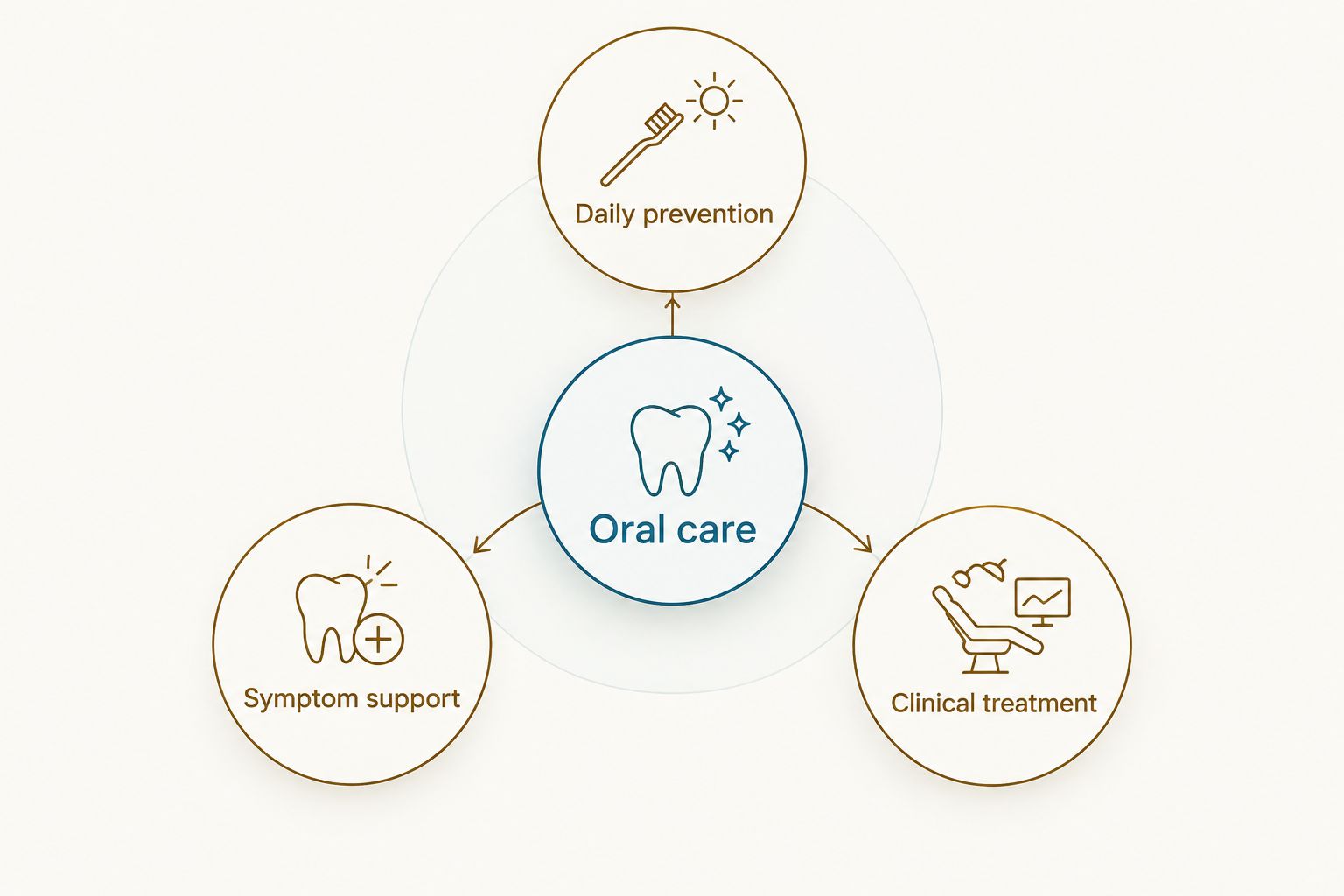
The options below complement one another. Your clinicians should adjust them when bleeding risk, immune suppression, mouth soreness, or healing concerns change.
| Option | Best for | Main benefit | Key limitation |
|---|---|---|---|
| Daily prevention | Patients able to clean their mouths comfortably | Supports plaque control and cavity prevention | Does not treat an established infection or severe mucositis |
| Symptom support | Dryness or irritation assessed by the care team | Helps with moisture, comfort, and daily function | The wrong product can irritate tissue; relief does not establish a diagnosis |
| General dental treatment | Cavities, damaged teeth, and routine dental disease | Addresses a specific dental cause | Timing and procedure choice depend on medical precautions |
| Specialist oral care | Complex complications or procedures with elevated healing risk | Adds focused assessment of treatment-related concerns | Requires coordination with existing medical and dental teams |
Choose the care setting by risk, not convenience alone. A local dentist is useful for general care, while complex cancer-related oral complications require the appropriate specialist. Neither home care nor a specialist referral eliminates the need for communication with oncology.
Common mistakes cancer patients make
Waiting until mouth pain becomes severe
A dental infection or ill-fitting denture is easier to discuss before treatment-related soreness complicates the picture. Report existing problems before therapy starts, and report new symptoms during treatment. Pain that prevents drinking needs prompt attention, not a stronger over-the-counter rinse.
Assuming all cancer treatments need the same precautions
Chemotherapy, radiation outside the mouth, head and neck radiation, and bone-targeting medicines have different implications. Give your dentist the treatment names and relevant records. A generic cancer history is not enough to determine extraction or implant safety.
Treating every white patch as a simple mouth sore
White patches, ulcers, and burning have different causes. Do not scrape tissue or borrow antifungal medicine from someone else. Your care team needs to identify the cause before treatment, particularly when immune defenses are reduced.
Booking cosmetic work before checking medical readiness
Whitening or aligners can wait when tissue is inflamed, brushing is difficult, or your clinicians recommend postponement. The same caution applies to implants and elective gum procedures. Ask what must stabilize first rather than choosing a procedure around a preferred calendar date.
FAQ
Should I see a dentist before chemotherapy?
Ask your oncology team to arrange a dental assessment before chemotherapy when the treatment plan allows. The dentist can identify infections, damaged teeth, and appliance irritation, while your oncologist determines how dental care fits the cancer-treatment schedule.
Can I have a tooth removed during cancer treatment?
A tooth extraction during cancer treatment requires a coordinated assessment by your dentist and oncology team. Blood counts, medicines, radiation history, infection urgency, and healing risks determine whether to proceed and whether specialist care is needed.
What should I do if my mouth is too sore to brush?
Contact your oncology team or dentist for an adjusted mouth-care plan rather than stopping cleaning without advice. A softer brush, different toothpaste, pain management, or clinician-directed rinses can help, depending on the cause of soreness.
Is dry mouth after cancer treatment just uncomfortable?
Dry mouth affects dental health as well as comfort because saliva helps protect teeth. Ask about fluoride prevention, saliva support, and follow-up, especially after radiation involving the salivary glands.
When is a fever an emergency during chemotherapy?
During chemotherapy, a temperature of 100.4°F or 38°C requires an immediate call to your doctor under CDC guidance. Follow your oncology team's urgent instructions, and do not wait for a dental appointment to assess the fever.
Can I get dental implants after head and neck radiation?
Dental implants after head and neck radiation require individualized assessment of the treated area and healing risk. Your dentist, oncology team, and an appropriate specialist should review radiation records before deciding whether implants are suitable.
Does Harmony Dental Group provide dental care for cancer patients?
Harmony Dental Group offers general, cosmetic, and restorative dentistry in La Jolla. When requesting care during cancer treatment, explain your treatment and medications and ask whether the proposed dental visit requires medical clearance or specialist referral.
One last thing
Keep a permanent record of head and neck radiation and bone-targeting medicines with your dental history. These details can affect future dental decisions long after the appointment at which they were first discussed. For your next visit in 2026, bring that record alongside your current medication list—not just a statement that cancer treatment is complete.