
Your root canal cost without insurance depends on which tooth needs treatment, how complex its canals are, and what restoration it needs afterward. Ask for a written estimate covering the entire treatment plan—not just the root canal procedure. In 2026, compare estimates only after checking whether the examination, imaging, buildup, and final crown or filling are included.
- Root canal cost without insurance depends on tooth complexity and the restoration needed afterward.
- Ask for an itemized estimate that separates root canal treatment, imaging, buildup, and the final restoration.
- Harmony Dental Group offers general and restorative dental care for La Jolla patients considering their treatment options.
- Compare complete treatment plans, not an isolated procedure fee or a monthly payment.
How much does a root canal cost without insurance?
There is no single fee that applies to every uninsured patient. A dentist needs to identify the affected tooth, assess whether it can be restored, and determine whether it needs initial treatment or retreatment before giving you an individualized estimate.
For patients in La Jolla and nearby San Diego neighborhoods, Harmony Dental Group offers general, restorative, and emergency dental care. Start with an assessment of the tooth rather than deciding between saving and removing it from a fee alone.
Use this breakdown when requesting a 2026 treatment estimate:
| Part of the treatment plan | What it addresses | What to ask |
|---|---|---|
| Examination | Diagnosis and whether the tooth can be restored | Is the diagnostic visit included? |
| Dental imaging | Roots, surrounding bone, and treatment planning | Which images are needed, and are they listed separately? |
| Root canal treatment | Cleaning, disinfecting, and sealing the canals | Is this initial treatment or retreatment? |
| Core buildup | Rebuilding missing tooth structure when needed | Does this tooth require a buildup? |
| Final restoration | Protecting and sealing the treated tooth | Does the plan include a crown or a filling? |
| Follow-up | Checking healing and addressing concerns | Which follow-up visits are included? |
Not every tooth needs every item. The useful estimate is the one that identifies what your tooth needs and explains any separate charges before treatment.
Why this matters
A root canal estimate and a completed-tooth estimate are not necessarily the same thing. Root canal treatment addresses the tissue inside the tooth; the restoration afterward helps seal the tooth and protect the remaining structure.
If you compare one estimate that includes a crown with another that excludes it, you are comparing different treatment plans. Ask each office to identify the same endpoint: a treated tooth with its recommended final restoration in place.
Pain also changes the decision. If you have swelling, worsening pain, or a broken tooth, arrange an assessment promptly rather than waiting until you have finished comparing every payment option.
Front teeth, premolars, and molars: what changes?
Tooth location gives a dentist useful clues about treatment complexity, but it does not replace an examination. Root anatomy varies, and an individual tooth can be more complicated than its position suggests.
Front teeth: ask about the remaining tooth structure
Front teeth generally have simpler canal anatomy than molars. However, previous trauma, a narrowed canal, or earlier treatment can make a front tooth more difficult to treat.
Do not assume that every front tooth needs a crown—or that none does. The restoration decision depends on how much sound tooth remains, existing fillings, cracks, and the forces placed on the tooth.
Premolars: ask about anatomy and chewing forces
Premolars sit between the front teeth and molars, and their canal anatomy varies. Your dentist also needs to assess the tooth's cusps, which are the raised areas used for chewing.
A heavily damaged premolar needs a restoration plan that addresses fracture risk. Ask why the recommended restoration fits your tooth instead of choosing from appearance alone.
Molars: ask about complexity and specialist involvement
Molars generally have more complex canal systems and carry substantial chewing forces. Their position at the back of the mouth also affects access during treatment.
Ask whether an endodontist—a dentist specializing in root canal treatment—is recommended. Also confirm who will provide the final restoration so that specialist treatment and restorative care do not become disconnected parts of your plan.
Why root canal treatment estimates vary
These clinical factors explain why two people can receive different treatment recommendations even when both need a root canal:
- Tooth location and anatomy: Curved, narrow, or difficult-to-locate canals affect the work required to clean and seal the tooth.
- Initial treatment versus retreatment: A previously treated tooth can require removal of existing filling material and investigation of persistent problems.
- Remaining tooth structure: Extensive decay, a large existing filling, or a fracture changes what is needed to rebuild and protect the tooth.
- Imaging requirements: Additional imaging is sometimes needed to clarify anatomy or assess a difficult diagnosis.
- Specialist involvement: A referral changes which clinicians provide care and which office issues each part of the estimate.
- Final restoration: A crown, filling, or buildup serves a different purpose from the root canal itself and needs to be identified in the plan.
Ask what makes your particular tooth straightforward or complicated. That explanation is more useful than a generic fee described as applying to everyone.
How to get a complete estimate without insurance
For a 2026 consultation, bring any relevant dental records you already have and tell the office that you will be paying without dental insurance. Explain your symptoms, including when they started and whether you have swelling, pain on biting, or a broken restoration.
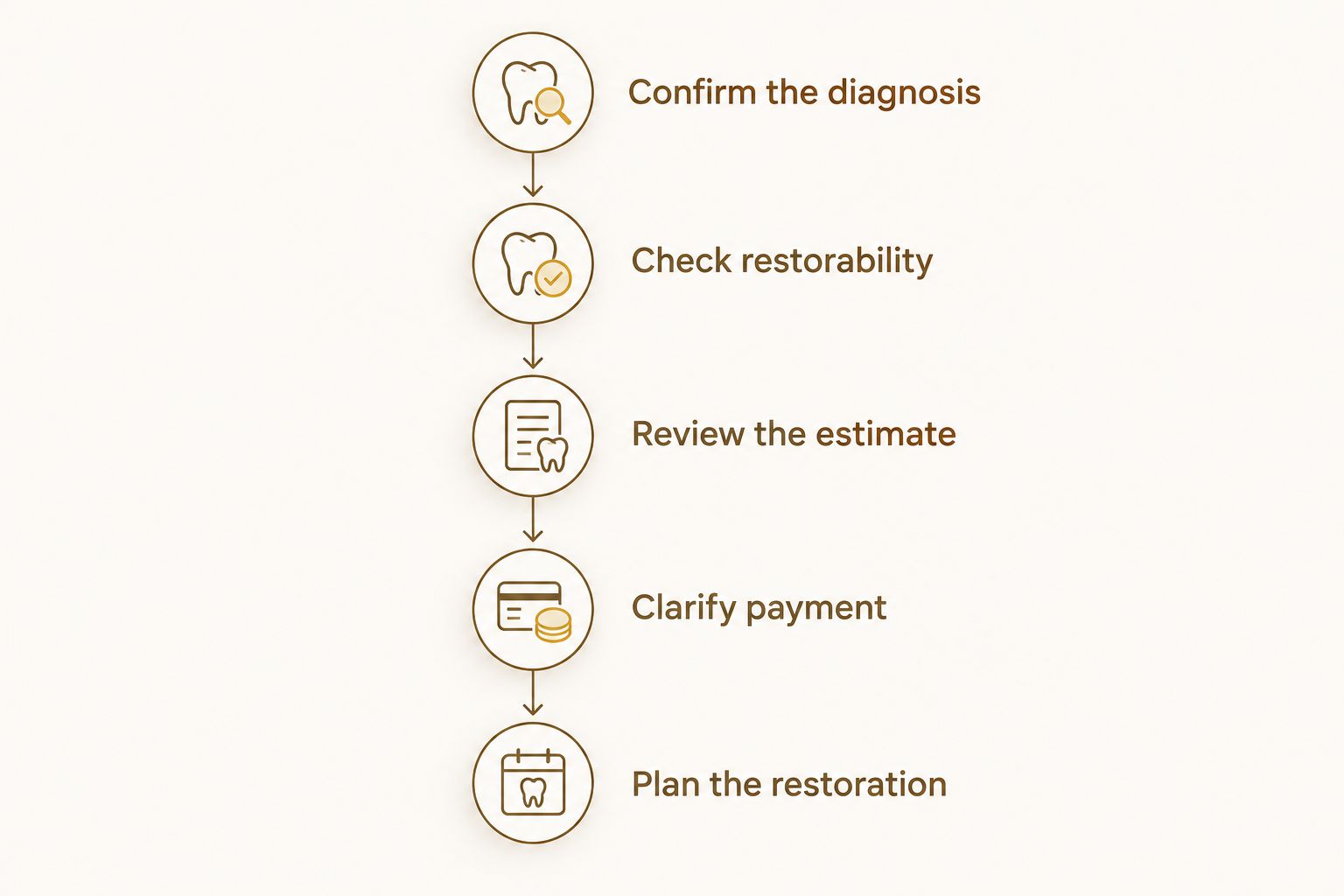
Use this sequence to keep the clinical decision and payment discussion clear:
- Confirm the diagnosis. Ask which tooth is causing the problem, what the examination shows, and whether root canal treatment is recommended.
- Check restorability. Ask whether enough healthy tooth remains to support a lasting restoration and whether any crack changes the prognosis.
- Review the estimate. Request separate entries for the examination, imaging, root canal, buildup, and final restoration where applicable.
- Clarify payment. Ask what is due at each stage, whether any payment arrangements are offered, and what their written terms require.
- Plan the restoration. Confirm who will complete the tooth and when that appointment should happen.
Before authorizing treatment, ask how the office handles an unexpected finding. You should understand when the dentist would pause to discuss a changed plan and how any additional treatment would be explained.
Keep a copy of the written estimate. If another clinician provides part of your care, confirm that the estimates fit together without leaving the final restoration unaccounted for.
Is saving the tooth better than removing it?
Root canal treatment is an option for preserving a tooth that can still be restored. Extraction removes the tooth, so the discussion must also address whether and how to replace it.
The right choice depends on the diagnosis, remaining tooth structure, gum and bone support, and your goals. Neither treatment is the right answer for every damaged tooth.
| Treatment approach | Best for | Main benefit | Main limitation |
|---|---|---|---|
| Root canal and restoration | Preserving a restorable tooth with inflamed or infected pulp | Retains the natural tooth | Requires a suitable restoration; some teeth cannot be predictably saved |
| Extraction without replacement | Situations where removal is necessary and replacement is not selected | Removes the affected tooth | Leaves a gap and can affect chewing or neighboring tooth positions |
| Extraction with replacement | Replacing a tooth that cannot be retained | Addresses the missing tooth after removal | Adds treatment planning, procedures, and maintenance needs |
Ask the dentist to explain the prognosis in plain language: what supports saving the tooth, what threatens its survival, and what would happen if treatment did not succeed. Do not choose extraction solely because its immediate treatment plan looks shorter.
Can you spread out treatment without risking the tooth?
Some dental treatment happens in stages, but the timing must follow the tooth's clinical needs. Ask which steps are urgent and which can safely be scheduled later; do not create your own delay between root canal treatment and the recommended restoration.
A temporary restoration is not a substitute for completing the plan. Follow instructions about chewing on the tooth, and contact the office if the temporary filling comes out or the tooth breaks.
For your 2026 payment discussion, separate the clinical schedule from the payment schedule. A monthly payment does not tell you the total repayment amount, and approval for financing is not the same as a dental treatment recommendation.
If an office offers financing, review interest, fees, promotional conditions, and payment deadlines before signing. Do not assume a payment arrangement is interest-free or available to every applicant.
What if you cannot afford the recommended treatment?
Tell the dentist directly that affordability affects your decision. Ask for the recommended plan, any clinically appropriate alternatives, and the consequences of delaying each option.
You can also ask local dental schools or community clinics whether they evaluate root canal cases and what their appointment process involves. Do not assume that a particular clinic provides the treatment you need or can see an urgent problem immediately.
Harmony Dental Group is a fit for La Jolla patients seeking general and restorative dental care. An examination is still needed to determine the right treatment for an individual tooth; the practice's service range is not a promise that every damaged tooth can be saved.
Discuss your tooth and treatment options
Ask about an examination and a written plan that includes the recommended final restoration.
When should you seek urgent help instead of comparing estimates?
Contact a dentist promptly for tooth pain with swelling, drainage, a broken tooth, or symptoms that are getting worse. Pain relief does not prove that the underlying problem has healed.
Trouble breathing or swallowing, or rapidly spreading facial or neck swelling, requires emergency medical attention. Do not wait for a routine dental appointment in those circumstances.
Antibiotics are not a substitute for treating the source of a dental infection. A clinician must determine whether they are needed and whether the tooth requires drainage, root canal treatment, or removal.
FAQ
What's included in root canal cost without insurance?
Root canal cost without insurance depends on what the written estimate includes. Ask whether the examination, imaging, root canal procedure, buildup, final restoration, and follow-up are included or listed separately.
Does a root canal estimate include the crown?
A root canal estimate does not automatically include the crown. Request explicit confirmation of the final restoration and ask whether a different office will provide it.
Is removing the tooth better than getting a root canal?
Removing the tooth is not automatically better than root canal treatment. A restorable tooth can be preserved, while extraction creates a separate decision about whether and how to replace it.
Do all teeth need a crown after a root canal?
Not every root-canal-treated tooth needs the same restoration. Tooth location, remaining healthy structure, existing damage, and chewing forces guide the recommendation.
Can I wait until my tooth stops hurting?
Do not use disappearing pain as proof that a tooth has healed. Arrange an examination, especially if you have swelling, drainage, or pain that returns.
Can I ask for a payment plan without dental insurance?
You can ask an office whether it offers payment arrangements for uninsured patients. Review eligibility, interest, fees, payment deadlines, and the total repayment amount before agreeing.
Can Harmony Dental Group help me understand my options?
Harmony Dental Group offers general, restorative, and emergency dental care in La Jolla. Ask for an assessment of the affected tooth and an explanation of the recommended treatment and restoration.
One last thing
The most useful question for a 2026 root canal consultation is: What needs to happen before this tooth is fully treated and protected? It shifts the discussion from a single procedure to the complete plan you are deciding whether to accept.
Write down the answer, including who provides each step. You should leave knowing what the dentist recommends, what remains uncertain, and which symptoms mean you should call sooner.