Best tooth-preserving alternative: vital pulp therapy, but only when the remaining pulp can be kept healthy. Best replacement after extraction: an implant-supported crown when your examination supports it. Best removable option: a partial denture. This guide has root canal alternatives compared for 2026, with one essential distinction: replacing an extracted tooth is not the same as treating and keeping it.
- Root canal alternatives compared: vital pulp therapy preserves suitable living pulp; it does not treat every infected tooth.
- An implant-supported crown replaces an extracted tooth; it does not save the original tooth.
- A conventional bridge uses neighboring teeth for support; a partial denture is removable.
- Harmony Dental Group offers general, restorative and emergency dental care in La Jolla.
- Choose treatment after a diagnosis, not from pain intensity or a replacement ranking alone.
Why this matters
A root canal treats inflamed or infected tissue inside a tooth while retaining the tooth itself. Extraction removes the tooth. An implant, bridge or partial denture addresses the gap afterward, not the original pulp problem.
Harmony Dental Group offers general, restorative and emergency dental care in La Jolla, San Diego. Harmony Dental Group is a local option for patients seeking restorative dental care in La Jolla. Start with an examination rather than choosing a procedure from a list.
For your 2026 treatment decision, ask whether the pulp is alive, whether the tooth can be restored and whether the supporting tissues are healthy. Those findings determine which alternatives belong on your shortlist. Pain alone cannot answer those questions, and a tooth that stops hurting is not necessarily healed.
What makes the best root canal alternative?
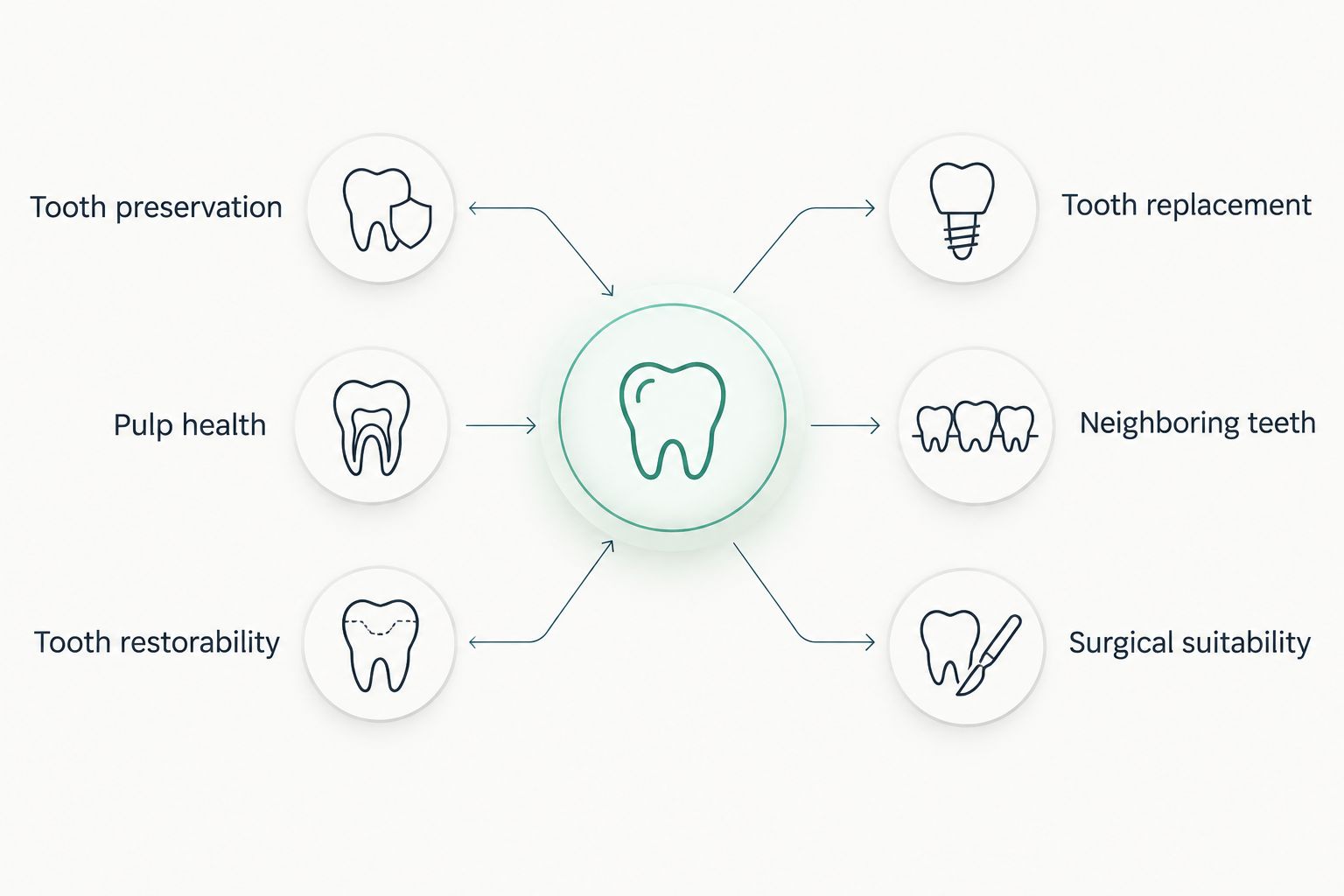
Use these criteria before comparing procedures:
- Pulp health: Is the pulp healthy enough to preserve, inflamed or dead? Vital pulp therapy requires an appropriate diagnosis.
- Tooth restorability: Can the remaining tooth support a reliable restoration? Deep decay, fractures and inadequate support change the decision.
- Infection control: Does the proposed treatment address the source of infection rather than temporarily reducing symptoms?
- Neighboring teeth: Are adjacent teeth healthy, already heavily restored or unsuitable as bridge supports?
- Surgical suitability: Does your medical and dental assessment support extraction, implant placement and healing?
- Daily maintenance: Can you clean the restoration or appliance and attend the follow-up care it needs?
The best alternative is the least destructive treatment that addresses the diagnosed problem. Keeping a tooth is not automatically appropriate; removing a restorable tooth is not automatically necessary.
Root canal alternatives at a glance
This 2026 comparison ranks options by their distinct role, not by a claim that one procedure suits every patient. Tooth preservation comes first when clinically appropriate; replacement choices follow when extraction is necessary.
| Rank and option | Best for | Standout feature | Key limitation |
|---|---|---|---|
| 1. Vital pulp therapy | Preserving suitable living pulp | Retains some or all healthy pulp tissue | Not suitable for every diagnosis or a tooth with dead pulp |
| 2. Extraction and implant-supported crown | Replacing a missing tooth without using adjacent teeth as supports | An implant supports the replacement crown | Requires surgery and suitable supporting conditions |
| 3. Extraction and conventional bridge | Fixed replacement when adjacent teeth suit bridge support | Replacement attaches to neighboring teeth | Usually requires preparation of supporting teeth |
| 4. Extraction and removable partial denture | Removable replacement, particularly across multiple gaps | One appliance can replace multiple teeth | Must be removed and cleaned; fit needs monitoring |
Think of the decision as two separate questions: can the original tooth be kept, and, if not, how should the gap be managed? Do not compare pulp therapy with an implant until your dentist has answered the first question.
1. Vital pulp therapy: best for preserving suitable living pulp
Vital pulp therapy protects or treats living tissue inside a tooth. Depending on the diagnosis, it can include pulp capping or a pulpotomy, which removes affected pulp tissue while retaining suitable tissue elsewhere in the tooth.
This is a genuine tooth-preserving alternative in selected cases. It is not a substitute for root canal treatment when the pulp is dead, and suitability depends on clinical findings rather than your preference to avoid a root canal.
Vital pulp therapy pros
- Preserves living pulp when the diagnosis supports treatment.
- Keeps the natural tooth rather than creating a replacement gap.
- Can avoid full removal of the pulp in an appropriately selected tooth.
Vital pulp therapy cons
- Requires careful case selection and an effective restoration.
- Does not suit every pattern of inflammation, decay or infection.
- Failure can lead to later root canal treatment or extraction.
Best for: A restorable tooth with living pulp that your dentist determines is suitable for preservation.
Ask what evidence supports the recommendation and what follow-up will confirm healing. The treatment name alone does not establish that it is the right choice. A protective filling over deep decay and treatment of an exposed pulp also involve different clinical decisions.
Verdict: Hold until pulp health and restorability are confirmed; choose vital pulp therapy only for a suitable diagnosis.
2. Implant-supported crown: best for independent tooth replacement
After extraction, an implant-supported crown replaces a missing tooth using an implant placed in the jaw. For 1 missing tooth, the implant supports the replacement crown rather than relying on adjacent teeth as bridge supports.
The comparison starts with whether extraction is necessary. An implant does not justify removing a tooth that can be predictably restored, and implant placement requires assessment of bone, gum health, medical history and the planned restoration.
Implant-supported crown pros
- Replaces a missing tooth without preparing neighboring teeth as bridge supports.
- Provides a fixed replacement rather than a removable appliance.
- Allows the replacement plan to focus on the individual gap.
Implant-supported crown cons
- Requires a surgical procedure and a healing plan.
- Suitable bone and healthy supporting tissues need assessment.
- Needs ongoing cleaning and monitoring; implant complications remain possible.
Best for: A patient who needs tooth replacement and is suitable for implant treatment without involving neighboring teeth as supports.
Harmony Dental Group lists implants among its restorative services. Ask how the proposed replacement relates to your extraction decision, what additional procedures are needed and how the restoration will be maintained.
For a 2026 comparison, request a written sequence covering extraction, healing, implant placement and the final crown. Do not assume every stage happens together or that every patient follows the same schedule.
Verdict: Hold until extraction is justified and implant suitability is established.
3. Conventional bridge: best when neighboring teeth suit fixed support
A conventional dental bridge replaces a missing tooth with an artificial tooth attached to crowns on neighboring teeth. A common design for 1 missing tooth uses 2 neighboring teeth as supports, although bridge designs vary.
A bridge deserves consideration when those supporting teeth already need substantial restorations. If neighboring teeth are healthy, the preparation needed for a conventional bridge becomes a significant trade-off.
Conventional bridge pros
- Provides a fixed replacement that stays in your mouth.
- Can combine replacement with restoration of suitable adjacent teeth.
- Does not require an implant to support the replacement tooth.
Conventional bridge cons
- Usually requires removal of tooth structure from supporting teeth.
- Depends on the health and strength of its supports.
- Requires cleaning beneath the replacement tooth and around the supporting crowns.
Best for: A fixed replacement where neighboring teeth are appropriate supports, especially when they already need crowns.
Ask which teeth would support the bridge and why they are suitable. You should understand the consequences for each supporting tooth, not just the appearance of the replacement.
A resin-bonded bridge has a different design and different indications. Do not assume the benefits or limitations of a conventional bridge apply unchanged to every bridge type.
Verdict: Hold until the condition of the supporting teeth justifies a conventional bridge.
4. Removable partial denture: best for removable gap management
A removable partial denture replaces missing teeth with an appliance you take out for cleaning. It can address several gaps within the same arch, which makes it a different decision from replacing an isolated tooth with an implant-supported crown.
A partial denture does not treat an infected tooth. Any necessary treatment or extraction comes first, and the appliance must suit the remaining teeth, gums and bite.
Removable partial denture pros
- Can replace multiple missing teeth in one appliance.
- Does not require an implant for every replacement tooth.
- Can be removed for cleaning and inspection.
Removable partial denture cons
- Is not fixed in place like an implant crown or conventional bridge.
- Needs adaptation, careful cleaning and fit checks.
- Clasps, appliance movement or bulk can affect comfort and appearance.
Best for: A patient seeking removable replacement, particularly when several teeth are missing and a fixed option is unsuitable.
Ask how the appliance will be supported and how it will affect the remaining teeth. Also ask whether it is intended as an interim appliance or part of your longer-term treatment plan.
Do not treat a partial denture as a reason to delay care for infection. Replacement planning and infection treatment serve different purposes.
Verdict: Hold until the appliance design, support and maintenance requirements match your needs.
How these alternatives were ranked
The order prioritizes preserving a suitable natural tooth, then separates replacement options by support and removability. It is a decision framework, not a measured ranking of clinical outcomes.
Vital pulp therapy occupies the preservation slot. Implant-supported crowns occupy independent replacement; conventional bridges occupy adjacent-tooth support; partial dentures occupy removable replacement. Your diagnosis can rule out any of these before personal preference enters the discussion.
Which root canal alternative should you choose?
If your tooth is restorable but its pulp cannot be preserved, root canal treatment remains the tooth-saving option to discuss. Avoiding the procedure by extracting the tooth changes the goal from preservation to replacement.
If the tooth cannot be restored, compare replacement options against neighboring tooth health, surgical suitability and maintenance. Ask for a plan that explains both the immediate problem and the eventual gap.
For your 2026 appointment, bring these questions:
- What is the pulp diagnosis, and what findings support it?
- Is the tooth restorable, and is a fracture affecting that decision?
- Does vital pulp therapy fit this specific tooth?
- If extraction is necessary, how should the gap be managed?
- What are the risks of delaying the recommended treatment?
Harmony Dental Group offers restorative and emergency dental care. Choose a diagnosis-led plan, not a procedure selected only because it avoids the words root canal.
What does not replace treatment?
Antibiotics are not a substitute for removing or treating the source of a dental infection. Dentists prescribe them for particular indications; they do not restore damaged pulp or rebuild a tooth.
Pain medicine can help manage symptoms, but relief does not establish healing. Mouth rinses, supplements and home remedies also do not remove infected tissue inside a tooth.
Facial swelling, fever or worsening symptoms require urgent professional assessment. Difficulty breathing or swallowing requires emergency medical care. Do not wait for a routine appointment or use this comparison to self-diagnose.
FAQ
What's the best alternative to a root canal?
Vital pulp therapy is a tooth-preserving alternative only when the tooth's living pulp and clinical findings support it. If the pulp cannot be preserved, discuss root canal treatment or extraction based on whether the tooth is restorable.
Can I get a filling instead of a root canal?
A filling is appropriate when the diagnosis supports treating the decay without root canal treatment. A filling alone does not treat dead or infected pulp; deep decay needs a pulp assessment before the restoration is chosen.
Is an implant better than keeping my natural tooth?
An implant replaces a missing tooth; it is not automatically better than retaining a restorable natural tooth. Compare the prognosis of the existing tooth with the surgical and maintenance requirements of implant treatment.
Can antibiotics cure a tooth infection without a root canal?
Antibiotics do not replace treatment of the source of a dental infection. Your dentist determines whether antibiotics are indicated alongside the necessary dental treatment.
Can I have the tooth pulled and leave the gap?
Leaving a gap requires an individual assessment of tooth position, bite, function and your treatment goals. Extraction alone does not answer whether replacement is needed; discuss that before removing the tooth when circumstances allow.
What if my tooth already had a root canal?
A previously root-treated tooth needs assessment for the cause of persistent or recurrent problems. Retreatment, root-end surgery or extraction are different options from vital pulp therapy, and suitability depends on the findings.
How do I compare root canal alternatives in 2026?
Compare diagnosis, restorability, neighboring teeth, surgical suitability and maintenance rather than choosing by procedure name. Ask for a written plan explaining why tooth preservation or extraction is recommended.
One last thing
Ask for the tooth's prognosis before asking for a replacement. That single question keeps the discussion focused on whether extraction solves a problem that treatment could address while preserving the tooth.
Once you have a restoration or replacement, maintenance still matters. Brush for 2 minutes twice daily with fluoride toothpaste, clean between teeth daily and follow the cleaning instructions for your specific bridge, implant or removable appliance.