Wisdom tooth removal recovery time is usually about 2 weeks, although you can often resume everyday activities sooner; difficult extractions generally need more downtime than straightforward removals. Feeling ready for work does not mean the socket has finished healing, so use your surgeon’s instructions—not the calendar alone—to decide when to restart exercise and your normal diet.
- Wisdom tooth removal recovery time is usually about 2 weeks; returning to everyday activities often happens sooner.
- Swelling commonly peaks around days 2–3, then should start improving.
- Increasing pain after initial improvement needs a dental review, not extra waiting.
- Harmony Dental Group provides general and emergency dental care for La Jolla patients.
Why this matters
Planning your recovery means arranging time away from work, choosing food you can comfortably eat, and knowing when symptoms need attention. For your 2026 calendar, leave room for healing rather than assuming you will feel completely normal the next morning.
Harmony Dental Group is a local option for La Jolla families seeking general and emergency dental care. You can find practice information through Harmony Dental Group. If another clinician performs your extraction, that clinician’s postoperative instructions and contact details should guide your recovery.
How long does it take to recover from wisdom tooth removal?
Allow about 2 weeks for recovery, with the first few days usually requiring the most adjustment. NHS patient guidance on wisdom tooth removal describes pain, swelling, jaw stiffness, and chewing discomfort during recovery. It also distinguishes returning to normal activities from the longer period when symptoms can remain.
Use this timeline as a planning guide, not a deadline your body must meet:
| Recovery stage | What commonly happens | What to do | Main limitation |
|---|---|---|---|
| First 24 hours | A clot forms; mild bleeding and soreness are expected | Rest and follow instructions for gauze, food, and medicines | Feeling alert does not mean the wound is ready for normal activity |
| Days 2–3 | Swelling often reaches its peak; your jaw can feel stiff | Continue gentle care and monitor the overall symptom pattern | More swelling at this stage does not automatically mean infection |
| Following days | Pain and swelling should gradually settle | Add activities and foods as comfort and instructions allow | A difficult extraction can require more downtime |
| Around 2 weeks | Most routine recovery symptoms have settled | Arrange a review if symptoms persist or worsen | Deeper socket healing continues beyond early recovery |
The American Association of Oral and Maxillofacial Surgeons’ patient guidance also describes swelling increasing during the early postoperative period before subsiding. These general expectations help with planning in 2026; your surgical team’s advice takes priority when your procedure needs different care.
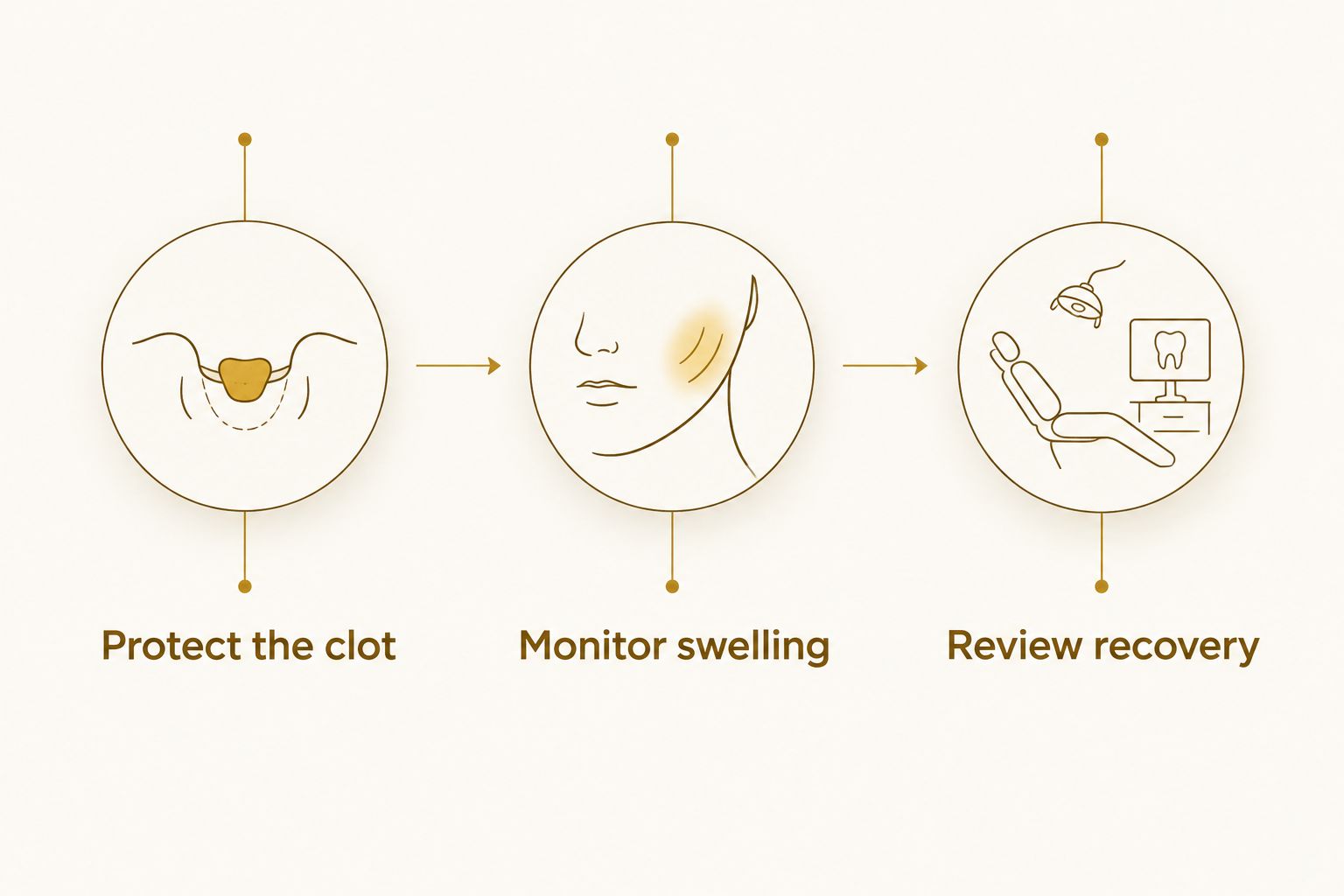
First 24 hours: protect the blood clot
The first 24 hours are about protecting the clot inside the extraction socket. That clot supports healing and covers the exposed tissue beneath it.
Follow the instructions you receive about biting on gauze. Avoid repeated spitting, vigorous rinsing, straws, smoking, and vaping during early recovery because disturbing the site can interfere with healing.
Wait until numbness has worn off before chewing, and avoid hot food or drinks while you cannot judge temperature normally. Choose soft foods that do not require much chewing, such as yogurt, scrambled eggs, or cooled soup without hard pieces.
Do not keep checking the socket with your tongue or finger. Repeatedly touching it does not tell you whether healing is on schedule and can irritate the wound. Rest with your head supported, and use any cold compress exactly as your surgical team directs.
Lightly blood-stained saliva can occur early on. Active bleeding that does not settle with the pressure technique your clinician recommended needs prompt advice.
Days 2–3: swelling can peak before it improves
Swelling commonly peaks around days 2–3 after oral surgery. Your cheek can look fuller, and opening your mouth can feel uncomfortable even when recovery is progressing normally.
Watch the direction of change rather than judging a single moment. Swelling that starts settling is different from swelling that continues to increase alongside fever, worsening pain, or difficulty swallowing.
After the first 24 hours, clinicians commonly recommend gentle saltwater rinses. Follow your own instructions for when to begin, how to prepare the rinse, and how often to use it; do not swish forcefully.
Keep cleaning your other teeth carefully. Avoid brushing directly into the socket, but do not abandon oral hygiene altogether. If stitches are present, ask whether they dissolve or require removal rather than pulling at a loose end yourself.
Around 2 weeks: assess comfort, not just the date
Around 2 weeks is a useful recovery checkpoint, not proof that the socket has fully closed. Surface comfort and deeper bone healing follow different timelines.
You should generally be moving toward easier eating, less swelling, and improved jaw movement. Persistent discomfort deserves a call if it is not improving, especially if you still cannot manage ordinary daily activities.
For a 2026 work or school schedule, build in flexibility if your extraction involves impacted teeth or physically demanding responsibilities. Do not schedule a strenuous event simply because it falls outside the first few days.
Your clinician can assess whether your progress fits the procedure you had. A calendar cannot show whether food is trapped, a socket is inflamed, or another problem needs treatment.
Why wisdom tooth removal recovery time varies
The same recovery estimate does not fit every extraction. These factors help explain why your instructions can differ from a friend’s:
- Tooth position: An erupted tooth is different from an impacted tooth trapped under gum or bone.
- Surgical complexity: Removing bone or dividing a tooth creates a different recovery experience from a straightforward extraction.
- Number of extraction sites: Multiple healing sites can make eating and cleaning more difficult.
- Smoking and vaping: Tobacco use and suction can interfere with healing and increase complication risk.
- Health and medicines: Conditions affecting healing, and medicines affecting bleeding or immunity, need individual planning.
- Aftercare: Protecting the clot, maintaining gentle hygiene, and following activity instructions support recovery.
Tell your surgical team about prescription medicines, supplements, and medical conditions before treatment. Do not stop a prescribed blood thinner or change a regular medicine on your own. The clinician managing that medicine needs to be involved when adjustments are necessary.
When can I go back to work or school?
About 2 weeks describes the broader recovery period, not an automatic requirement to miss that much work or school. NHS guidance says normal activities can often resume the next day, while more difficult removals or general anesthesia can require 1–3 days away from work.
Your job matters. Desk work is different from lifting, repeated bending, outdoor labor, or speaking throughout the day. Ask for restrictions that match your actual responsibilities, and return gradually if symptoms increase with activity.
For students in La Jolla and nearby San Diego neighborhoods, plan around classes, presentations, and sports separately. Being comfortable enough to attend a lecture does not mean you are ready for athletic training.
When can I exercise after wisdom tooth removal?
The first 24 hours should focus on rest, and NHS guidance advises avoiding strenuous activity for a few days after removal. Your surgeon should set the return-to-exercise plan when your extraction is more involved.
Heavy lifting and intense workouts can provoke bleeding or throbbing during early healing. Resume gradually rather than testing your recovery with your usual hardest session.
If activity brings on fresh bleeding or increased pain, stop and contact the surgical team for advice. Do not use pain medicine to push through symptoms that are telling you to slow down.
Does sedation change how long recovery takes?
About 2 weeks remains a general guide to tissue recovery; sedation adds separate restrictions related to alertness and coordination. Feeling awake after sedation does not establish that you are safe to drive or make important decisions.
Before your appointment, ask whether you need an escort, supervision afterward, or restrictions on driving and work. The answer depends on the anesthesia and medicines actually used.
Our guide to wisdom tooth removal sedation options explains the choices to discuss with your clinician. Do not choose an anesthesia approach solely because you expect it to shorten socket healing.
What should you eat and take for discomfort?
Start with soft, easy-to-chew food and move toward your normal diet as comfort allows. Chew away from the extraction site when practical, and avoid sharp or crunchy pieces that can irritate healing tissue.
Drink fluids regularly without using a straw during the restricted period. If nausea, pain, or difficulty opening your mouth prevents you from drinking, contact the surgical team rather than waiting for dehydration to worsen.
Use pain medicine only as directed. Check whether a prescription already contains acetaminophen before adding another product with the same ingredient, and ask about interactions with your regular medicines.
Antibiotics are not a substitute for an examination when symptoms worsen. Take them only when prescribed, and contact the prescriber about side effects or questions about the course.
Which symptoms mean you should call the dentist?
Pain that becomes worse after initially improving needs a dental review. Dry socket occurs when the protective clot is lost or fails to form properly, exposing the underlying socket; severe pain can spread toward the ear or temple.
Contact your extraction clinician promptly for:
- Increasing pain that prescribed care does not control.
- Fever, pus, or swelling that is worsening rather than settling.
- Bleeding that continues despite the instructed pressure technique.
- New or persistent numbness that needs assessment.
- Difficulty drinking or keeping fluids down.
Trouble breathing, rapidly spreading swelling, or difficulty swallowing requires emergency medical attention. Do not wait for a routine dental appointment when breathing or swallowing is affected.
Harmony Dental Group offers emergency dental care, but the team that performed your extraction should usually be your first contact for postoperative concerns. Keep that team’s daytime and after-hours instructions accessible before you go home.
FAQ
What is the usual wisdom tooth removal recovery time?
Wisdom tooth removal recovery time is usually about 2 weeks, although everyday activities often resume sooner. Difficult extractions and complications can require a longer recovery, so follow your surgical team’s instructions.
Can I go back to work the day after wisdom tooth removal?
You can often resume normal activities the next day after a straightforward removal, according to NHS guidance. A difficult extraction or general anesthesia can require 1–3 days away from work, and physical jobs need separate advice.
Is swelling worse on the third day after wisdom tooth removal?
Swelling commonly peaks around days 2–3 after oral surgery. Swelling that keeps increasing, particularly with fever or worsening pain, needs a call to your surgical team.
When can I rinse my mouth after wisdom tooth removal?
Gentle rinsing commonly begins after the first 24 hours, following your clinician’s instructions. Avoid vigorous swishing or forceful spitting that could disturb the clot.
How do I know whether I have dry socket?
Severe pain that develops or worsens after extraction, particularly after initial improvement, needs a dental examination for dry socket or another complication. Pain can spread toward the ear or temple, but symptoms alone do not confirm the diagnosis.
Can I drive home after wisdom tooth removal?
Do not drive home if your anesthesia or medicines make driving unsafe. Confirm transportation and supervision requirements with the treating team before the appointment rather than judging safety by how awake you feel.
Does a healed-looking gum mean the socket is completely healed?
No, comfortable or closed-looking gum does not mean the deeper socket has finished healing. Keep following cleaning and activity instructions even after early soreness settles.
One last thing
The trend in your symptoms matters more than reaching a particular day. A sore jaw that steadily improves tells a different story from pain that settles and then suddenly returns.
Before your 2026 appointment, write down whom to call, what medicines to take, and which symptoms need urgent attention. Harmony Dental Group patients should also tell the treating clinician about upcoming travel, work demands, or other dental treatment so the recovery plan fits their needs.