
Best starting point for mild anxiety: nitrous oxide with local anesthesia. Best for low-anxiety patients: local anesthesia alone. Best for stronger, adjustable sedation: clinician-selected IV sedation. This 2026 guide compares wisdom tooth removal sedation options so you can discuss comfort, medical safety, and recovery—not simply choose the deepest sedation.
- Wisdom tooth removal sedation options depend on anxiety, medical history, and surgical complexity—not preference alone.
- Nitrous oxide suits mild anxiety; local anesthesia still provides pain control.
- Oral sedation avoids an IV for sedative delivery but is less adjustable once swallowed.
- IV sedation and general anesthesia require different levels of monitoring and recovery planning.
- Harmony Dental Group is a starting point for La Jolla patients discussing wisdom tooth concerns.
Why this matters
Sedation helps manage anxiety and awareness; local anesthesia numbs the surgical area. These are different jobs. You can remain awake during removal and still have effective pain control, although you can feel pressure or movement.
Choosing more sedation does not automatically make treatment safer or more appropriate. Your clinician needs to assess the tooth position, planned surgery, medications, breathing risks, and previous anesthesia experiences before recommending an approach.
For La Jolla and nearby San Diego patients, Harmony Dental Group is a starting point for discussing wisdom tooth concerns. Ask which treatment setting and anesthesia approach your situation requires, including whether an oral surgeon should evaluate you. Use this 2026 comparison to prepare questions, not to select medication yourself.
What makes the best wisdom tooth removal sedation option?
Use these criteria before comparing options:
- Pain control: Confirm how the surgical area will be numbed, regardless of the sedation method.
- Anxiety fit: Describe what worries you: injections, sounds, awareness, gagging, or previous experiences.
- Medical suitability: Discuss sleep apnea, pregnancy, heart or lung conditions, medications, and substance use.
- Adjustability: Ask whether the clinician can change the sedation level during treatment.
- Monitoring: Confirm who administers anesthesia, who monitors you, and how emergencies are managed.
- Recovery needs: Understand fasting, escort, driving, and supervision instructions before scheduling.
For a 2026 consultation, the best option is the least intensive approach that safely supports your treatment and comfort. That decision belongs to you and the treating clinician together.
Wisdom tooth removal sedation options at a glance
The order below starts with approaches for lower anxiety and progresses to options requiring more assessment and recovery planning. Local anesthesia is included because some patients need numbing without sedation.
| Option | Best for | Standout feature | Key limitation |
|---|---|---|---|
| Nitrous oxide with local anesthesia | Mild anxiety while remaining responsive | Inhaled sedation can be adjusted during treatment | Not sufficient for every anxiety level or procedure |
| Local anesthesia alone | Low anxiety and willingness to remain fully awake | Numbs the treatment area without sedating you | Does not reduce awareness or anxiety itself |
| Oral sedation with local anesthesia | Patients seeking sedation without IV delivery | Sedative medication is taken by mouth | Less adjustable after the medication is swallowed |
| IV sedation with local anesthesia | Stronger anxiety or procedures needing adjustable sedation | Medication can be adjusted through intravenous delivery | Requires IV access, monitoring, and recovery arrangements |
| General anesthesia | Selected cases requiring unconsciousness | You are unconscious during the procedure | Requires advanced airway management and anesthesia support |
1. Nitrous oxide: best for mild anxiety
Nitrous oxide is an inhaled sedative delivered with oxygen through a nasal mask. It helps you relax while remaining responsive; local anesthesia is still used to numb the surgical area.
Its effects generally wear off quickly after administration stops. That does not automatically mean you can drive: other medications, how you feel, and the clinician's discharge instructions determine your next steps.
Nitrous oxide pros:
- The clinician can adjust administration during treatment.
- You can usually communicate while receiving it.
- It avoids an IV for sedative delivery.
- Its sedative effects resolve faster than many oral sedatives.
Nitrous oxide cons:
- You need to breathe effectively through your nose.
- It does not guarantee freedom from anxiety or procedural memories.
- Nausea can occur, and medical screening still matters.
Best for: Patients with mild anxiety who want help relaxing without losing awareness.
Ask whether nitrous oxide alone provides enough anxiety control for your planned extraction. Severe fear or difficulty tolerating treatment requires a separate discussion.
Verdict: Hold until your clinician confirms that inhaled sedation fits your anxiety, breathing, and procedure.
2. Local anesthesia alone: best for patients comfortable staying awake
Local anesthesia blocks pain signals in the treatment area. It is not sedation: you remain awake and aware of the appointment.
You can feel pushing, vibration, or pressure during removal, but sharp pain should prompt you to alert the clinician. Agree on a stop signal before treatment begins so you can communicate without trying to speak during surgery.
Local anesthesia pros:
- It directly addresses pain at the extraction site.
- You remain able to communicate throughout treatment.
- It avoids sedative-related drowsiness.
- It does not create the same sedation-specific recovery requirements.
Local anesthesia cons:
- It does not treat anxiety by itself.
- You remain aware of sounds and movement.
- Local anesthetic injections can be uncomfortable.
Best for: Patients with low anxiety who can tolerate an awake procedure and whose clinician considers this approach appropriate.
Surgical complexity alone does not determine whether you must be unconscious. Ask the treating dentist or oral surgeon how the expected procedure affects your options.
Verdict: Hold until the clinician confirms that numbing alone will support your comfort and treatment.
3. Oral sedation: best for avoiding IV sedative delivery
Oral sedation uses prescribed medication taken by mouth before treatment. Depending on the medication, dose, and individual response, it can produce relaxation or more substantial drowsiness.
Avoiding an IV does not mean avoiding all needles: local anesthetic injections are still commonly needed. You must also follow the prescribing clinician's instructions rather than take leftover medication or adjust a dose yourself.
Oral sedation pros:
- Sedative delivery does not require IV placement.
- It can reduce anxiety before the procedure begins.
- It can help patients who find the anticipation especially difficult.
Oral sedation cons:
- The effect cannot be adjusted as directly as an IV medication once swallowed.
- Responses vary between patients.
- Drowsiness and impairment can continue after treatment.
Best for: Patients seeking medication-based anxiety relief without IV delivery, when medically appropriate.
Arrange an escort and follow the practice's supervision instructions. Alcohol, opioids, sleep medications, and other sedatives can interact with oral sedation; disclose everything you take.
Verdict: Hold until the prescribing clinician provides a medication, escort, and recovery plan.
4. IV sedation: best for adjustable sedation during treatment
IV sedation delivers medication through a vein, allowing the clinician to adjust its administration during the procedure. The route does not identify the depth by itself: intravenous medication can be used for different sedation levels.
For moderate sedation, you remain capable of purposeful responses to verbal instructions or light touch. Memory of the procedure varies, so do not treat phrases such as sleep dentistry as a promise that you will be unconscious or remember nothing.
IV sedation pros:
- Medication administration can be adjusted during treatment.
- It can address substantial anxiety in appropriately selected patients.
- IV access allows the team to administer medication directly.
IV sedation cons:
- It requires placement of an IV.
- Breathing and circulation need appropriate monitoring.
- Fasting, escort, and activity restrictions require advance planning.
Best for: Patients whose anxiety or treatment needs justify adjustable sedation after clinical assessment.
Ask the exact intended depth, who provides it, and how the team responds if sedation becomes deeper than planned. These questions matter more than the label attached to the appointment.
Verdict: Hold until the provider confirms medical suitability and explains monitoring and discharge arrangements.
5. General anesthesia: best for selected cases requiring unconsciousness
General anesthesia makes you unconscious and unable to respond even to painful stimulation. It requires a team and setting equipped to manage breathing, circulation, and recovery.
Some patients need this approach because of clinical, behavioral, or procedural factors. It is not the routine first choice simply because a wisdom tooth is impacted or you prefer not to remember treatment.
General anesthesia pros:
- You are unconscious during the procedure.
- It can allow treatment when lesser approaches are unsuitable.
- Anesthesia care includes management of the patient's unconscious state.
General anesthesia cons:
- Breathing often requires assistance.
- It involves more extensive anesthesia and recovery arrangements.
- It carries risks that require individualized assessment.
Best for: Selected patients for whom the treating team determines that unconsciousness is necessary or appropriate.
Ask why general anesthesia is recommended instead of moderate or deep sedation, and where treatment will take place. A clear explanation should connect the recommendation to your actual needs.
Verdict: Skip as a routine default; consider it only when the treating team identifies a clinical reason.
Sedation route and sedation depth are different
An oral tablet, nasal mask, or IV describes how medication enters your body. Sedation depth describes how you respond and whether breathing support is needed.
The American Society of Anesthesiologists describes a continuum:
- Minimal sedation: You respond normally to verbal commands, although coordination or judgment can be affected.
- Moderate sedation: You respond purposefully to verbal commands or light touch.
- Deep sedation: You respond purposefully only after repeated or painful stimulation; breathing assistance can be needed.
- General anesthesia: You cannot be awakened, and breathing often requires assistance.
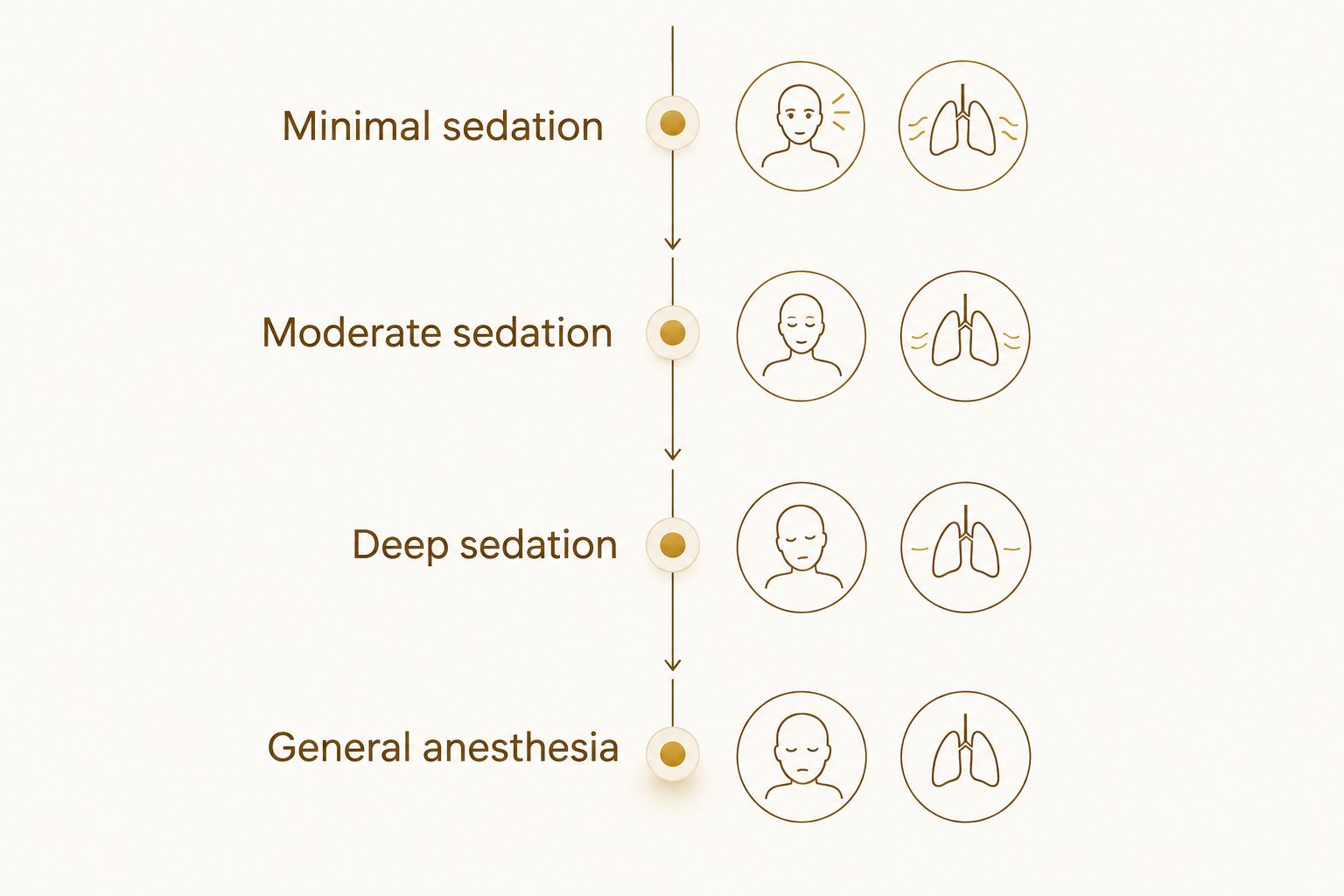
Do not assume IV sedation means general anesthesia. Ask the provider to name the planned depth and explain the monitoring that goes with it.
What to discuss before your consultation
Bring your medication list and describe your concerns plainly. In 2026, the useful question is not “Which option is strongest?” but “Which approach fits my health, anxiety, and planned surgery?”
Harmony Dental Group patients can use this checklist to organize the discussion with the treating clinician:
- Medical history: Mention sleep apnea, breathing conditions, pregnancy, allergies, and previous anesthesia problems.
- Medication history: Include prescriptions, supplements, nonprescription medicines, alcohol, and cannabis use.
- Anxiety triggers: Explain whether you fear pain, injections, gagging, sounds, or awareness.
- Treatment details: Ask whether the teeth are impacted and whether an oral surgeon's evaluation is needed.
- Safety responsibilities: Ask who administers sedation, who monitors you, and what emergency preparation is in place.
- Recovery logistics: Confirm your escort, supervision, driving restrictions, and return-to-work instructions.
Do not stop prescribed medication on your own. The dental and medical teams should tell you whether any changes are necessary.
Discuss your wisdom tooth concerns
Start with your symptoms, anxiety concerns, and questions about the right treatment setting.
Fasting and recovery: follow your written instructions
Fasting requirements depend on the planned anesthesia and your health. For healthy patients undergoing elective procedures, American Society of Anesthesiologists guidance commonly uses minimum fasting intervals of 2 hours for clear liquids, 6 hours for a light meal, and 8 hours or longer for fried or fatty foods or meat.
These are reference intervals, not permission to eat or drink before your appointment. Your treating team must give you instructions for your situation; conditions such as delayed stomach emptying require individualized planning. Milk is not a clear liquid.
If you eat or drink outside the instructions, tell the team before medication is given. Concealing it creates an avoidable aspiration risk—the risk of stomach contents entering the lungs.
After sedating medication, follow the discharge plan for driving, supervision, alcohol, and other medicines. Do not decide you are ready to drive simply because you feel awake.
How these options are ranked
This comparison prioritizes medical suitability, anxiety relief, adjustability, monitoring, and recovery burden. It does not rank providers or claim that one sedation technique produces better extraction results for everyone.
Nitrous oxide leads for mild anxiety because it offers adjustable relaxation while maintaining responsiveness. Local anesthesia alone remains a valid choice for comfortable, appropriately assessed patients. Oral sedation, IV sedation, and general anesthesia require progressively different planning—not an assumption that stronger is better.
Which option should you choose?
Start by asking whether local anesthesia alone or local anesthesia with nitrous oxide meets your needs. If anxiety or treatment factors make those unsuitable, discuss oral or IV sedation; reserve general anesthesia for a recommendation supported by your clinical assessment.
Harmony Dental Group is a starting point for La Jolla patients discussing wisdom tooth concerns and the appropriate treatment setting. For your 2026 appointment, request an explanation covering pain control, intended awareness, monitoring, and recovery. That is more useful than choosing from a menu of sedation names.
FAQ
What's the best sedation for wisdom tooth removal?
The best sedation depends on your anxiety, medical history, and planned surgery. Nitrous oxide with local anesthesia is a useful starting point for mild anxiety, while oral or IV sedation requires an individualized assessment.
Can I have my wisdom teeth removed without being asleep?
Yes, wisdom teeth can be removed while you are awake using local anesthesia when the clinician considers that appropriate. Local anesthesia numbs the treatment area, but you can still notice pressure, movement, and sounds.
Is IV sedation the same as general anesthesia?
No, IV sedation and general anesthesia are not the same. IV describes medication delivery; general anesthesia describes an unconscious state in which you cannot be awakened and breathing often requires assistance.
Will I feel pain during wisdom tooth removal with sedation?
Local anesthesia provides pain control at the extraction site; sedation primarily changes anxiety and awareness. Tell the clinician if you feel sharp pain so the team can assess the numbing before continuing.
Can I drive home after wisdom tooth sedation?
Do not drive after oral or IV sedation; follow the provider's escort and discharge instructions. Driving after nitrous oxide depends on recovery, other medications, and the clinician's assessment, not simply on how awake you feel.
Do I need to fast before wisdom tooth sedation?
Fasting depends on the planned sedation or anesthesia and your medical situation. Follow the treating team's written instructions exactly, and tell them if you have eaten or drunk outside those instructions.
Is wisdom tooth sedation safe if I have sleep apnea?
Sleep apnea requires specific assessment before sedation because sedating medications can affect breathing. Tell the provider about your diagnosis, treatment, and any prescribed breathing device before an anesthesia plan is selected.
How do I ask Harmony Dental Group about wisdom tooth sedation?
Start by explaining your wisdom tooth symptoms, anxiety triggers, medications, and previous anesthesia experiences. Ask which treatment setting is appropriate and which anesthesia options the treating provider recommends for your case.
One last thing
The word asleep is not a precise anesthesia plan. Before a 2026 wisdom tooth appointment, ask: “Will I respond to you, who will monitor my breathing, and what do I need arranged afterward?” Clear answers give you a more useful picture of the experience than promises that you will remember nothing.