Dentist-guided peroxide teeth whitening generally does not remove enamel when used as directed on healthy teeth. Temporary sensitivity and gum irritation can still occur, and whitening over untreated decay, exposed roots, or damaged teeth needs a different approach.
- Does teeth whitening damage enamel? Properly used peroxide whitening generally does not remove healthy enamel.
- Temporary tooth sensitivity is not the same as enamel erosion, but persistent pain needs an examination.
- Avoid lemon juice and abrasive scrubbing; whitening should not depend on wearing away tooth surfaces.
- Harmony Dental Group offers cosmetic dentistry consultations for La Jolla patients considering changes to their smile.
Does teeth whitening damage tooth enamel?
Properly used peroxide whitening generally does not remove healthy enamel; acidic or abrasive whitening methods present different risks. The method, your dental health, and how you use the product all matter.
| Whitening approach | Best for | Main benefit | Main limitation or risk |
|---|---|---|---|
| Dentist-supervised peroxide whitening | Patients needing an individualized plan | Professional assessment and treatment guidance | Sensitivity and gum irritation remain possible |
| Over-the-counter peroxide strips | Suitable adults following labeled directions | At-home bleaching of natural teeth | Uneven contact, misuse, and sensitivity |
| Whitening toothpaste | People targeting surface stains | Removes some external staining during brushing | Does not bleach deeper tooth color; abrasive use can contribute to wear |
| Acidic home remedies | Not recommended | No reason to choose acid exposure for whitening | Acid can erode enamel |
For patients considering cosmetic dentistry in La Jolla, Harmony Dental Group offers a local place to discuss smile goals and existing dental concerns.
Why this matters
Tooth sensitivity, enamel erosion, and gum irritation are different problems. Treating them as interchangeable makes it harder to decide whether you need to pause whitening, change your routine, or arrange an examination.
Peroxide bleaching changes colored compounds within teeth rather than sanding away the outer layer. Enamel erosion is actual loss of tooth structure through acid exposure. Both deserve attention, but a brief cold sensation after whitening does not establish that enamel has disappeared.
If you are planning whitening in 2026, start with the condition of your teeth rather than the promised shade change. Whitening cannot repair a cavity, cover an exposed root, or correct a cracked tooth.
Dentist-supervised whitening: best for an individualized plan
Dentist-supervised whitening is best for patients who need help assessing sensitivity, existing restorations, or uneven discoloration. An examination helps determine whether bleaching is appropriate before you expose teeth and gums to a whitening agent.
The advantage is guidance, not a guarantee of zero discomfort. Professional treatment still involves peroxide, and temporary sensitivity or irritation remains possible. Your dentist can explain the selected method, protection for soft tissues, and what to do if symptoms develop.
Choose an assessment before whitening if you already have pain, recession, or visibly damaged teeth. Do not assume a stronger whitening product solves a stain that has not been diagnosed.
Over-the-counter strips: best for suitable, healthy teeth
Peroxide strips are best for adults whose teeth and gums are healthy and who can follow the product directions precisely. They bleach natural tooth structure, but their fit and contact differ from a treatment planned around your mouth.
The benefit is a straightforward home routine. The limitation is that the packaging cannot diagnose decay, identify the cause of a dark tooth, or account for every filling and crown in your smile.
Choosing a whitening method in 2026 should include reading the actual instructions, not copying a social media routine. Never extend wear time, add extra applications, or combine products because the first result seems subtle. More exposure is not a substitute for knowing why a tooth looks dark.
For a closer look at the choices, see the teeth whitening options comparison.
Whitening toothpaste: best for surface stains
Whitening toothpaste is best for removing some external stains, not for reproducing every effect of peroxide bleaching. Toothpaste formulas differ: some primarily clean or polish, while others include additional stain-removing ingredients.
The benefit is that stain control fits into regular brushing. The limitation is that scrubbing harder does not make toothpaste a better bleaching treatment. Aggressive brushing and abrasive products are a poor combination when you have exposed roots or existing wear.
Use a soft-bristled toothbrush and gentle pressure. If your teeth look yellower because enamel is thin or roots are exposed, stronger scrubbing does not address the cause and can make the underlying problem worse.
Why whitening risks vary
The safety question is not simply whether whitening is professional or purchased at a store. These factors change the decision:
- Existing dental disease: Cavities, cracks, and inflamed gums need assessment before cosmetic bleaching. Whitening is not treatment for these conditions.
- Exposed roots: Receding gums uncover surfaces that are not protected by enamel in the same way as the tooth crown. Those areas can be sensitive.
- Product formulation: Peroxide bleaching, abrasive stain removal, and acidic home remedies work differently. Do not treat them as equivalent.
- Exposure and frequency: Leaving a product on longer or repeating applications beyond its directions increases exposure without establishing safety.
- Contact with gums: Whitening agents can irritate soft tissue. Poorly positioned strips or overflowing trays can increase unwanted contact.
- Existing restorations: Crowns, veneers, and tooth-colored fillings do not bleach like natural teeth. Whitening can leave a visible color mismatch.
Your starting shade also affects expectations. A tooth that is darker because of an injury needs a diagnosis, not repeated applications of a product intended for general staining.
How do you whiten teeth without taking unnecessary risks?
Before starting whitening in 2026, use a plan that puts dental health ahead of speed. These steps help you decide what to discuss at a consultation and what to avoid at home.
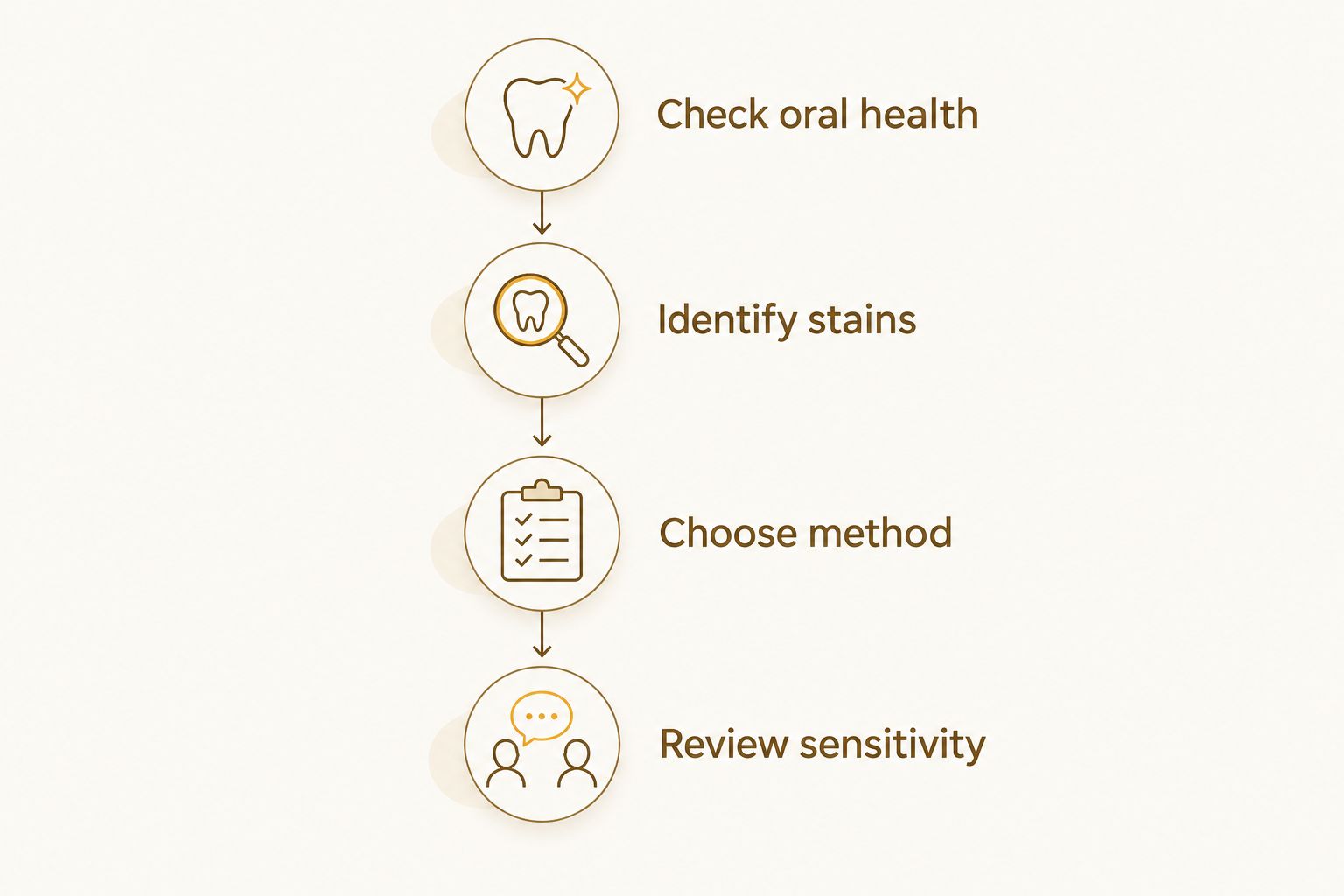
- Check oral health. Tell your dentist about cold sensitivity, pain when biting, bleeding gums, recession, and any broken fillings. An examination can identify problems that should be treated before whitening. Mention previous reactions to whitening products, even if you stopped using them long ago.
- Identify stains. Ask whether the discoloration is on the surface, within natural tooth structure, or associated with a restoration. These are different situations. Whitening will not make a porcelain crown respond like a natural tooth, and a darkened tooth should not automatically be treated as ordinary staining.
- Choose method. Review the product, directions, and reasons it suits your dental condition. Ask what areas it will change and what it will leave unchanged. If you use an over-the-counter product, keep its packaging so you can show your dentist exactly what you applied.
- Review sensitivity. Agree on when to pause treatment and when to call. Do not push through sharp pain, burning gums, or worsening symptoms to finish a course. A comfortable plan is more useful than a deadline that encourages you to ignore warning signs.
Bring a list of your current dental products to the consultation. Whitening strips, stain-removing toothpaste, rinses, and home remedies all belong on that list; evaluating them together is more useful than discussing each in isolation.
Is sensitivity after whitening a sign of enamel damage?
Sensitivity after whitening is not, by itself, proof of enamel damage. Peroxide can cause temporary sensitivity without the treatment physically removing enamel.
Pause whitening if your teeth become uncomfortable and follow the product instructions or your dentist's advice. Persistent, worsening, or sharply localized pain needs an examination rather than an assumption that whitening explains everything.
Can whitening make thin enamel or exposed roots look better?
Whitening does not rebuild thin enamel or cover exposed roots. Those conditions need an assessment because the visible color and sensitivity can have causes that bleaching does not correct.
Avoid trying to scrub away a yellow area near the gumline. Ask whether you are seeing natural tooth color, an exposed root, surface staining, or another change before choosing treatment.
Should I whiten before getting veneers or crowns?
Whitening is worth discussing before the final shade of a visible veneer or crown is selected. Natural teeth can change color with bleaching, while restorations do not respond in the same way.
If you are planning cosmetic dental work in 2026, ask your dentist to coordinate the sequence and shade decisions. Do not schedule repeated whitening sessions around a restoration without discussing the overall plan.
When should you stop whitening and call a dentist?
Stop whitening when pain or tissue irritation develops; do not treat discomfort as evidence that the product is working. Remove the product and follow its safety instructions.
Contact a dentist for pain focused in a particular tooth, discomfort when biting, persistent symptoms, or irritated gums that are not settling. These symptoms need assessment because whitening does not rule out another dental problem.
Facial swelling, fever with dental symptoms, or difficulty swallowing needs prompt attention. Difficulty breathing is an emergency. Do not delay care while trying a different whitening product or waiting for a cosmetic appointment.
What should you ask at a cosmetic dentistry consultation?
Harmony Dental Group is best suited to La Jolla patients seeking a local cosmetic dentistry consultation. The useful next step is to discuss whether a color change alone addresses your concerns or whether tooth shape, wear, or existing dental work also matters.
Ask your dentist:
- What is causing the discoloration, and will bleaching address it?
- Do any cavities, cracks, exposed roots, or gum problems need treatment first?
- Which visible fillings, crowns, or veneers will stay the same color?
- What should I do if sensitivity starts?
- How will whitening fit with other cosmetic treatment I am considering?
A consultation helps you avoid choosing treatment for the wrong problem. Its limitation is equally important: an examination informs a plan, but it does not promise a particular shade or guarantee that sensitivity will not occur.
FAQ
Does teeth whitening damage enamel permanently?
Properly used peroxide whitening generally does not remove healthy enamel. Acidic home remedies, abrasive scrubbing, and misuse present different risks, so the product and your dental condition matter.
Can I whiten my teeth if I already have sensitive teeth?
Existing sensitivity should be assessed before whitening. Exposed roots, decay, cracks, and other conditions can cause sensitivity, and the right response depends on the cause.
Is professional whitening completely free of side effects?
Professional whitening is not free of side effects. Temporary sensitivity and gum irritation can still occur, even when treatment is supervised.
Can I use lemon juice to whiten my teeth naturally?
Do not use lemon juice as a tooth-whitening treatment. Its acidity can erode enamel, and natural does not mean safe for tooth surfaces.
Will whitening change the color of my fillings or veneers?
Whitening does not change fillings or veneers the way it changes natural teeth. Discuss shade matching before bleaching if restorations are visible when you smile.
Can I keep whitening if only one tooth hurts?
Stop whitening and contact a dentist if pain is focused in one tooth. Localized pain needs assessment rather than an assumption that it is an expected whitening effect.
What should I bring to a whitening consultation?
Bring the names or packaging of whitening products you use, along with details of sensitivity and previous dental work. Tell your dentist which teeth concern you and what change you want to achieve.
One last thing
A whiter tooth is not necessarily a healthier tooth. For your 2026 smile plan, make health the first decision and shade the second.
For everyday care, American Dental Association patient guidance recommends brushing for 2 minutes, 2 times daily, with fluoride toothpaste and cleaning between teeth 1 time daily. Those habits support oral health; they do not make it safe to ignore whitening instructions or persistent pain.
At a Harmony Dental Group cosmetic dentistry consultation, explain what you want to change and what you want to protect. Your natural teeth, comfort, and existing dental work belong in the same conversation.