
Dental insurance covers dental implants only when your specific plan includes the relevant benefits; some plans cover part of treatment, while others exclude implants. Even with coverage in 2026, you can still owe for deductibles, benefit limits, excluded procedures, and charges outside the plan’s allowed amount.
- Does dental insurance cover dental implants? Some plans do, but coverage must be checked for each treatment component.
- Harmony Dental Group offers dental implant consultations for patients in La Jolla and nearby San Diego neighborhoods.
- Request a written pretreatment estimate; an insurance estimate is not a guarantee of payment.
- Check implant exclusions, annual maximums, waiting periods, and missing-tooth clauses before scheduling treatment.
Does dental insurance cover dental implants?
Some dental plans cover implants, but a general major-services benefit does not prove that implant treatment is covered. Your plan document and the proposed procedure codes determine which benefits apply. A benefit summary alone can leave out important restrictions.
Harmony Dental Group is a local option for La Jolla patients seeking a dental implant consultation. The clinical consultation addresses whether an implant fits your needs; insurance verification addresses what your plan contributes. Keep those decisions separate.
An implant restoration generally has three main components: the implant placed in the jaw, the connector called an abutment, and the replacement tooth called a crown. Your insurer can treat those components differently.
| Treatment component | What it does | What to ask your insurer |
|---|---|---|
| Implant placement | Places the supporting implant in the jaw | Is implant surgery covered or specifically excluded? |
| Abutment | Connects the implant to the replacement tooth | Is the connector covered separately, and under which benefit? |
| Implant-supported crown | Provides the visible replacement tooth | Does coverage include an implant-supported crown, not just a crown on a natural tooth? |
| Preparatory care | Addresses needs such as extraction or bone grafting | Which proposed procedures qualify independently? |
| Imaging and evaluation | Helps the dentist assess and plan treatment | Which examination and imaging services are eligible? |
Coverage for one row does not establish coverage for another. Ask for an itemized treatment plan rather than a single estimate labeled dental implant.
Why this matters before you book treatment
An insurance card tells you that you have a plan, not that the plan covers every recommended procedure. The distinction matters when treatment involves surgery, healing, and a later restoration.
For your 2026 treatment plan, match each proposed procedure to the current policy. Employer benefits, network participation, and plan rules can change at renewal, even when the insurance company’s name stays the same.
You do not need to understand every insurance term before a consultation. You do need a clear explanation of what treatment is recommended, which benefits have been checked, and which expenses remain your responsibility.
The safest starting point is a clinical plan followed by a written benefits estimate—not a promise based on your insurance card.
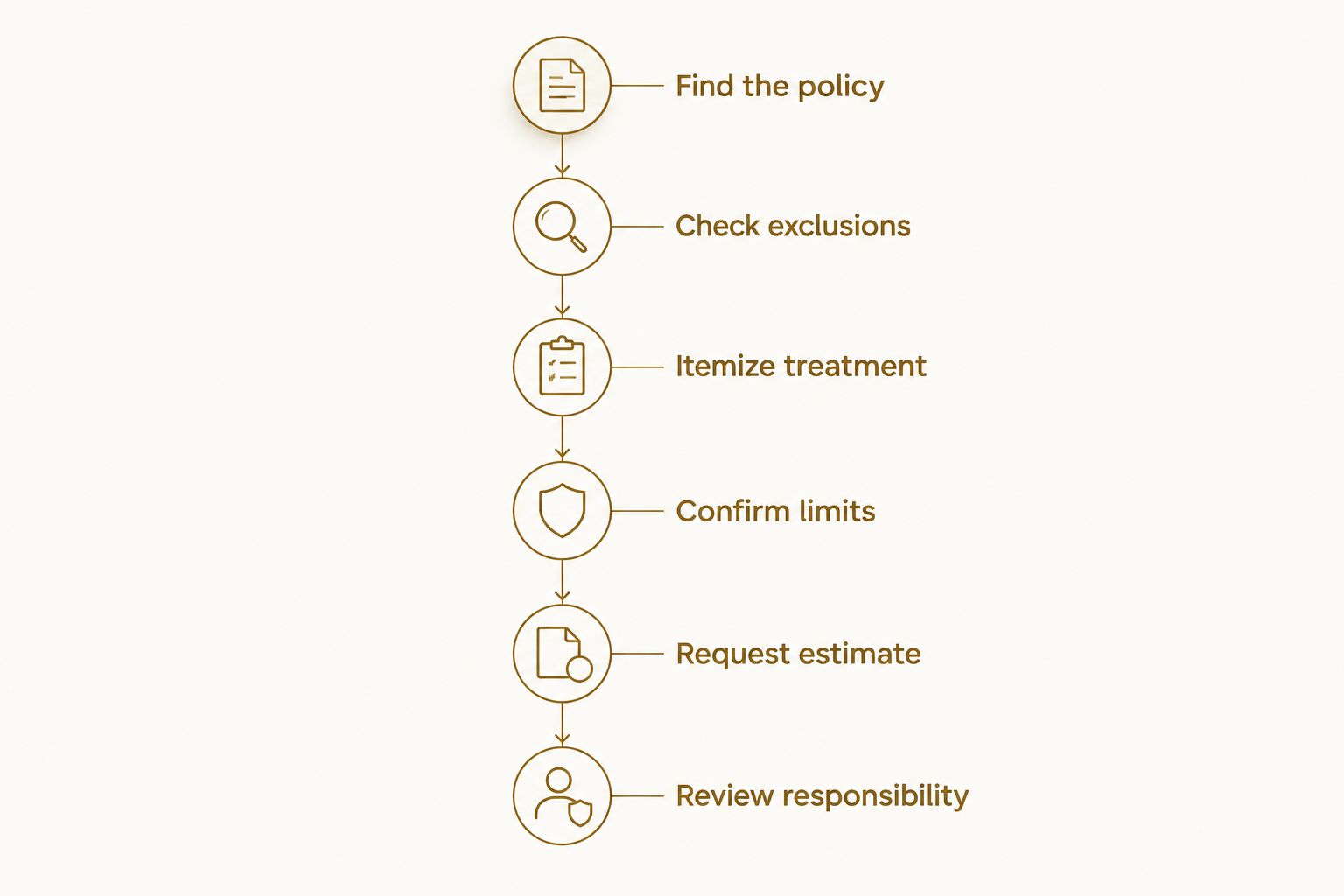
How to verify implant coverage in six steps
1. Find the exact policy
Get your plan name, member identification, group information, and current benefit document. If your coverage comes through work, ask the benefits administrator where to find the full policy rather than relying only on an enrollment summary.
Confirm that your coverage is active. Also check whether the plan follows the calendar year or a different benefit year; that affects when deductibles and benefit limits reset.
2. Ask specifically about implant exclusions
Ask whether the policy covers implant placement, abutments, and implant-supported crowns. Then ask whether any exclusion overrides the general benefit for major restorative treatment.
Do not stop at the question, Does my plan cover crowns? A crown on a natural tooth and a crown supported by an implant are different procedures, and the benefits need separate verification.
3. Get an itemized clinical treatment plan
Your dentist first needs to assess the missing tooth, gum health, remaining teeth, and supporting bone. Ask for the proposed procedures and their billing codes once the examination supports a treatment recommendation.
If your dentist identifies inadequate bone, read about dental implants with bone loss before discussing the next step. A preparatory procedure needs its own clinical explanation and benefits check; it is not automatically included in implant coverage.
4. Confirm network status and benefit limits
Ask the insurer whether the treating dentist participates in your exact plan. A practice accepting insurance paperwork is not the same as a dentist being in-network.
Request your remaining deductible, available annual benefit, and any separate implant limit. Ask whether other pending claims could change those figures before the implant claim is processed.
5. Request a written pretreatment estimate
Ask whether the insurer offers a pretreatment estimate, sometimes called a predetermination. Submit the proposed procedures and any supporting records the insurer requests.
A written estimate helps identify exclusions and expected benefits before treatment. It is not a payment guarantee: eligibility, remaining benefits, policy terms, and the final claim still matter.
6. Review your responsibility before scheduling
Compare the insurer’s response with the dentist’s itemized plan. Ask which services the estimate includes, which remain unreviewed, and what happens if the recommended treatment changes.
Keep the written response and a record of your conversations, including the date and any reference number. Before a later treatment stage, confirm that the estimate still reflects your coverage.
Why dental implant coverage varies
Your neighbor’s experience does not establish your benefits, even if you share an insurance company. These policy details explain why similar treatment plans receive different coverage decisions:
- Implant exclusions: A policy can exclude implants even when it covers other restorative services. Check the exclusion language directly.
- Deductibles and annual maximums: Covered treatment can still leave a balance after the plan applies its deductible or reaches its benefit limit.
- Waiting periods: Some plans require enrollment for a specified period before certain services qualify. Ask whether a waiting period applies to the proposed procedures.
- Missing-tooth clauses: Some policies restrict benefits for teeth missing before coverage began. Ask how the clause applies to your history.
- Network and allowed amounts: Benefits can depend on network participation and the amount the insurer recognizes for a procedure, not simply the dentist’s charge.
- Alternative-benefit provisions: Some policies calculate payment using another eligible treatment rather than the implant treatment you choose. Ask whether this affects your estimate.
For coverage decisions in 2026, request the policy wording behind an answer you do not understand. A clear explanation should identify the relevant benefit or exclusion, not just say the procedure is not covered.
What an implant benefit does—and does not—tell you
A covered implant benefit is useful because it can contribute toward eligible treatment. Its limitation is that covered does not mean fully paid, clinically appropriate, or approved regardless of the circumstances.
Ask the insurer to explain the difference between the amount billed, the allowed amount, the plan’s payment, and your responsibility. A coverage percentage without that context does not tell you what you owe.
Likewise, a benefits denial is not a clinical judgment that you should avoid implants. It explains the insurer’s payment position. Your dentist should explain the treatment’s expected benefits, limitations, risks, and alternatives independently.
Harmony Dental Group provides dental implant care, but a consultation does not establish insurance eligibility. Your individual examination and your policy answer different questions, and both belong in your decision.
Does coverage for a crown mean the implant is covered?
Crown coverage does not establish implant coverage. Ask separately about the implant-supported crown, the abutment, and implant placement, using the proposed procedure codes.
If the insurer confirms only the crown, request a written explanation of the remaining components. Do not interpret a partial approval as approval of the entire treatment plan.
Will insurance cover bone grafting before an implant?
Bone grafting requires its own coverage check. The answer depends on your policy, the proposed procedure, and the reason it is needed.
Ask whether the benefit changes when grafting supports an implant that the policy excludes. Your dentist can explain the clinical purpose; the insurer must explain the applicable benefit rules.
Can treatment cross into another benefit year?
Implant treatment can involve separate stages across benefit years, but that does not guarantee additional payment. Coverage depends on the policy and how the insurer applies benefits to each procedure.
If planning begins in 2026 and later care falls into a subsequent benefit year, ask about renewal changes and claim timing. Do not delay necessary care solely to pursue a possible insurance advantage without discussing the clinical consequences.
What to do if your plan excludes dental implants
First, separate a true policy exclusion from an incomplete or incorrectly processed claim. Ask for the written explanation and compare it with the benefit document and treatment codes.
If the insurer requests additional records, ask what is missing. If you believe a denial conflicts with your policy, follow the appeal instructions and deadlines in the insurer’s notice. An appeal is a review process, not a promise that the decision will change.
If the exclusion is clear, ask your dentist to distinguish necessary care from optional choices within the proposed plan. You can discuss clinically suitable alternatives, treatment sequencing, and payment arrangements without assuming that another approach is right for your mouth.
Keep financing separate from insurance. Financing spreads a payment obligation under its own terms; it does not create an insurance benefit or reduce the amount owed by itself. Review the agreement before committing.
What should you bring to an implant consultation?
Bring your insurance information, current medication list, relevant medical history, and any dental records you already have. Tell the dentist what bothers you most: chewing, appearance, discomfort, or concern about a missing tooth.
A useful consultation answers whether you are a candidate, what additional evaluation is needed, and what the recommended treatment includes. Implant treatment involves surgery and ongoing maintenance, so ask about those responsibilities as well as the expected improvement in function.
For patients considering Harmony Dental Group dental implant care, the next step is an individualized evaluation—not choosing treatment from an insurance summary. You can ask questions without treating the appointment as a commitment to proceed.
Discuss Your Implant Treatment Options
Ask about implant suitability and the information needed to check your dental benefits.
FAQ
Does dental insurance cover dental implants in 2026?
Some dental insurance plans cover part of dental implant treatment in 2026, while others exclude it. Check implant placement, the abutment, and the implant-supported crown separately under your current policy.
Will dental insurance pay for the whole implant treatment?
Dental insurance does not necessarily pay for the whole implant treatment, even when implants are covered. Deductibles, annual maximums, exclusions, and allowed amounts can leave you responsible for part of the bill.
Can I get implant coverage if my tooth was already missing?
Coverage for a tooth that was already missing depends on your policy. Ask whether a missing-tooth clause applies and request the relevant wording before scheduling treatment.
Is a pretreatment estimate a guarantee that insurance will pay?
A pretreatment estimate is not a guarantee of payment. Final benefits depend on policy terms, eligibility, remaining benefits, and the claim submitted after treatment.
Does being in-network mean my dental implant is covered?
Being in-network does not mean your dental implant is covered. Network status and procedure eligibility are separate checks, and both affect your expected responsibility.
Will medical insurance cover a dental implant?
Medical insurance is not automatic coverage for a dental implant. Ask the medical insurer whether your circumstances qualify under a specific benefit and what documentation or authorization it requires.
Should I book a consultation if I am unsure about coverage?
A consultation can establish what treatment is clinically appropriate before you request a detailed insurance estimate. Ask about the consultation’s own charges and benefits before booking, and bring your policy information.
One last thing
Ask which document supports the coverage answer. A verbal yes is less useful than a written explanation tied to your actual procedures and policy.
Keep your 2026 benefits document, itemized treatment plan, and pretreatment response together. When you review them side by side, you can see whether an answer concerns the entire implant treatment or only one component. That distinction is more useful than a broad promise that insurance covers implants.