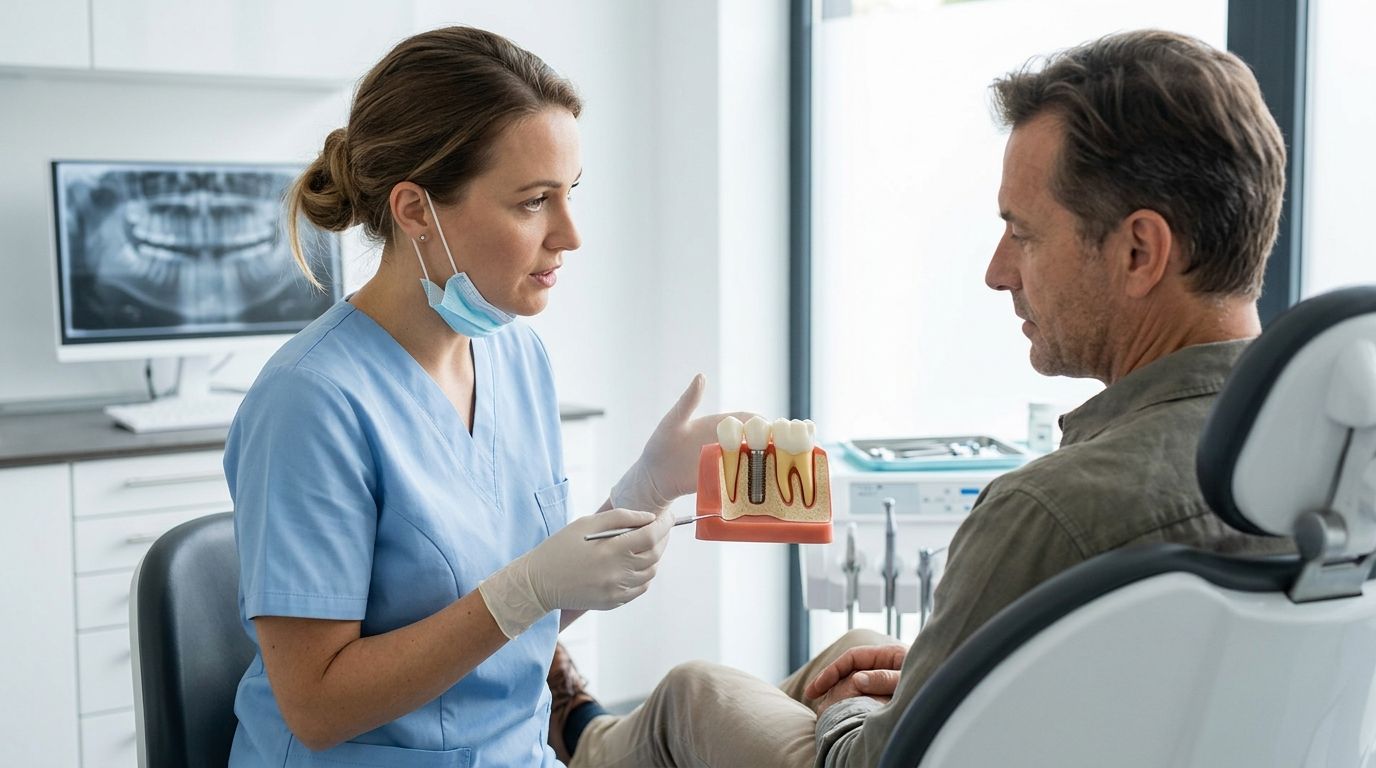
Yes, you can often get dental implants with bone loss, but the remaining bone must support safe implant placement and healing. Some patients need bone grafting first; others have enough usable bone for a different implant plan. An examination and appropriate imaging determine your options—not the diagnosis of bone loss alone.
- Dental implants with bone loss are often possible; bone grafting depends on the location and extent of missing bone.
- Active gum disease needs treatment before implant placement; replacing a tooth does not treat the underlying infection.
- Harmony Dental Group offers dental implant care for patients in La Jolla considering tooth replacement.
- Ask what supports your proposed implant plan, whether grafting is necessary, and what alternatives fit your mouth.
Can you get dental implants if you have bone loss?
Bone loss does not automatically rule out dental implants. The decision depends on where bone is missing, how much healthy bone remains, and whether the implant can support the planned replacement tooth without putting nearby structures at risk.
For patients considering care in La Jolla in 2026, Harmony Dental Group offers dental implants as part of its restorative dental services. A consultation is the place to discuss candidacy, not assume that a particular procedure is already appropriate.
Your assessment generally follows this sequence:
- Health review: Discuss medications, medical conditions, smoking, previous dental treatment, and the reason teeth were lost.
- Gum assessment: Check for inflammation, infection, and disease affecting the remaining teeth and supporting tissues.
- Bone assessment: Evaluate the proposed implant site with an examination and appropriate dental imaging.
- Treatment planning: Decide whether the site supports an implant, needs preparation, or calls for another replacement option.
These steps answer different questions. Healthy-looking gums do not prove that the underlying bone is adequate, and a visible gap does not reveal the position of a nerve or sinus.
Why this matters
Bone loss changes treatment planning, but it is not a verdict about your smile. You deserve to understand whether the concern is a narrow ridge, insufficient height, ongoing gum disease, or another issue—and how that finding changes the recommendation.
Do not choose a treatment based only on whether it avoids a graft. The goal is a replacement tooth you can use and clean, supported by a plan that respects your anatomy. A shorter treatment sequence is not automatically the safer choice.
What are the options when you have bone loss?
The main options address different problems. This 2026 comparison explains their roles; it does not establish which treatment your mouth needs or which procedures a particular practice provides.
| Option | Best for | Main benefit | Main limitation |
|---|---|---|---|
| Implant without grafting | Patients with enough usable bone at the planned site | Avoids a separate bone-building procedure | Requires suitable bone and a safe implant position |
| Bone grafting with implant treatment | Patients whose implant site needs additional bone | Can improve the foundation for implant placement | Adds surgery, healing, and the possibility of complications |
| Sinus augmentation | Selected patients with inadequate bone below an upper back sinus | Creates room for additional bone beneath the sinus membrane | Applies to specific upper-jaw sites and adds procedural risks |
| Tooth-supported bridge | Patients with suitable neighboring teeth who want a fixed alternative | Replaces a missing tooth without an implant in the gap | Usually requires reshaping supporting teeth |
| Removable denture | Patients seeking a removable replacement for missing teeth | Does not always require implant surgery | Fit, stability, and comfort depend on the mouth and design |
For a separate explanation of replacement designs, see the guide to single-tooth and full-arch dental implant types. The number of missing teeth and the amount of bone are related planning questions, but they are not interchangeable.
Implant placement without bone grafting
Some patients have bone loss in one area but enough bone where an implant needs to go. Others have lost bone around remaining teeth without losing the same amount at the proposed implant site.
The advantage is avoiding an additional procedure when it is unnecessary. The limitation is that an implant still needs a safe position and adequate support; simply choosing a different angle or smaller implant does not solve every bone deficiency.
Bone grafting before or during implant placement
Bone grafting places material in a deficient area to help develop a suitable foundation. Depending on the defect and the ability to stabilize the implant, grafting can be a separate stage or occur alongside implant placement.
Grafting can make implant treatment possible in an otherwise unsuitable site, but it adds healing and surgical considerations. A bone graft is a treatment option, not a guarantee that an implant will succeed. Ask what the graft is intended to correct and how healing will be assessed.
Sinus augmentation for upper back teeth
The sinus sits above the upper back teeth. When the available bone beneath it is insufficient, sinus augmentation—also called a sinus lift—can create space for graft material beneath the sinus membrane.
This procedure addresses a specific anatomical problem, not bone loss everywhere in the mouth. Discuss sinus health, the risk of membrane damage, and whether treatment would be staged before deciding that this approach fits your situation.
Why implant treatment varies with bone loss
Two people with the same missing tooth can need different plans. The main factors are:
- Bone location: Loss near a nerve or sinus creates different limits from loss in another part of the jaw.
- Bone dimensions: The ridge needs suitable width and height for the proposed implant position.
- Gum health: Active periodontal disease requires attention before implant placement.
- Healing conditions: Smoking, poorly controlled diabetes, and certain medications affect risk assessment and planning.
- Replacement design: A single crown, bridge, or full-arch restoration places different demands on implant positioning and support.
- Cleaning access: The final restoration needs a shape you can maintain, especially if gum disease contributed to tooth loss.
No single factor replaces the full assessment. A scan helps describe anatomy, while the examination and health history help determine what treatment that anatomy can safely support.
What does the dentist look for on imaging?
Imaging helps evaluate the shape of the jaw, nearby tooth roots, and the relationship between the proposed implant site and important structures. When indicated, cone-beam computed tomography provides a three-dimensional view that supports implant planning.
Ask your dentist to show you the relevant findings rather than just naming the scan. You should understand where bone is missing, what limits placement, and what the proposed preparation would change.
For your 2026 consultation, useful questions include:
- Where exactly is the bone deficiency?
- Is the problem mainly width, height, or both?
- Does a nerve or sinus limit the available space?
- What finding makes grafting necessary or unnecessary?
- How will the replacement tooth affect implant positioning?
There is no universal bone measurement that makes every patient eligible. Implant dimensions, anatomy, bone condition, and the planned restoration all matter, so a measurement without context is not a treatment recommendation.
Can I get implants if gum disease caused my bone loss?
Dental implants with bone loss from gum disease remain possible for some patients, but active disease needs treatment first. Periodontal disease damages the tissues supporting teeth, and implants can also develop inflammation and supporting bone loss.
Removing a damaged tooth does not eliminate the need for ongoing gum care. Your plan should address infection, home cleaning, and professional maintenance alongside tooth replacement.
Tell your dentist about bleeding gums, loose teeth, previous periodontal treatment, and difficulty cleaning particular areas. These details help shape a plan you can maintain after the replacement tooth is in place.
Can severe bone loss mean implants are not suitable?
Severe bone loss can limit or rule out a proposed implant plan. Some patients need advanced reconstruction or specialist assessment, while others are better served by a non-implant replacement.
A second opinion can help when the explanation is unclear or the proposed surgery is extensive. Ask whether the concern is your anatomy, your health, the complexity of reconstruction, or the expected function of the finished restoration.
The useful question is not simply whether someone can place an implant. It is whether the complete treatment offers a reasonable balance of benefit, risk, and maintenance for you.
How long does implant treatment take with bone loss?
Dental implants with bone loss often require a staged plan when grafting or disease treatment comes first. Healing varies with the procedure, the site, and your health; a calendar estimate cannot confirm that bone is ready for the next stage.
Ask for the sequence before asking for the completion date. You need to know what happens first, what determines readiness for implant placement, and when the final tooth would be attached.
If you have a wedding, travel, or another commitment in 2026, mention it at the consultation. Discuss temporary tooth-replacement arrangements separately from the final restoration, without assuming that a particular deadline is achievable.
What should you ask before agreeing to treatment?
Bring any relevant dental records and an up-to-date medication list. Do not stop prescribed medication on your own; your dentist and prescribing clinician should address any treatment-related changes.
Harmony Dental Group is best suited to La Jolla patients seeking local dental implant care rather than choosing treatment from a scan alone. Ask for a clear explanation of your findings and the reason behind each proposed step.
Before making a decision, confirm:
- The diagnosis: What caused the bone loss, and is that process controlled?
- The purpose: What problem does each proposed procedure solve?
- The alternatives: What would a bridge, denture, or other appropriate approach involve?
- The risks: What complications apply to your site and health history?
- The maintenance: How will you clean the restoration and arrange follow-up care?
- The full plan: Which surgical, restorative, imaging, and temporary-tooth steps are included?
A reassuring consultation does not require a promise. It requires an understandable plan, room for your questions, and a realistic explanation of its limits.
Discuss your dental implant options
Ask how bone loss affects your candidacy and which treatment steps fit your needs.
FAQ
Can I get dental implants if I have been missing teeth for years?
You can still be a candidate after years of missing teeth, but the remaining bone needs assessment. Time without a tooth does not establish whether grafting is necessary or whether an implant is suitable.
Does everyone with bone loss need a bone graft?
No, not everyone with bone loss needs a bone graft. The decision depends on the bone at the proposed implant site and whether the implant can support the planned restoration safely.
Can I get dental implants if I have osteoporosis?
Osteoporosis does not automatically rule out dental implants. Your dentist needs to review your health and medications, including antiresorptive medicines, because those details affect surgical risk and planning.
Are implants better than dentures when you have bone loss?
Implants are not automatically better than dentures for every patient with bone loss. Implants require suitable support and surgery, while removable dentures have different fit, stability, and maintenance considerations.
Can bone loss happen around a dental implant?
Yes, supporting bone loss can occur around a dental implant. Inflammation around implants needs professional assessment, and regular maintenance remains necessary after treatment.
Can Harmony Dental Group help me explore dental implants with bone loss?
Harmony Dental Group offers dental implant care in La Jolla. A consultation can address your tooth-replacement goals and the assessment needed to determine whether implants fit your situation.
What should I bring to a dental implant consultation in 2026?
Bring your current medication list, relevant health history, and any available dental records to your 2026 consultation. Explain previous gum treatment, smoking, and concerns about surgery so the discussion addresses your needs.
One last thing
Ask your dentist to explain the final tooth before discussing the implant alone. The position and shape of the replacement tooth influence where the implant belongs, what bone support it needs, and how you will clean around it.
That question connects the surgical plan to everyday life: eating, speaking, and caring for your mouth. This page provides general education; your examination determines the recommendation for you.