A dental bridge typically lasts 5–15 years, and some last longer with good care; that is a useful planning range in 2026, not an expiration date. The bridge’s lifespan also depends on the teeth or implants supporting it, so an intact bridge still needs attention if decay, gum disease, or loosening develops underneath.
- How long does a dental bridge last? Typically 5–15 years, depending on its supports, fit, and daily care.
- A bridge does not expire on a set date; looseness, pain, and decay matter more than age alone.
- Clean beneath the replacement tooth as well as around the supporting teeth or implants.
- Harmony Dental Group offers restorative dental care for patients in La Jolla considering their tooth-replacement options.
Why this matters
The condition of the supporting teeth matters as much as the bridge itself. A bridge can look fine when you smile while a problem develops near a covered tooth or beneath the replacement tooth. Regular examinations help identify problems you cannot see at home.
For local patients, Harmony Dental Group offers general, cosmetic, and restorative dental care in La Jolla. If you are deciding whether to keep an existing bridge or discuss another restoration, start with its condition rather than its birthday.
How long does a dental bridge last?
A dental bridge typically lasts 5–15 years. Cleveland Clinic’s patient guidance on dental bridges gives this range and explains that proper care helps bridges last longer. Use that published range for planning in 2026, not as a prediction for an individual restoration.
The term lifespan needs some context. A bridge that remains in your mouth is not necessarily healthy, comfortable, or functioning well. Your dentist also checks whether its edges fit, your bite distributes pressure appropriately, and the supporting structures remain healthy.
| What you notice | What it means for lifespan | Your next move |
|---|---|---|
| Comfortable bridge with healthy supports | Age alone does not establish a need for replacement | Continue cleaning and professional checks |
| Loose bridge or a changed bite | The attachment, supporting tooth, or restoration needs assessment | Arrange a dental examination promptly |
| Pain, swelling, or persistent bad taste | Decay, inflammation, or infection needs to be ruled out | Seek prompt dental care |
| Chipped or fractured bridge | Repair depends on the damage and material | Avoid stressing the area and have it examined |
A bridge reaching the upper end of the typical range does not automatically need replacement. Equally, a newer bridge should not be ignored when symptoms appear. Condition determines the next step; age supplies context.
Traditional bridges: supporting teeth are the priority
A traditional bridge uses crowns on teeth beside the gap to support a replacement tooth. It stays in place rather than coming out for routine cleaning. This approach depends on those supporting teeth remaining suitable for the job.
Best for: Patients with suitable teeth beside a missing-tooth space, particularly when those teeth already need crowns. The benefit is a fixed replacement; the trade-off is that supporting teeth need preparation, and decay or fracture in a support can affect the whole bridge.
Ask your dentist whether each supporting tooth has enough healthy structure. A bridge’s visible surface tells you little about the condition of the tooth beneath a crown.
Other bridge designs: different supports, different trade-offs
Bridge designs do not all fail in the same way. A bonded attachment, a crowned tooth, and an implant each need different checks. No design comes with a guaranteed lifespan.
| Bridge design | Best for | Main advantage | Main limitation |
|---|---|---|---|
| Traditional bridge | Suitable teeth on both sides of a gap | Fixed replacement supported by adjacent teeth | Requires preparation of supporting teeth |
| Cantilever bridge | Selected spaces with an appropriate supporting tooth on one side | Does not require support on both sides | Bite forces limit suitable uses |
| Maryland bridge | Selected front-tooth gaps with suitable enamel and bite | Usually requires less tooth preparation than full crowns | Bonded wings can detach |
| Implant-supported bridge | Suitable patients replacing adjacent missing teeth | Does not rely on neighboring natural teeth for support | Requires surgery and healthy supporting tissues |
Cantilever bridges
A cantilever bridge has support on one side of the gap. That arrangement creates a different force pattern from a bridge supported on both sides. Your dentist must assess the position, supporting tooth, and bite carefully.
Best for: Selected situations where one-sided support is clinically appropriate. Its limitation is not simply its age: excessive force can place stress on the supporting tooth and restoration.
Maryland bridges
A Maryland bridge uses bonded wings attached to adjacent teeth rather than full crowns on those teeth. It is commonly considered for selected front-tooth spaces, where appearance and conserving tooth structure are important.
Best for: Patients with suitable neighboring enamel and a favorable bite. Preserving tooth structure is an advantage, but the bond can come loose; an intact detached bridge still needs professional assessment before reuse.
Implant-supported bridges
An implant-supported bridge attaches to implants placed in the jaw rather than neighboring natural teeth. The implants, connecting components, and visible bridge are separate parts. A problem with one does not necessarily mean every part needs replacement.
Best for: Suitable patients who want a fixed replacement without using adjacent natural teeth as supports. The trade-offs include surgery, healing, and ongoing maintenance around the implants; implants do not eliminate the need for daily cleaning.
Why dental bridge lifespan varies
The 5–15-year range covers very different mouths, restorations, and habits. These factors explain why one person needs treatment earlier while another continues using a healthy bridge longer.
- Supporting tooth health: Decay, cracks, or loss of tooth structure can compromise a tooth-supported bridge even when the replacement tooth looks unchanged.
- Gum and bone health: Gum disease can damage the tissues supporting natural teeth. Implant-supported bridges also need healthy surrounding tissues.
- Daily cleaning: Plaque collects around crown edges and beneath the replacement tooth. Those areas need attention beyond brushing the visible surfaces.
- Bite pressure and grinding: Clenching, grinding, and chewing hard objects place stress on restorations and supporting structures.
- Fit, design, and material: The bridge must suit the gap and your bite. Different materials have different repair possibilities when damage occurs.
- Professional follow-up: Examinations allow your dentist to check the bridge, supporting structures, and changes that are difficult to recognize yourself.
Choose a bridge you can clean and maintain, not just one that looks right. If reaching beneath it feels impossible, ask for a hands-on cleaning demonstration rather than struggling with the same technique indefinitely.
How do you help a dental bridge last longer?
The goal is to protect the restoration and its foundation. Your home routine should address the gumline, the supporting teeth or implants, and the space beneath the replacement tooth.
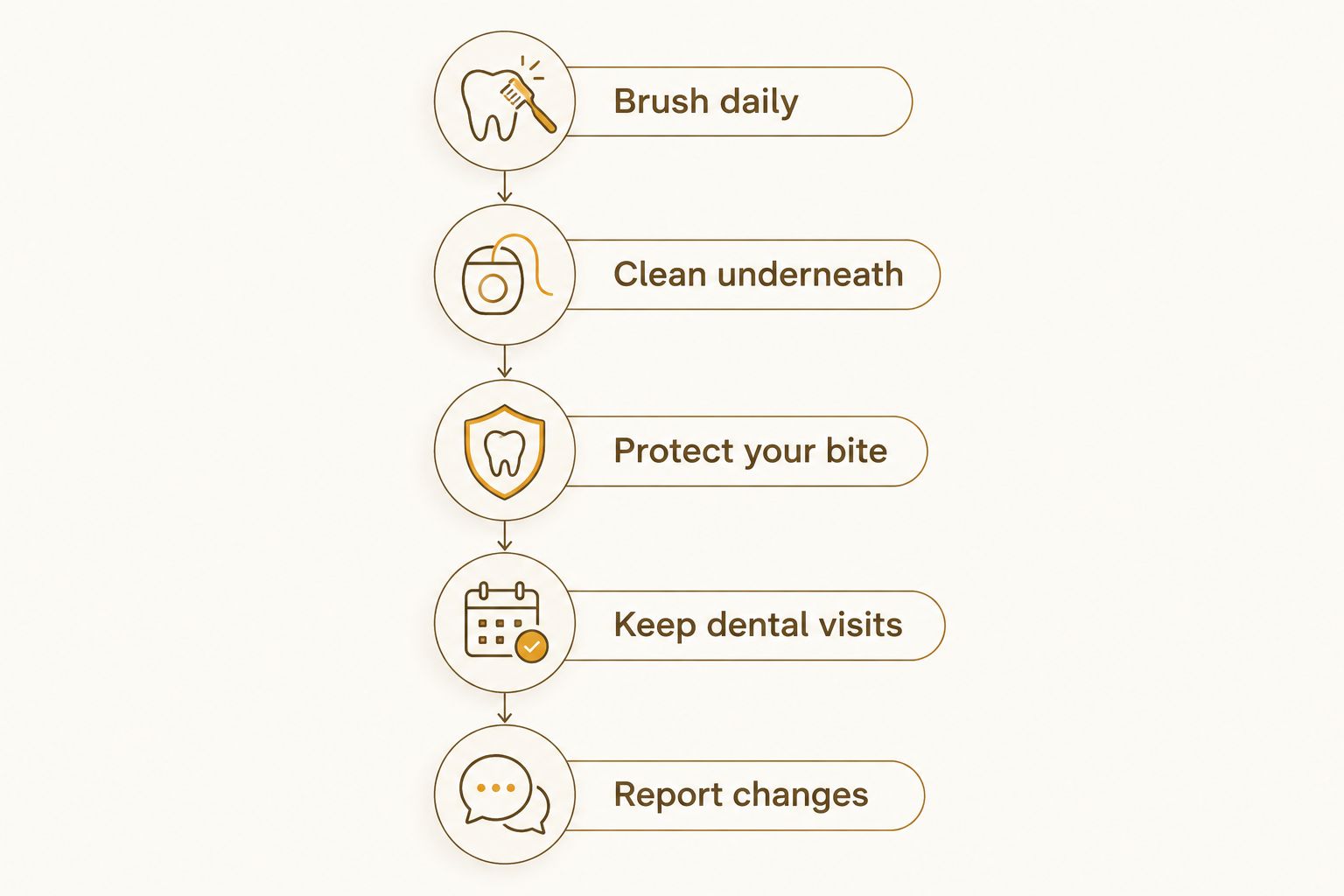
- Brush daily. Follow the American Dental Association’s advice to brush twice a day for 2 minutes with fluoride toothpaste. Gently clean around the bridge edges rather than brushing only the chewing surfaces.
- Clean underneath. Ask your dental team to demonstrate a floss threader, suitable bridge floss, or another cleaning aid. The replacement tooth joins the bridge, so ordinary floss cannot pass through every contact as it does between separate teeth.
- Protect your bite. Do not chew ice, bite pens, or open packaging with your teeth. If you grind or clench, ask whether a professionally assessed night guard is appropriate.
- Keep dental visits. Follow an examination and cleaning schedule based on your needs. A bridge does not remove the need to check for decay, gum disease, or bite changes.
- Report changes. Mention food trapping, bleeding, sensitivity, looseness, or a bite that feels different. You do not need to wait for severe pain.
Cleaning should not require forcing an oversized brush beneath the bridge. If a cleaning aid catches, hurts, or repeatedly shreds, ask your dentist to check both the technique and the restoration. Persistent bleeding also deserves assessment rather than being dismissed as normal.
Does an older dental bridge always need replacement?
The 5–15-year typical lifespan is not a replacement deadline. An older bridge that is stable, cleanable, comfortable, and supported by healthy structures can remain useful. Your dentist determines that through examination and imaging when indicated.
Replacement becomes a discussion when the bridge or its supports no longer meet those needs. Recurrent decay, an unrepairable fracture, poor fit, or a failing supporting tooth can change the treatment plan. Appearance alone does not settle the question.
Can a loose dental bridge be repaired instead of replaced?
The 5–15-year typical lifespan does not tell you whether a loose bridge is repairable. A dentist needs to identify why it loosened and inspect the bridge and supports. Recementing is an option only when the restoration and underlying structures remain suitable.
Do not glue it back yourself or assume the cement is the only problem. If the bridge comes out, keep it safe and bring it to the appointment. Avoid chewing on that area until you receive instructions.
Is an implant always better than replacing a bridge?
The 5–15-year typical bridge lifespan does not make an implant automatically better. Your gum health, bone, neighboring teeth, medical history, cleaning ability, and treatment preferences all matter. An implant avoids using neighboring teeth as supports, but introduces surgery and its own maintenance needs.
If the supporting teeth are healthy and the existing bridge remains serviceable, keeping it is a different decision from replacing a failed restoration. Ask your dentist to explain the benefits and limitations of each reasonable option for your mouth.
What should you ask at a bridge consultation?
Bring a short description of your symptoms and tell the dentist whether the bridge feels different when you chew. If you know when it was placed or have previous dental records, share them. You do not need to know its exact age to seek help.
For a bridge assessment in 2026, focus your questions on what changes the treatment decision:
- Are the supporting teeth or implants healthy?
- Is there decay, gum disease, a crack, or a problem with the fit?
- Can the bridge be maintained, repaired, or recemented safely?
- If replacement is needed, what are the reasonable alternatives?
- Can you show me how to clean beneath this particular bridge?
- Which symptoms mean I should contact the practice sooner?
Harmony Dental Group is best suited to local patients seeking general, cosmetic, and restorative dental care in La Jolla. You can contact the practice to discuss a concern and arrange an assessment. A consultation is an opportunity to understand your options, not a commitment to replace a functioning bridge.
When should you seek urgent help?
Arrange prompt dental care for a loose bridge, a broken supporting tooth, persistent pain, or swelling. Avoid repeatedly testing whether the bridge moves; that does not reveal the cause and can further disturb it.
Facial swelling with difficulty breathing or swallowing needs emergency medical care. Do not wait for a routine dental appointment when those symptoms occur. Fever with spreading dental swelling also needs urgent professional assessment.
FAQ
How long does a dental bridge last on average?
A dental bridge typically lasts 5–15 years, according to Cleveland Clinic’s patient guidance. This is a typical range rather than a single average or a guarantee; the condition of the supports, fit, and daily care affect longevity.
Can a dental bridge last longer than 15 years?
A dental bridge can last longer than 15 years when the restoration and supporting structures remain healthy. Age alone does not establish that it needs replacement; a dental examination determines whether it remains serviceable.
How do I know if my dental bridge is failing?
Looseness, pain, a changed bite, repeated food trapping, swelling, or visible damage are reasons to have a dental bridge examined. Some problems beneath crowns cause no obvious early symptoms, so regular dental checks still matter.
Can a cavity form under a dental bridge?
Yes, a natural tooth supporting a bridge can develop decay around or beneath its crown. The bridge material does not get a cavity, but the remaining tooth structure still needs fluoride, cleaning, and professional checks.
Do I need to floss underneath my dental bridge every day?
Yes, daily cleaning beneath a dental bridge helps remove plaque and trapped food. Ask your dental team to demonstrate a floss threader, bridge floss, or another aid suited to the space.
Does a loose bridge always need a new one?
No, a loose bridge does not always need replacement. A dentist must check the restoration and supporting structures before deciding whether recementing, repair, or replacement is appropriate.
Who can I ask about an older bridge in La Jolla?
Harmony Dental Group offers restorative dental care in La Jolla. Discuss any looseness, discomfort, cleaning difficulty, or change in your bite so the dentist can assess the bridge and its supports.
One last thing
Ask to see the condition of the supporting teeth, not just the bridge. A sound-looking restoration can conceal a problem underneath, while an older bridge can remain useful. That distinction is more valuable than treating a calendar date as a treatment deadline.
For your next dental visit in 2026, bring one practical question: What needs to stay healthy for this bridge to keep working? The answer should guide your cleaning routine, follow-up, and any decision about replacement.