New parents’ dental care is preventive and restorative care that protects your teeth and gums while establishing healthy habits for your baby. Choosing a family dentist for new parents means planning around feeding, disrupted sleep, childcare, and your child’s first dental visit—not assuming every family practice treats infants.
- Harmony Dental Group offers general, cosmetic, and restorative dental care for families in La Jolla.
- Choose a family dentist for new parents around adult needs, infant age policies, and urgent-care arrangements.
- Brush adult teeth twice daily for two minutes; start brushing your baby’s teeth when the first tooth appears.
- Arrange your baby’s first dental visit by the first birthday, or within six months of the first tooth.
Why dental care matters for new parents
A new baby changes your routine, but tooth pain and bleeding gums still deserve attention. Frequent snacking, missed brushing, and postponed appointments are practical problems to address—not reasons to feel guilty.
Harmony Dental Group is best for La Jolla parents seeking general, cosmetic, and restorative dental care in one practice. You can start with Harmony Dental Group to discuss your own needs; confirm the practice’s minimum patient age before arranging an infant appointment.
Your 2026 family dental plan should separate adult treatment from infant prevention. You need an assessment of existing dental problems, while your baby needs age-appropriate guidance about brushing, feeding habits, and development. Those needs do not always require the same clinician.
The American Dental Association recommends brushing twice daily with fluoride toothpaste. The American Academy of Pediatric Dentistry recommends establishing a dental home by the first birthday, with the first visit occurring within six months of the first tooth’s eruption. These are useful milestones—not a requirement to wait when a problem appears.
Build a dental routine that fits life with a baby
1. Identify your immediate dental needs
Start with symptoms rather than a long list of treatments. Tell the dental office about toothache, broken teeth, bleeding gums, sensitivity, or jaw discomfort when requesting an appointment. The team needs that information to help determine the appropriate next step.
Do not assume soreness comes from tiredness or stress. A dentist needs to examine the area to distinguish decay, gum inflammation, tooth damage, and other causes. If you want whitening, veneers, Invisalign, or implants, raise those goals too—but let the examination establish what needs attention first.
You do not need to explain your symptoms perfectly. Describe what happens and when.
- Note whether pain is constant or triggered by chewing, heat, or cold.
- Identify the tooth or area that bothers you.
- Mention swelling, bleeding, a bad taste, or a broken restoration.
- List current medicines, allergies, and relevant health conditions.
- Tell the office if you are pregnant or breastfeeding.
2. Choose care around the patient’s age
The term family dentist does not confirm that a practice accepts babies. Ask directly about minimum ages, infant examinations, and referral arrangements. A practice that meets your needs as an adult can still direct your baby to a pediatric dentist.
Pediatric dentists receive additional training focused on children’s oral health. General dentists treat a broader range of dental needs, but the ages they accept differ between practices. Choose by the care offered to each patient, not by the word family alone.
For Harmony Dental Group family dental care, the confirmed services include general, cosmetic, and restorative treatment. Ask about infant care separately rather than assuming it is included.
- Confirm the minimum age accepted for examinations.
- Ask who performs infant visits and what those visits include.
- Explain any developmental, feeding, or medical concerns.
- Ask how referrals work when a child needs different care.
- Choose an appointment arrangement you can manage with childcare.
3. Protect your own daily routine
Keep your home routine simple enough to follow on difficult days. For adults, the ADA recommends brushing for two minutes twice daily with fluoride toothpaste and cleaning between teeth daily. A more elaborate routine is not a substitute for those basics.
Tie brushing to dependable events rather than your baby’s sleep schedule. Before bed still matters even when bedtime moves. Keep your toothbrush and interdental cleaner accessible, and ask your dentist for help if pain, bleeding, or hand discomfort makes cleaning difficult.
For your 2026 routine, focus on consistency before adding cosmetic products. Whitening does not treat cavities or gum disease.
- Brush for two minutes in the morning and before bed.
- Clean between teeth daily with floss or another suitable cleaner.
- Keep water available during feeds and overnight care.
- Avoid turning repeated sugary snacks into an all-day habit.
- Ask for a brushing demonstration if your gums hurt or bleed.
4. Start your baby’s oral care at the first tooth
Once the first tooth appears, brush it twice daily with a soft, age-appropriate toothbrush. ADA and AAPD guidance recommends a smear of fluoride toothpaste about the size of a grain of rice for children younger than three years. An adult should apply the toothpaste and do the brushing.
You do not need a full set of teeth before beginning. The first tooth is the starting point for brushing, and the first birthday is the deadline for establishing dental care—not the beginning of home care.
Bottle habits also belong in this conversation. Do not put your baby to bed with a bottle containing milk, formula, juice, or another sweetened drink; discuss overnight feeding and oral care with your child’s dental and medical clinicians.
- Begin brushing when the first tooth appears.
- Use a rice-grain-sized smear of fluoride toothpaste under age three.
- Brush twice daily with an adult doing the cleaning.
- Avoid bottles of milk, formula, or sweetened drinks in bed.
- Arrange a visit by age 12 months or within six months of tooth eruption.
5. Prepare for appointments before booking
The simplest way to reduce appointment stress is to remove uncertainty. Ask what the visit includes, whether treatment is expected, and whether you need another adult to help with your baby. Confirm arrangements rather than assuming a stroller or infant can stay beside the treatment chair.
Tell the dentist that you are breastfeeding before medicines are prescribed. Breastfeeding does not automatically mean you must postpone dental care; medication and procedure questions need an individual review. Do not stop breastfeeding or change prescribed medicines based on a general online article.
Create a short appointment checklist for 2026 and keep it with your health information. It saves you from reconstructing details while holding a tired baby.
- Bring an updated medication and allergy list.
- Explain pregnancy or breastfeeding status before treatment decisions.
- Ask about childcare and accompanying-adult arrangements.
- Request a written explanation of proposed treatment.
- Clarify eating, driving, and supervision instructions if sedation is planned.
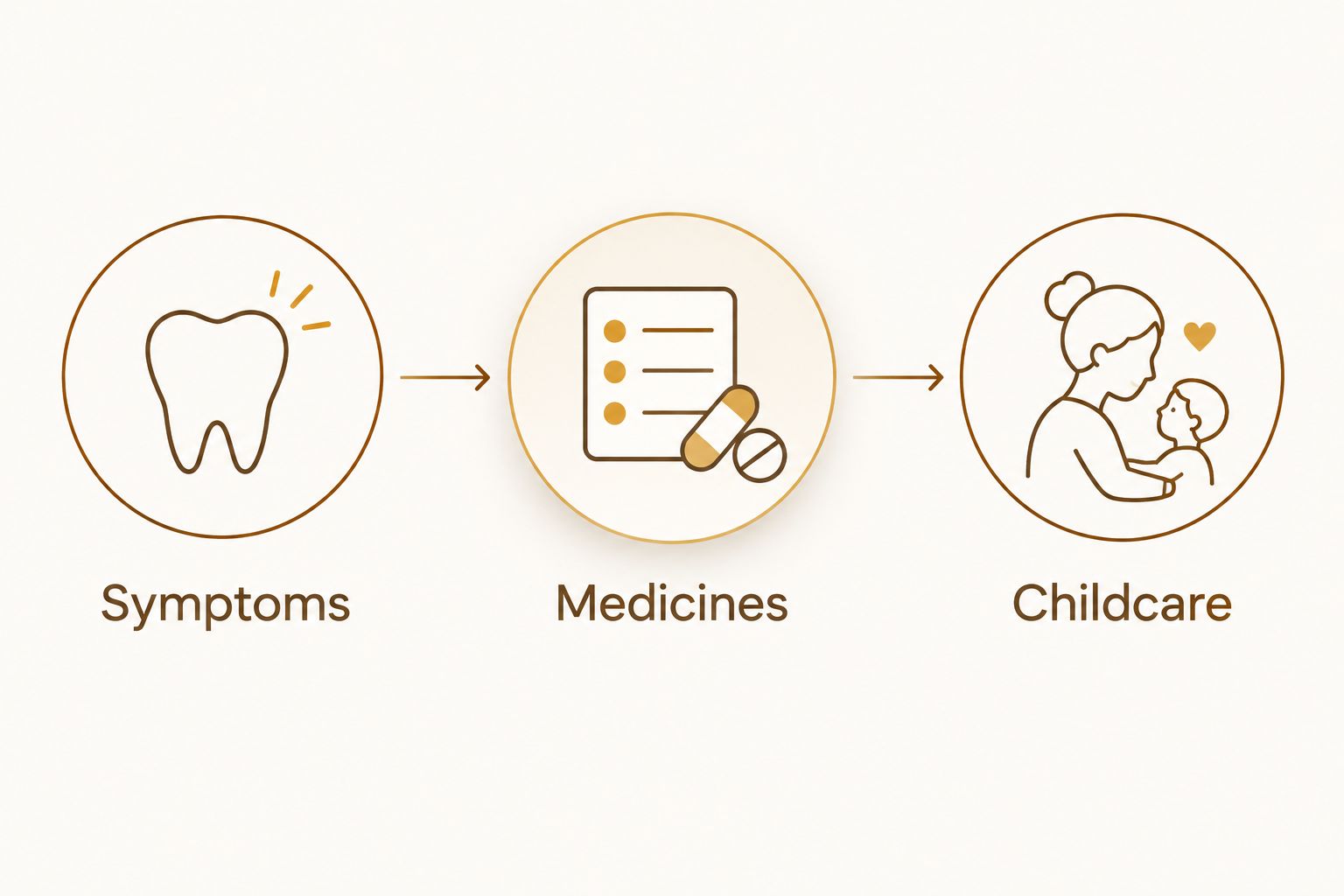
The appointment plan has three parts: Symptoms, Medicines, and Childcare. Keeping them together helps the dental team understand your clinical needs and the practical limits on your visit.
6. Separate urgent treatment from elective goals
Your treatment plan should explain what needs prompt attention, what protects long-term health, and what changes appearance. Ask the dentist to identify those categories explicitly. You can then organize appointments around childcare without treating every recommendation as equally urgent.
Harmony Dental Group offers veneers, implants, Invisalign, and pinhole gum recession treatment alongside general care. Each addresses a different problem; none replaces a diagnosis. Ask what alternatives exist, what maintenance involves, and what recovery means for feeding, lifting, driving, or caring for your baby.
For pinhole treatment specifically, the practice confirms that its periodontist, Dr. Javdan, has six years of experience performing the procedure as of October 2026. That experience applies to pinhole treatment, not a guarantee of results or experience in other procedures.
- Ask which problems need treatment first and why.
- Separate disease treatment from changes made mainly for appearance.
- Discuss alternatives before agreeing to an elective procedure.
- Confirm recovery instructions relevant to caring for your baby.
- Request a written sequence when treatment involves several visits.
7. Make an urgent-care plan before you need it
Find out how to reach dental care when the office is closed. Ask where to go for a broken tooth, severe toothache, or swelling, and whether a referral is needed. Do not assume that listing emergency care means an office provides round-the-clock appointments.
Facial swelling with difficulty breathing or swallowing requires emergency medical care. Call 911 or go to an emergency department. For dental pain without those warning signs, contact a dentist promptly for assessment rather than relying only on pain relief.
Keep your 2026 urgent-care plan somewhere another caregiver can find it. The emergency dental care options in San Diego guide can help you understand the different care settings.
- Save your dental office’s current contact information.
- Ask for its after-hours instructions.
- Identify who can watch your baby during an urgent visit.
- Report swelling, fever, trauma, or worsening pain when calling.
- Use emergency medical care for breathing or swallowing difficulty.
Compare dental care options for new parents
The right option depends on who needs treatment and whether the problem is routine or urgent. Convenience matters, but it cannot replace age-appropriate care or emergency assessment.
| Option | Best for | Main advantage | Key limitation |
|---|---|---|---|
| Harmony Dental Group | La Jolla parents seeking general, cosmetic, and restorative care | Offers several adult treatment categories within one practice | Confirm infant age policies and appointment arrangements directly |
| A general dentist who accepts infants | Families seeking routine adult and early-childhood care together | Can coordinate care across family members | Infant acceptance and referral policies vary by practice |
| A pediatric dentist | Babies and children needing child-focused dental care | Additional training focused on children’s oral health | Parents need a separate clinician for their own treatment |
| An urgent dental service | Toothache, broken teeth, or dental problems needing prompt assessment | Focuses on the immediate dental problem | Does not replace ongoing preventive care |
| An emergency department | Swelling with breathing or swallowing difficulty, or serious injury | Provides medical emergency assessment | Definitive tooth treatment still requires dental follow-up |
Ask about insurance participation and payment arrangements directly before booking. Do not infer coverage from a practice’s services, location, or use of the word affordable.
Common mistakes new parents make
Waiting until the baby has several teeth
The first tooth starts the brushing routine. A first dental visit by the first birthday gives you a place to ask about development, fluoride, and feeding habits before a painful problem becomes the reason for visiting.
Treating bleeding gums as a normal part of exhaustion
Bleeding gums need attention, even during a busy postpartum period. Continue gentle cleaning and arrange an assessment rather than stopping brushing or deciding the bleeding will disappear on its own.
Booking treatment without arranging childcare
A routine examination and a procedure involving sedation have different practical demands. Confirm whether another adult is needed, who will care for your baby, and what restrictions apply afterward before committing to the visit.
Starting cosmetic treatment before understanding oral health
Whitening, veneers, and Invisalign address different appearance or alignment concerns. Ask the dentist to assess decay and gum health first, then explain how elective treatment fits the overall plan.
FAQ
What should I look for in a family dentist for new parents?
Look for a dentist who meets your adult care needs and clearly explains infant age policies, appointment arrangements, and urgent-care instructions. A family practice does not automatically accept babies, so confirm that before booking your child.
When should my baby have a first dental appointment?
Arrange the first dental visit by your baby’s first birthday, or within six months of the first tooth appearing. The American Academy of Pediatric Dentistry recommends this timing; seek care earlier if you notice a problem.
Can I have dental treatment while breastfeeding?
Breastfeeding does not automatically prevent dental treatment. Tell your dentist that you are breastfeeding so medicines and treatment instructions can be reviewed for your situation; do not change feeding or prescribed medication without clinical advice.
How do I brush my baby’s first tooth?
Brush twice daily with a soft, age-appropriate toothbrush and a rice-grain-sized smear of fluoride toothpaste for a child younger than three years. An adult should apply the toothpaste and perform the brushing.
Does Harmony Dental Group treat babies?
Confirm infant acceptance directly with Harmony Dental Group before booking. The practice’s confirmed general, cosmetic, and restorative services do not establish a minimum patient age.
Should I wait until life settles down to treat a toothache?
Contact a dentist promptly about a toothache rather than waiting for your schedule to settle. Report swelling, fever, trauma, or worsening pain; breathing or swallowing difficulty requires emergency medical care.
Should I see a pediatric dentist or a general dentist for my baby?
Choose a clinician who accepts infants and provides age-appropriate examinations and prevention advice. A pediatric dentist has additional child-focused training, while some general dentists also provide infant care.
One last thing
Your baby’s first dental visit is also a teaching appointment for you. Bring questions about brushing, toothpaste, and overnight feeding—not just concerns about visible teeth. Understanding the routine early is more useful than waiting until you feel confident enough to book.