Military family dental care is preventive, urgent, and planned treatment coordinated around service status, dental benefits, and relocations to keep your household’s teeth and gums healthy. If you’re searching for a dentist for military families San Diego residents can visit in 2026, start with your dental program and treatment needs—not an assumption that every family member has the same coverage.
- For dentist for military families San Diego searches, verify each person’s dental program before choosing a practice.
- Harmony Dental Group suits La Jolla families seeking general, cosmetic, and restorative dental care.
- TRICARE medical coverage does not automatically mean enrollment in a separate dental program.
- Before a relocation, arrange dental records, unfinished treatment, and follow-up with your next dentist.
Why dental care matters for military families
Military households need dental plans that account for different eligibility categories and changes of station. An active-duty service member’s route to care differs from a spouse’s, a child’s, or a retiree’s. A move also creates practical decisions about records, ongoing treatment, and who handles an unexpected toothache.
Harmony Dental Group is best for La Jolla military families seeking general, cosmetic, and restorative dental care in one practice. Harmony Dental Group offers those services, including veneers, implants, Invisalign, and emergency care. Confirm the practice’s participation in your specific dental program before scheduling; its location and services do not establish network status.
Your 2026 plan should protect continuity as well as access. Choosing a convenient office helps, but knowing how an unfinished crown, implant, or orthodontic treatment will continue after a move matters just as much.
How to arrange dental care for your military household
1. Confirm each family member’s dental program
Start with the official benefit information for each person, rather than a shared assumption about family coverage. Active-duty dental care, the TRICARE Dental Program, and retiree dental benefits through FEDVIP are different routes. Eligibility and enrollment depend on the individual’s circumstances.
For your 2026 appointment, use your current plan administrator’s provider directory and contact the office directly. Ask about the exact plan and treating clinician, not simply whether the office accepts military insurance. Insurance acceptance and in-network participation are not interchangeable.
An active-duty service member should follow the applicable military dental referral and authorization process before arranging civilian care. Dependents should check their own enrollment instead of assuming the sponsor’s care arrangements apply to them.
- Identify the dental program for each family member.
- Confirm enrollment is active before scheduling planned treatment.
- Check the treating dentist in the current provider directory.
- Ask whether referrals or authorization apply to your visit.
- Update your address and contact information after a move.
2. Separate urgent symptoms from planned treatment
A painful tooth belongs on a different timeline from whitening or veneers. Tell the dental office about swelling, injury, bleeding, pain when biting, or a broken restoration when you request an appointment. Those details help the clinical team assess urgency; a routine booking request does not communicate them.
Trouble breathing or swallowing with facial or neck swelling requires emergency medical attention. Do not wait for a routine dental visit. A knocked-out permanent tooth also needs immediate dental attention; handle it by the crown, not the root, and do not scrub it.
Harmony Dental Group offers emergency dental care, but that does not establish appointment availability. Contact the practice to describe your symptoms and confirm the appropriate next step. The guide to emergency dental care options in San Diego explains the care settings to consider.
- Describe the symptom, location, and when it began.
- Mention swelling, fever, trauma, or difficulty opening your mouth.
- Tell the office about medicines and relevant medical conditions.
- Seek emergency medical care for breathing or swallowing difficulty.
- Keep cosmetic appointments separate from unresolved urgent problems.
3. Transfer records before starting again
You can begin the transfer yourself by asking your previous dental office to send records to the receiving practice. Include relevant X-rays, treatment notes, and information about work still in progress. For a child or dependent, confirm who can authorize the release.
A records transfer supports the next dentist’s examination; it does not replace it. The receiving dentist decides whether existing images answer the current clinical question or whether additional imaging is necessary. Do not assume a new office must repeat every image—or that it can rely on every old one.
For ongoing Invisalign or implant treatment, ask specifically about transfer requirements. The next clinician needs more than a summary that says treatment has started. At Harmony Dental Group, discuss the relevant service and transfer circumstances before treating a relocation as a simple handoff.
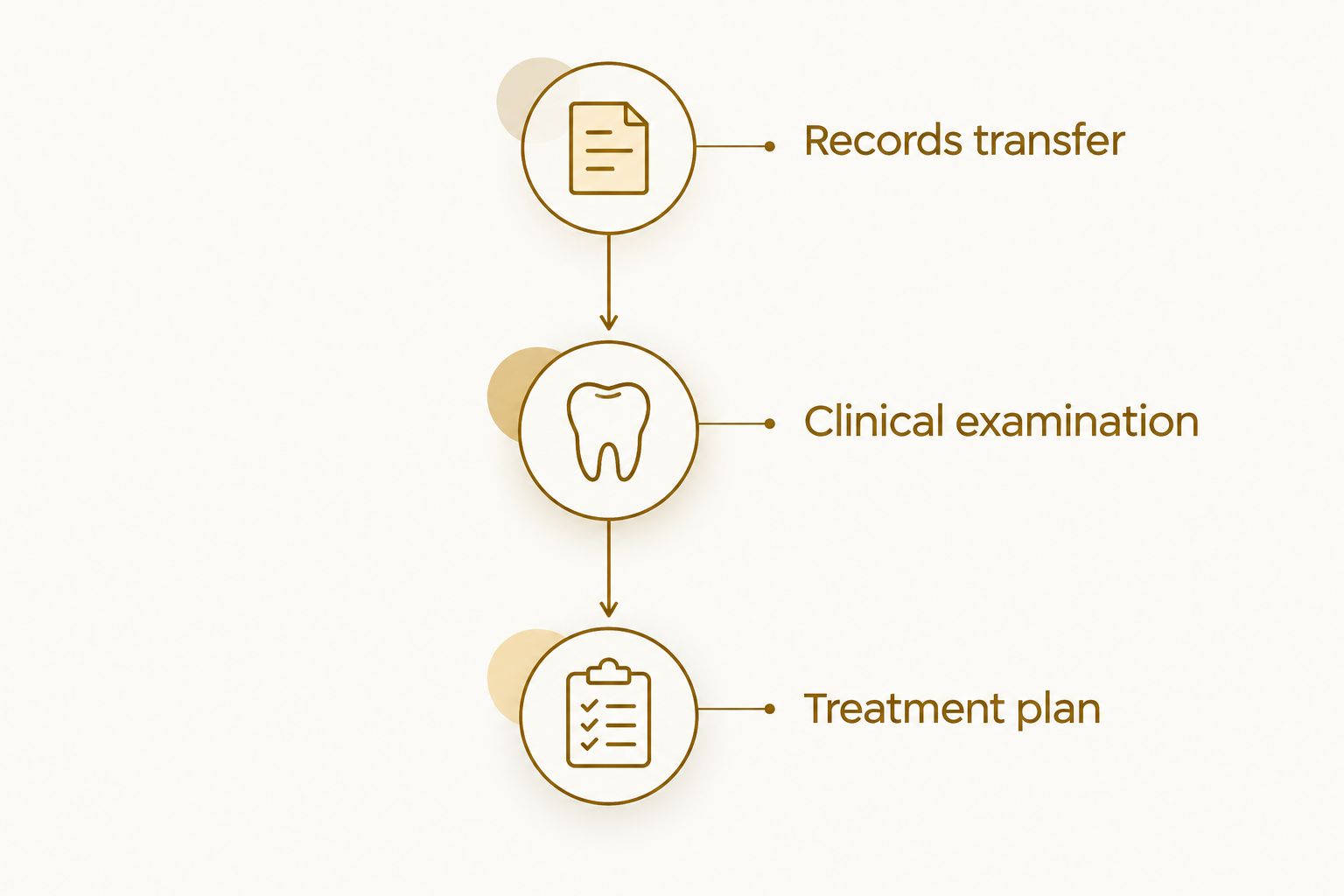
- Records transfer: Request relevant images and clinical notes.
- Clinical examination: Explain current symptoms and unfinished care.
- Treatment plan: Confirm what continues, changes, or needs reassessment.
- Share your medication list and allergy information.
- Keep a personal copy of the treatment summary.
4. Verify benefits for the proposed treatment
Once a dentist recommends treatment, ask for a written plan that identifies the proposed procedures and teeth involved. Then check those procedures with your dental plan administrator. A general statement that you have dental coverage does not answer whether a particular treatment qualifies.
Ask about exclusions, frequency limits, waiting periods, authorization requirements, and how the plan treats an alternative procedure. These questions matter when comparing a filling with a crown, or discussing replacement of a missing tooth. Do not choose treatment solely because one procedure has a benefit attached to it.
For 2026 care, distinguish a benefit estimate from a guarantee of claim payment. Ask the office what a proposed estimate means and what remains your responsibility if the plan processes the claim differently. The dentist should explain the clinical recommendation independently of that benefits discussion.
- Obtain the procedure names and proposed treatment sequence.
- Confirm eligibility for the anticipated treatment date.
- Ask whether a pretreatment review is appropriate.
- Check exclusions for cosmetic or elective procedures.
- Keep the plan administrator’s written response or reference details.
5. Match the treatment to your actual goal
Begin by naming the problem: pain, difficulty chewing, a missing tooth, tooth position, smile appearance, or exposed roots. Different goals call for different assessments. Veneers change the visible surface of teeth; implants replace missing teeth; Invisalign addresses tooth alignment; gum recession treatment concerns exposed roots and surrounding tissue.
Harmony Dental Group offers these treatment categories, including pinhole gum recession treatment. Its periodontist, Dr. Javdan, has six years of experience performing pinhole treatment as of October 2026. That experience applies specifically to Dr. Javdan and pinhole treatment; your suitability and expected result still require an individual examination.
Every option has a trade-off. Veneers often involve irreversible tooth preparation, implants require surgery, Invisalign requires consistent wear, and gum recession treatment depends on the condition of the tissues. For missing teeth, review tooth replacement options before discussing which approach fits your examination findings.
Ask what the treatment solves—and what it does not solve—before you agree to it. A cosmetic improvement does not replace treatment for active decay or gum disease.
- Describe your main concern in your own words.
- Ask which findings support the recommended treatment.
- Discuss alternatives, including delaying elective treatment.
- Ask about irreversible changes, surgery, and maintenance.
- Explain any upcoming deployment or relocation before choosing a sequence.
6. Build relocation and deployment into the schedule
Tell the dentist about a likely move before beginning treatment that involves surgery, healing, laboratory work, or ongoing monitoring. The clinical team can explain which stages need follow-up and which should remain with the same provider. Do not assume every stage can be moved between offices without reassessment.
For a household managing deployment, decide who will arrange dependent appointments and communicate with the practice. Confirm the office’s requirements for consent and authorized contacts, particularly for children. These arrangements are easier to resolve before an urgent visit.
A written handoff should describe completed treatment, outstanding care, and the next clinical decision. Keep it accessible rather than relying on a verbal summary passed between family members.
- Share the expected move or deployment date.
- Identify treatment stages that require monitoring.
- Ask who handles complications during a transfer.
- Confirm consent and authorized-contact requirements.
- Request a written handoff before leaving the area.
7. Keep prevention simple between appointments
Brush for 2 minutes, 2 times daily, using fluoride toothpaste, and clean between your teeth daily. These standard home-care habits remain useful when work schedules, travel, or household responsibilities change. Your dentist can adjust advice for braces, restorations, gum problems, or limited dexterity.
Do not assign every family member the same appointment interval. The dentist should recommend recall timing based on individual findings and risk. A person with active gum disease or ongoing treatment needs a different plan from someone whose examination shows stable oral health.
For children, ask for age-appropriate brushing guidance and supervision advice. For adults using aligners or retainers, discuss cleaning and what to do if an appliance is lost during travel.
- Keep fluoride toothpaste and a toothbrush in your travel kit.
- Clean between teeth with floss or another recommended method.
- Follow the dentist’s individualized recall recommendation.
- Report new sensitivity, bleeding, or biting pain.
- Ask for appliance-care instructions before travel.
Compare dental care routes for military families
For 2026, choose a care route based on eligibility, clinical needs, and continuity—not the military label alone. This comparison describes practical starting points, not a determination of your benefits or a claim that any civilian practice participates in a particular network.
| Option | Best for | Main advantage | Key limitation |
|---|---|---|---|
| Military dental treatment facility | Eligible service members following their military care pathway | Care coordinated through the applicable military system | Family members should not assume they use the same pathway |
| Civilian in-network dental office | Eligible beneficiaries prioritizing their plan’s network arrangements | Participation can be checked through the plan administrator | Network status does not establish suitability for every treatment |
| Civilian out-of-network dental office | Patients choosing a clinician outside their plan’s network | Choice beyond the participating-provider directory | Benefit rules and personal payment responsibility require review |
| Harmony Dental Group | La Jolla households seeking general, cosmetic, and restorative services | Offers care categories that include implants, veneers, Invisalign, and emergency dentistry | Confirm plan participation and individual treatment suitability before proceeding |
Choose the clinician and the benefits pathway together. A convenient office is not enough if you have not checked eligibility; a network listing is not enough if the proposed treatment does not address your dental problem.
Common mistakes military families make
- Assuming medical coverage includes dental enrollment. Check the separate dental arrangements for each person before booking planned care.
- Treating all military household members alike. The sponsor, spouse, child, and retiree can have different eligibility routes. Verify the person receiving treatment.
- Starting staged treatment without discussing a move. Explain the relocation timeline before beginning an implant, orthodontic, or restorative sequence.
- Choosing cosmetic treatment before resolving disease. Ask whether decay, infection, or gum problems need attention before veneers or other appearance-focused work.
- Assuming an office offers a military-specific benefit. Ask directly about network participation and any arrangements relevant to your household; do not infer them from general insurance language.
FAQ
How do I find a dentist for military families in San Diego?
Start by identifying each family member’s dental program, then check its current provider directory and confirm participation with the dental office. Choose a practice that also addresses your treatment needs and can discuss continuity around relocations.
Can active-duty service members book a civilian dentist directly?
Active-duty service members should follow the applicable military dental referral and authorization process before arranging civilian care. Ask your military dental clinic or program administrator which pathway applies to the visit.
Does TRICARE medical coverage automatically include family dental care?
No. TRICARE medical coverage does not automatically establish enrollment in the separate TRICARE Dental Program. Check each eligible family member’s enrollment and current benefit arrangements.
Is Harmony Dental Group an option for military families in La Jolla?
Harmony Dental Group is a La Jolla practice offering general, cosmetic, and restorative dental care, including veneers, implants, Invisalign, and emergency care. Confirm participation in your specific dental program before scheduling; those services do not establish network status.
Will military dental benefits cover veneers, implants, or Invisalign?
Coverage depends on your dental program, eligibility, procedure, and plan rules. Ask the dentist for a written treatment plan and check exclusions and authorization requirements with the administrator before starting.
What should I do if I am moving during dental treatment?
Tell your dentist before the move and request records plus a written summary of completed and unfinished treatment. Ask the receiving dentist whether the treatment can continue as planned or needs reassessment.
Should I wait until after deployment to address a toothache?
Do not postpone assessment of a toothache solely because deployment is approaching. Contact a dental clinician promptly, and seek emergency medical attention for facial or neck swelling that causes difficulty breathing or swallowing.
One last thing
Your most useful pre-move document is not just an X-ray—it is a treatment summary explaining what still needs to happen. Ask for it while your current dentist can answer questions. That turns an unfamiliar appointment in a new city into a clearer conversation about your next step.