Best overall: a dental implant for an eligible patient replacing a single tooth. Best fixed option without implant surgery: a conventional bridge. Best removable option when natural teeth remain: a partial denture. The best tooth replacement options in 2026 depend on which teeth are missing, the condition of the surrounding teeth and jawbone, and how you want to clean the replacement. Harmony Dental Group offers implant care in La Jolla; an examination determines whether an implant fits your mouth and health needs.
- For the best tooth replacement options in 2026, a dental implant leads when the jawbone and overall health support it.
- A fixed bridge replaces a missing tooth without implant surgery but usually relies on adjacent teeth.
- A removable partial denture serves gaps across an arch; a complete denture replaces an arch with no remaining teeth.
- Harmony Dental Group is a local choice for La Jolla patients considering implant care.
Why this matters
A missing tooth changes more than the appearance of a smile. Depending on the gap, it can affect chewing, speech and how neighboring teeth meet. The replacement also becomes part of your daily cleaning routine, so a choice that looks straightforward in a photo can feel different in use.
The best replacement is the one you can maintain and that your dentist confirms will work with the teeth and tissues you have. In 2026, that decision still requires an examination. A comparison guide can narrow your questions; it cannot establish whether your bone can support an implant or whether the teeth beside a gap can support a bridge.
What makes the best tooth replacement option?
Use these criteria before comparing treatments. Each one can change the recommendation, even when two people are missing a tooth in the same position.
- Tooth coverage: Are you replacing one tooth, gaps in several places, or every tooth in an arch? A device built for one gap does not solve a full-arch problem.
- Adjacent teeth: A conventional bridge commonly uses neighboring teeth for support. An implant does not require those teeth to support its crown.
- Jawbone and surgery: An implant needs an assessment of bone and surrounding health, followed by a surgical placement process. Bridges and dentures avoid implant placement.
- Cleaning access: Implants, bridges and removable dentures have different cleaning tasks. Choose an option you can maintain every day.
- Fixed versus removable: A fixed replacement stays in place for daily use. A removable denture comes out for cleaning and requires a different routine.
- Treatment sequence: Implant care can involve healing between stages. Ask what you will use during that period and when the final replacement is planned.
The 2026 shortlist should start with anatomy, not a favorite material or a photograph of someone else's result. Ask your dentist to show you which teeth or tissues would support each option.
Tooth replacement options at a glance
| Option | Best for | Standout feature | Key limitation |
|---|---|---|---|
| Dental implant | An eligible patient replacing a single tooth | Supports a replacement without relying on adjacent teeth | Requires surgery and suitable supporting bone |
| Conventional fixed bridge | Someone seeking a fixed replacement without implant surgery | Spans a gap using neighboring teeth | Usually requires preparation of supporting teeth |
| Resin-bonded bridge | A suitable single front-tooth gap | Can require less preparation of adjacent teeth than a conventional bridge | Not appropriate for every bite or tooth position |
| Removable partial denture | Gaps across an arch with natural teeth remaining | Replaces teeth in more than one area | Must be removed and cleaned |
| Complete denture | An arch with no natural teeth remaining | Replaces a full arch without implant placement | Retention and chewing feel differ from fixed teeth |
This table compares common treatment categories, not a menu of services at any particular practice. Harmony Dental Group's stated restorative services include implants; confirm any other treatment directly with the practice.
1. Dental implant: best tooth replacement for an eligible single-tooth gap
A dental implant is placed in the jawbone and supports a replacement tooth. For an eligible patient with a single gap, it avoids using the neighboring teeth as supports for a conventional bridge. Harmony Dental Group is best considered by La Jolla patients seeking local implant care, not by anyone expecting an implant recommendation before an examination.
Dental implant pros:
- Leaves adjacent teeth out of the bridge-support role.
- Provides a fixed replacement for daily use.
- Can be cleaned with an implant-specific routine your dental team explains.
Dental implant cons:
- Requires surgery and an assessment of bone and overall health.
- Can involve multiple treatment stages and healing time.
- Still needs ongoing cleaning and dental reviews; it is not maintenance-free.
Best for: A patient who wants to replace a single tooth without relying on adjacent teeth and is confirmed to be a suitable implant candidate.
Ask where the replacement tooth will sit, whether the gap affects your bite, and what must happen before placement. If the tooth was recently lost, discuss the condition of the site rather than assuming the implant can be placed immediately. Verdict: Hold the implant decision until an examination confirms suitability.
2. Conventional fixed bridge: best fixed option without implant surgery
A conventional bridge places a replacement tooth between restorations supported by teeth beside the gap. It stays in place rather than coming out for daily cleaning. Its central trade-off is clear: you avoid implant surgery, but the supporting teeth become part of the treatment.
Conventional fixed bridge pros:
- Provides a fixed replacement for an appropriate gap.
- Does not require implant placement in the jawbone.
- Gives patients with unsuitable implant sites another fixed option to discuss.
Conventional fixed bridge cons:
- Usually involves preparing the adjacent supporting teeth.
- Requires careful cleaning beneath the replacement tooth.
- Depends on the condition of the supporting teeth and their bite forces.
Best for: Someone who wants a fixed replacement and whose neighboring teeth are suitable bridge supports, particularly when implant surgery is not the chosen route.
Do not treat all bridges as interchangeable. Ask which teeth would support yours, what would be changed on those teeth, and how you would clean under the finished bridge. If a supporting tooth already needs restorative work, that matters to the comparison; if it is untouched and healthy, that matters too. Verdict: Hold until the supporting teeth and cleaning access have been assessed.
Dental implant or fixed bridge: what actually changes?
The support system is the deciding difference. A dental implant is supported from the implant site; a conventional fixed bridge is supported by adjacent teeth. That distinction affects the procedure, the teeth involved and the cleaning instructions you will follow afterward.
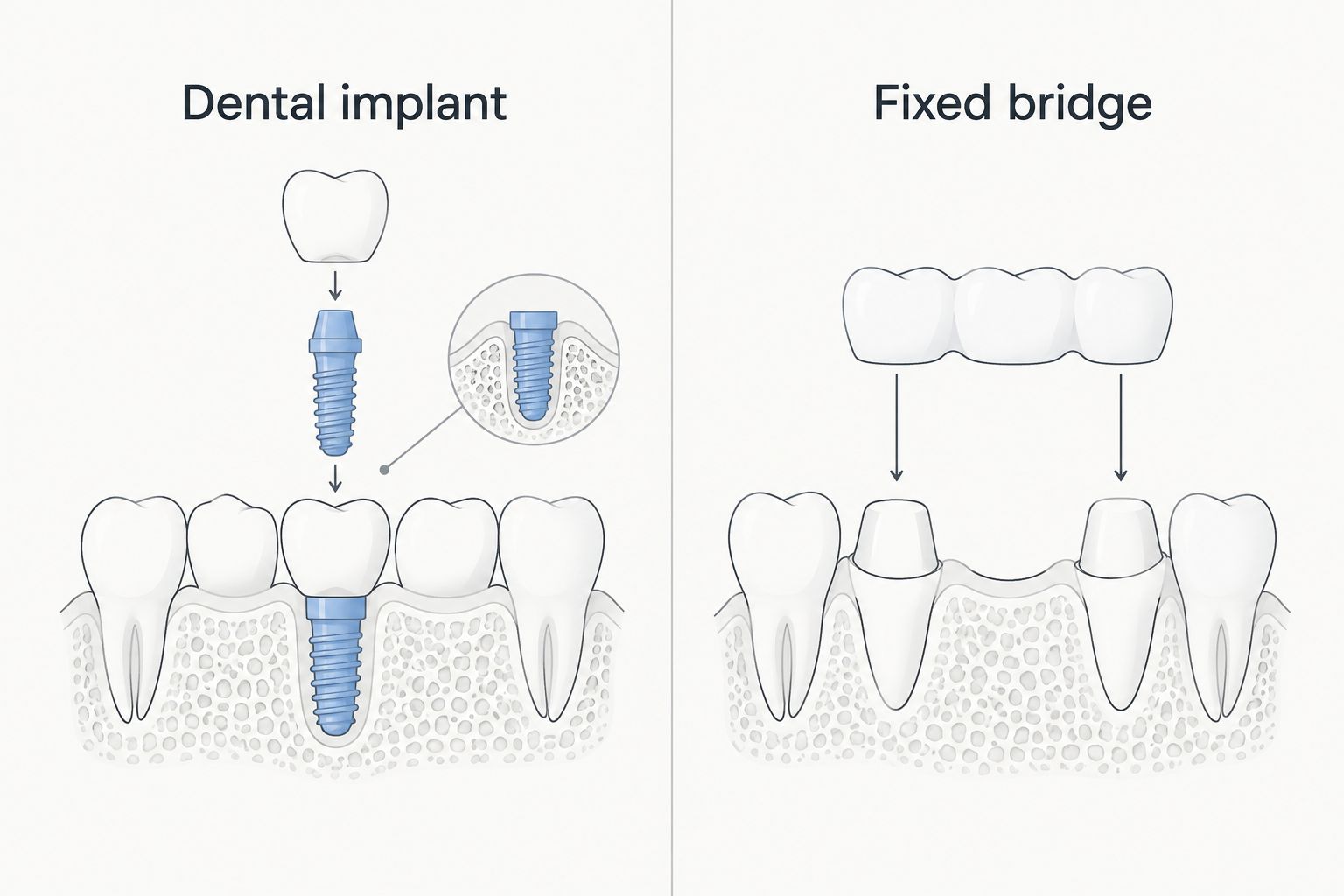
A bridge is not automatically the easier choice, and an implant is not automatically the better one. The bridge question is whether the neighboring teeth can and should carry the restoration. The implant question is whether the site and your health support placement. In 2026, bring both questions to the same appointment so the alternatives are evaluated against your actual mouth.
3. Resin-bonded bridge: best for a suitable single front-tooth gap
A resin-bonded bridge attaches a replacement tooth to an adjacent tooth or teeth using a bonded support. It is distinct from a conventional bridge: it can preserve more of the supporting tooth structure. Suitability depends on the position of the gap, the available bonding surfaces and the way your teeth meet.
Resin-bonded bridge pros:
- Can involve less preparation of neighboring teeth than a conventional bridge.
- Avoids implant surgery.
- Provides a fixed option for an appropriate front-tooth gap.
Resin-bonded bridge cons:
- Bonded support can come loose.
- Bite forces and tooth position can rule it out.
- It does not answer every question about appearance or long-term maintenance.
Best for: A patient with a single front-tooth gap whose dentist confirms that the adjacent tooth surfaces and bite suit a bonded bridge.
Ask to see where the support would attach and what happens if it comes loose. That is more useful than asking whether a bonded bridge is simply better than a conventional one. They solve different clinical problems. Verdict: Hold until a dentist checks the bonding surfaces and bite.
4. Removable partial denture: best for gaps across an arch
A removable partial denture replaces missing teeth when some natural teeth remain. Its design depends on the pattern of gaps and the teeth available for support. Unlike a fixed bridge, it can address missing teeth in different areas of the same arch without joining every gap to a separate fixed restoration.
Removable partial denture pros:
- Can replace teeth in multiple areas of an arch.
- Does not require implant surgery.
- Can be removed so you can clean the appliance separately.
Removable partial denture cons:
- Feels different from a fixed replacement and takes practice to use.
- Needs removal and cleaning as part of the daily routine.
- Fit and support depend on the condition of the remaining teeth and tissues.
Best for: Someone with natural teeth remaining and gaps in more than one part of an arch who accepts a removable appliance.
Ask how the partial will gain support and which natural teeth it will contact. Those details affect how it feels and how you clean around your remaining teeth. A partial denture is not the same thing as a complete denture, even though both are removable. Verdict: Hold until the remaining teeth and gap pattern have been mapped.
5. Complete denture: best for an arch with no natural teeth
A complete denture replaces the teeth in an arch where no natural teeth remain. It rests on oral tissues and is removed for cleaning. This is the relevant category when a single-tooth bridge or a partial denture no longer matches the number and position of teeth missing.
Complete denture pros:
- Replaces a full arch of missing teeth.
- Does not require implant placement.
- Can be removed for cleaning and inspection.
Complete denture cons:
- Does not feel or function exactly like fixed natural teeth.
- Retention and comfort depend on the shape and health of supporting tissues.
- Requires adaptation, cleaning and assessment of fit over time.
Best for: A patient replacing a full arch who wants or needs a removable option without implant placement.
If you already wear a denture, explain what is not working: movement, sore areas, speech or chewing. Those are more actionable details than saying the denture is old. If teeth still remain, discuss whether keeping them changes the plan before selecting a complete denture. Verdict: Hold until the dentist evaluates the arch and its supporting tissues.
How these options are ranked
The ranking starts with a single-tooth gap because it makes the support trade-off easiest to see. The dental implant comes first for an eligible patient who wants to avoid using adjacent teeth as bridge supports. A conventional bridge follows for a fixed replacement without implant surgery, then a resin-bonded bridge for a narrower front-tooth use case. Partial and complete dentures answer different questions about how many natural teeth remain; their lower position is not a judgment about patients who need them.
Do not use the table as a diagnosis. In 2026, the useful outcome is a shortlist to discuss with a dentist, not a treatment selected from a headline. Tell the dentist which gaps bother you, whether you want a fixed or removable replacement, and what daily cleaning you can sustain.
Which tooth replacement option should you choose?
Choose a dental implant as the first option to investigate for a single missing tooth if you want a fixed replacement that does not rely on neighboring teeth. Choose a conventional bridge to investigate when a fixed result matters but implant surgery is not your route. For a suitable front-tooth gap, ask whether a resin-bonded bridge changes the adjacent-tooth trade-off.
If you have gaps across an arch and still have natural teeth, start the removable discussion with a partial denture. If no natural teeth remain in an arch, discuss a complete denture. The default in 2026 is not to choose the same device for every gap: match the replacement to the teeth, bone and tissues that will support it.
FAQ
What are the best tooth replacement options in 2026?
Dental implants, fixed bridges, resin-bonded bridges, removable partial dentures and complete dentures are the main options compared here. The best choice depends on the missing teeth, supporting teeth, jawbone and your preference for a fixed or removable replacement.
Is an implant better than a bridge for one missing tooth?
An implant avoids using adjacent teeth as bridge supports, but it requires surgery and a suitable site. A bridge uses neighboring teeth and avoids implant placement; an examination determines which trade-off fits your mouth.
Can a bridge replace a front tooth?
A bridge can replace a front tooth when its design and supporting teeth are suitable. Ask whether a conventional or resin-bonded bridge fits the gap and your bite.
What is the difference between a partial and a complete denture?
A partial denture replaces missing teeth when natural teeth remain in the arch. A complete denture replaces an arch with no natural teeth remaining.
Do dental implants need cleaning?
Yes, dental implants need daily cleaning and ongoing dental reviews. Ask your dental team how to clean around the specific restoration placed on your implant.
How do I know whether I can get a dental implant?
A dentist must assess the implant site, jawbone, surrounding tissues and your health. A missing tooth alone does not establish that an implant is suitable.
Can I leave a missing tooth unreplaced?
A dentist can assess whether leaving the space open is reasonable in your case. The position of the gap, your bite and the condition of nearby teeth all matter.
One last thing
Do not let the replacement distract from the teeth you still have. For a 2026 home-care routine, brush natural teeth for 2 minutes, 2 times per day, and clean between them 1 time per day; ask for separate instructions for a bridge, implant or denture. The best tooth replacement is the one you can both use and maintain.