Best overall for appropriate patients with obstructive sleep apnea: a custom, adjustable mandibular advancement device. Best tooth-independent option to discuss: a tongue-retaining device. Skip over-the-counter snoring guards as a substitute for prescribed treatment. This 2026 guide compares the main appliance types, their limitations, and the checks you need before choosing one.
- Oral appliances for sleep apnea compared: custom, adjustable mandibular advancement devices are the preferred oral-appliance starting point for suitable patients.
- Tongue-retaining devices offer a different approach when tooth-supported appliances are unsuitable; fitting and tolerance still matter.
- CPAP generally controls obstructive breathing events better than oral appliances, particularly when sleep apnea is severe.
- Harmony Dental Group’s guide helps patients distinguish sleep apnea appliances from night guards and prepare questions for their clinicians.
Why this matters
A mouthpiece that reduces snoring does not necessarily control sleep apnea. Obstructive sleep apnea involves repeated narrowing or closure of the upper airway during sleep; treatment needs to address breathing, not just noise.
For La Jolla and nearby San Diego patients, Harmony Dental Group provides general, cosmetic, and restorative dental care. Sleep apnea appliance selection requires a sleep-medicine diagnosis and a dental assessment specific to the proposed device.
Do not stop prescribed CPAP because a mouthpiece feels more comfortable or your partner hears less snoring. Your sleep clinician needs evidence that the alternative treatment works.
What makes the best oral appliance for sleep apnea?
The best appliance is the one that fits your diagnosis, remains tolerable, and demonstrates effective treatment on follow-up testing. Use these criteria when reviewing options in 2026:
- Clinical suitability: Your sleep apnea type, severity, symptoms, and medical history determine whether an appliance is appropriate.
- Custom fit: A professionally fitted device accounts for your teeth, gums, bite, and available jaw movement.
- Adjustability: A titratable device lets your clinician change the jaw position rather than committing to one fixed setting.
- Dental support: Tooth-supported appliances require an assessment of tooth stability, gum health, and existing dental work.
- Nightly tolerance: Jaw soreness, tongue discomfort, saliva changes, and handling difficulties can interfere with use.
- Measured effectiveness: Follow-up sleep testing checks whether treatment controls breathing events, not simply whether snoring improves.
Oral appliances for sleep apnea compared at a glance
| Rank and appliance | Best for | Standout feature | Key limitation |
|---|---|---|---|
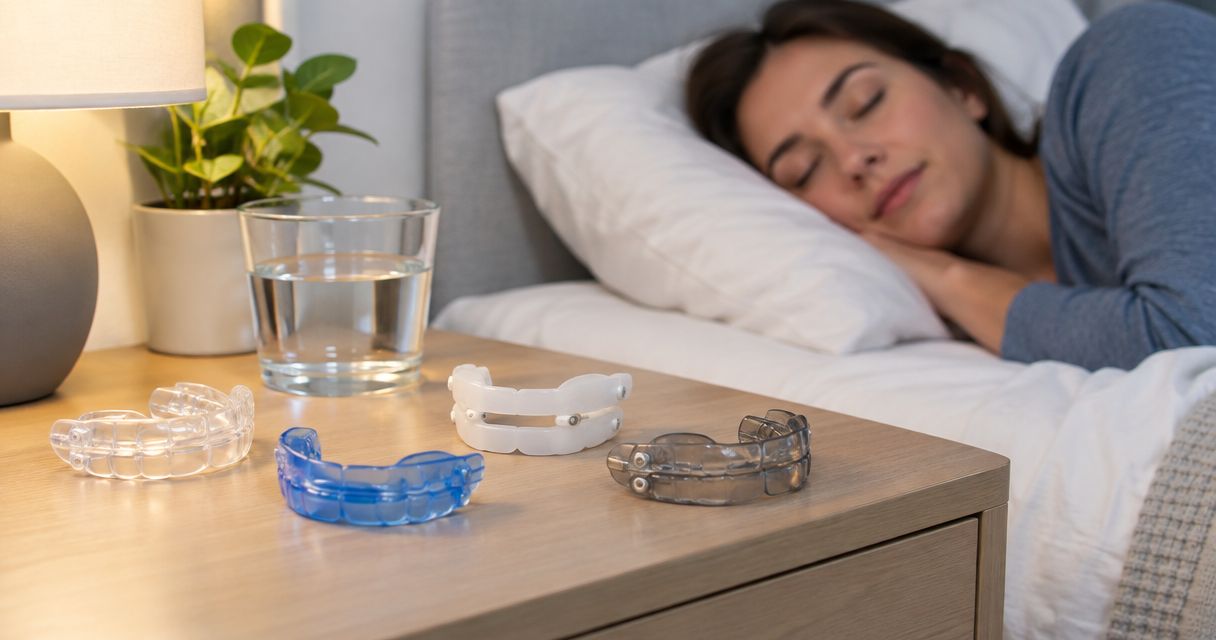
| 1. Custom adjustable mandibular advancement device | Suitable patients needing clinician-guided adjustment | Moves the lower jaw forward with adjustable positioning | Requires suitable dental support and monitoring for bite changes |
| 2. Tongue-retaining device | Selected patients unsuitable for tooth-supported advancement devices | Holds the tongue forward rather than advancing the jaw | Tongue discomfort and tolerance can limit use |
| 3. Custom fixed mandibular advancement device | Selected patients prescribed a nonadjustable jaw position | Custom fit with a fixed advancement setting | Cannot be progressively adjusted like a titratable device |
| 4. Noncustom boil-and-bite advancement device | Understanding why retail devices are not equivalent to prescribed appliances | Moldable rather than individually fabricated | Fit and treatment effectiveness are not established by reduced snoring |
These are appliance categories, not interchangeable retail recommendations. A diagnosis and examination come before choosing a design.
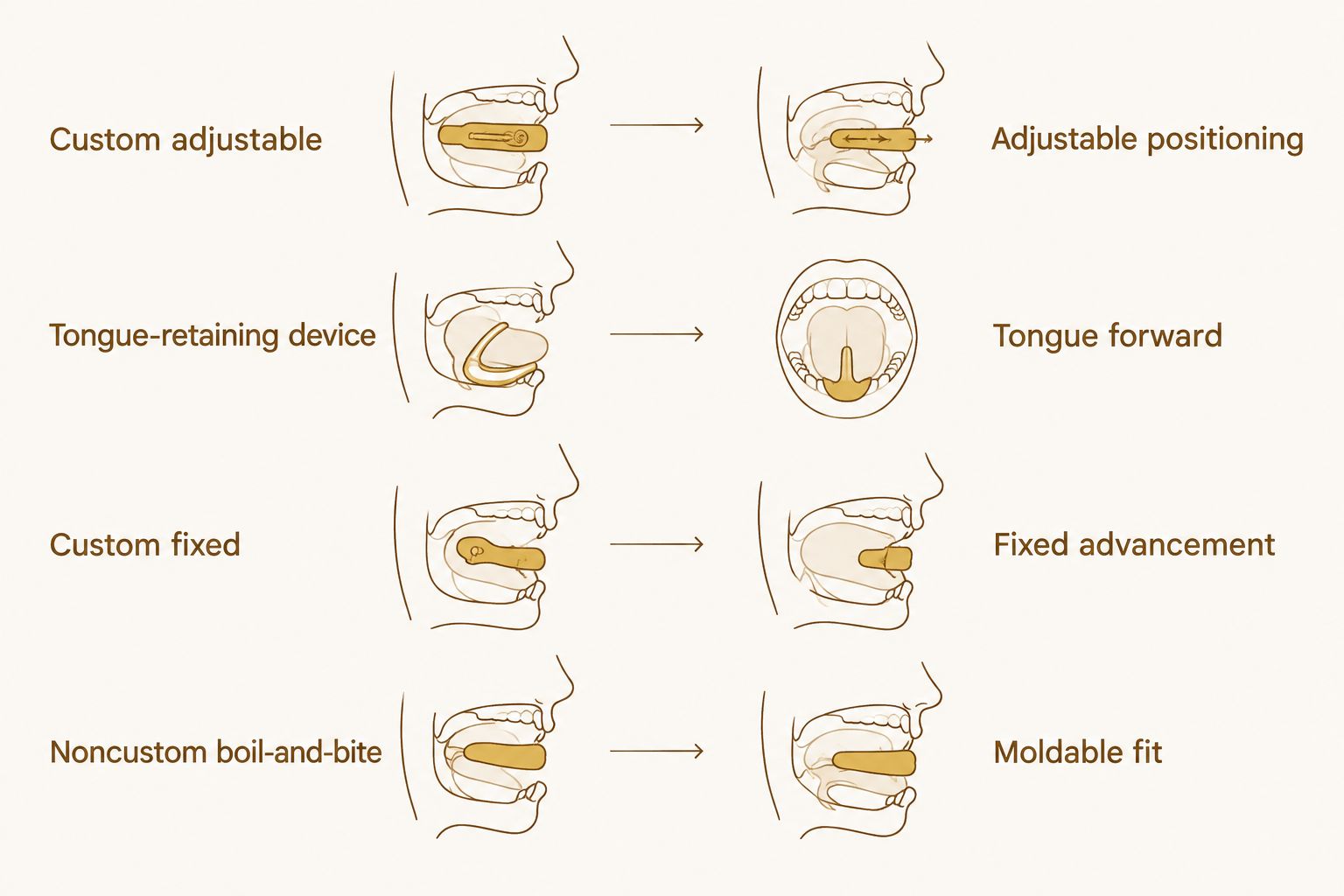
1. Custom adjustable mandibular advancement device: best for titration
A custom adjustable mandibular advancement device holds your lower jaw forward during sleep. That position helps keep the upper airway open in appropriate patients with obstructive sleep apnea. Adjustable, also called titratable, designs allow changes to the amount of advancement.
The American Academy of Sleep Medicine and American Academy of Dental Sleep Medicine recommend custom, titratable appliances over noncustom devices when oral-appliance therapy is prescribed. This is a recommendation about appliance selection, not a promise that every patient will respond.
Custom adjustable device pros:
- Individual fabrication accommodates your dental anatomy.
- Adjustable positioning supports clinician-guided treatment changes.
- The device does not require a CPAP mask or air hose.
- Dental follow-up provides opportunities to identify soreness or bite changes.
Custom adjustable device cons:
- Jaw discomfort, tooth tenderness, and saliva changes can occur.
- Long-term tooth movement or bite changes require monitoring.
- Loose teeth, active gum disease, or limited jaw movement can complicate suitability.
Best for: Patients with diagnosed obstructive sleep apnea who prefer oral-appliance therapy or cannot tolerate CPAP, when their clinicians consider the option appropriate.
Ask how adjustment will be supervised and when effectiveness will be tested. Do not keep advancing the device on your own to chase quieter snoring.
Verdict: Hold until prescribed; this is the first oral-appliance category to discuss.
2. Tongue-retaining device: best for a tooth-independent approach
A tongue-retaining device holds the tongue forward, commonly through a suction-based design. Unlike a mandibular advancement device, its primary action is not to move the lower jaw forward.
This distinction matters when a tooth-supported appliance is unsuitable. A tongue-retaining design still needs professional assessment; missing teeth do not automatically make it the right treatment.
Tongue-retaining device pros:
- Offers an approach that does not rely on the same tooth-supported jaw advancement mechanism.
- Targets the tongue’s position during sleep.
- Provides an alternative design to discuss when a mandibular advancement device is unsuitable.
Tongue-retaining device cons:
- Tongue soreness, irritation, or saliva changes can affect tolerance.
- Maintaining the tongue-retaining seal can be difficult for some users.
- Comfort alone cannot establish that the device treats sleep apnea.
Best for: Selected patients whose dental condition makes tooth-supported mandibular advancement unsuitable and whose clinicians recommend tongue retention.
Ask whether the proposed design fits your mouth and whether you can breathe comfortably while wearing it. Your dental and sleep clinicians should explain how they will check the response.
Verdict: Hold until assessed; choose this category for a specific clinical reason, not as a universal replacement for jaw advancement.
3. Custom fixed mandibular advancement device: best for a prescribed fixed position
A custom fixed mandibular advancement device also moves the lower jaw forward. Its main difference is that the advancement position is not progressively adjustable in the way a titratable device is.
Custom fabrication and adjustability are separate features. A device can fit your teeth individually yet still offer limited ability to change its treatment position.
Custom fixed device pros:
- Individual fabrication accounts for your dental anatomy.
- Holds the jaw at the position selected during the fitting process.
- Avoids a patient-operated advancement mechanism.
Custom fixed device cons:
- Limited adjustment makes it harder to refine jaw position as treatment progresses.
- A different position can require modification or replacement rather than a setting change.
- Jaw symptoms, tooth movement, and bite changes still require monitoring.
Best for: Selected patients whose treating clinician identifies a reason to prescribe a fixed custom design.
For a first appliance discussion in 2026, ask why a fixed design is being recommended instead of a custom adjustable one. The explanation should address your clinical situation, not just the device’s appearance.
Verdict: Hold unless your clinician gives a patient-specific reason for choosing a fixed design.
4. Noncustom boil-and-bite device: best for recognizing retail limitations
A boil-and-bite device uses a moldable material rather than laboratory fabrication from an individual dental impression or scan. Some retail devices aim to advance the jaw, while other mouthguards only protect teeth.
The packaging does not establish that a device controls your diagnosed sleep apnea. A snoring claim and a treatment plan are different things.
Noncustom device pros:
- Moldable material allows some adaptation to the teeth.
- A simple design can be straightforward to handle.
- No individual laboratory fabrication is involved.
Noncustom device cons:
- Fit is not equivalent to an individually fabricated appliance.
- Unsupervised jaw positioning can cause discomfort or dental problems.
- Reduced snoring does not demonstrate adequate control of breathing events.
Best for: Understanding the distinction between retail mouthpieces and clinician-managed therapy, not self-treating diagnosed sleep apnea.
If you already use a retail mouthpiece, bring it to your appointment. Tell your clinician whether you have developed tooth pain, jaw symptoms, or a changed bite.
Verdict: Skip as a substitute for prescribed sleep apnea treatment.
How these options were ranked
This 2026 comparison prioritizes clinical suitability, custom fit, adjustability, dental monitoring, and confirmed effectiveness. The custom adjustable category ranks first because it matches the AASM and AADSM recommendation for prescribed oral-appliance therapy.
Tongue retention has a distinct role when tooth-supported advancement is unsuitable. Fixed and noncustom devices rank lower because they provide less flexibility or do not meet the same custom-fitting recommendation.
Harmony Dental Group’s oral-appliance guide is best for patients preparing an informed treatment discussion, not choosing a mouthpiece without a diagnosis. The ranking does not establish which individual device will work for your airway.
When CPAP remains the better starting point
CPAP supplies pressurized air through a mask to help keep the airway open. It generally reduces obstructive breathing events and improves oxygen measures more effectively than oral appliances; severe obstructive sleep apnea usually makes CPAP the primary treatment to discuss.
Your apnea-hypopnea index, or AHI, counts breathing interruptions per hour of sleep. Common adult severity categories are:
- Mild: 5 to fewer than 15 events per hour.
- Moderate: 15 to fewer than 30 events per hour.
- Severe: 30 or more events per hour.
These categories do not decide treatment alone. Symptoms, oxygen levels, other medical conditions, and treatment tolerance also matter.
| Treatment | Best for | Main advantage | Main limitation |
|---|---|---|---|
| CPAP | Patients needing effective airway support, including many with severe obstructive sleep apnea | Generally stronger control of breathing events | Mask tolerance and consistent use can be difficult |
| Prescribed oral appliance | Suitable patients who prefer an alternative or cannot tolerate CPAP | No air hose or mask | Response varies and requires dental monitoring and sleep testing |
An advancement appliance is not a treatment for central sleep apnea, where the problem involves breathing signals rather than simply an obstructed airway. Confirm which condition your sleep study identified.
What to ask before agreeing to an appliance
Bring your sleep-study report, medication list, and any existing night guard or retainer. Tell the dentist about jaw pain, loose teeth, gum disease, dentures, implants, and changes in your bite.
Use this appointment checklist:
- Diagnosis: Is my sleep apnea obstructive, central, or mixed?
- Suitability: Do my teeth, gums, and jaw support the proposed design?
- Adjustment: Who changes the settings, and what symptoms should prompt a call?
- Testing: How will my sleep clinician confirm that treatment works?
- Monitoring: How will tooth movement and bite changes be checked?
- Coordination: Who manages my current CPAP plan while the appliance is being fitted?
Do not assume a grinding guard, orthodontic retainer, or denture can perform the same function. Each has a different purpose, and combining devices requires professional guidance.
Which oral appliance should you choose?
Start with a discussion about a custom adjustable mandibular advancement device if oral-appliance therapy is appropriate for your diagnosis. Ask about tongue retention when dental support makes jaw advancement unsuitable; do not select a fixed or retail design without understanding its limitations.
For patients using Harmony Dental Group’s comparison in 2026, the next move is to bring the sleep-study findings into a coordinated dental and sleep-medicine discussion. The decision is not simply which mouthpiece feels easiest to wear. It is which prescribed treatment you can use consistently and verify objectively.
FAQ
What is the best oral appliance for obstructive sleep apnea?
A custom, adjustable mandibular advancement device is the preferred oral-appliance category to discuss for suitable patients. Your sleep clinician and a qualified dentist must confirm suitability, and follow-up sleep testing must check the treatment response.
Is an oral appliance better than CPAP?
CPAP generally controls obstructive breathing events more effectively than oral appliances. An oral appliance is an alternative for suitable patients who prefer it or cannot tolerate CPAP, with clinician guidance and follow-up testing.
Can I use a teeth-grinding night guard for sleep apnea?
A standard teeth-grinding night guard is not a prescribed sleep apnea treatment. It protects teeth rather than necessarily positioning the jaw or tongue to help keep the airway open.
Can I use an oral appliance if I have missing teeth?
Missing teeth do not automatically rule out every oral appliance, but they can affect tooth-supported designs. A dentist must assess the remaining teeth, gums, dental restorations, and whether a tongue-retaining approach is appropriate.
Can sleep apnea mouthpieces change my bite?
Jaw-advancement appliances can cause tooth movement and bite changes over time. Regular dental follow-up checks these effects alongside soreness, tooth tenderness, and other symptoms.
How do I know whether my sleep apnea appliance works?
Follow-up sleep testing evaluates whether the appliance controls breathing events. Less snoring or better sleep alone does not prove that obstructive sleep apnea is adequately treated.
Does Harmony Dental Group offer sleep apnea appliances?
Confirm sleep apnea appliance services directly with Harmony Dental Group before arranging treatment. Ask whether the practice provides the proposed device and coordinates care with your sleep clinician.
One last thing
A quieter bedroom is not the same as a treated airway. Before you leave an appliance consultation, ask who will arrange the follow-up sleep test and how the result will change your plan. That question matters more than a mouthpiece’s appearance.