Your all on 4 dental implants price depends on an examination and a written treatment plan; an online estimate cannot establish your personal total in 2026. Before comparing quotes, check whether each includes one or both arches, any necessary extractions, temporary teeth, the final bridge, anesthesia, and follow-up care.
- Compare an all on 4 dental implants price by treatment scope, not the advertised monthly payment.
- All-on-4 uses four implants to support a full-arch bridge; treating both arches requires separate planning.
- Ask whether temporary teeth, the final bridge, extractions, and follow-up care appear in your written estimate.
- Harmony Dental Group is a local option for La Jolla patients seeking a dental implant evaluation.
How much do all-on-4 dental implants cost?
The useful number is your complete, individualized treatment estimate—not an advertised starting figure. A quote for one arch does not describe the same treatment as a quote for both arches. Likewise, a surgical quote alone does not establish what you will pay for the finished teeth.
For local patients, Harmony Dental Group provides dental implant care in La Jolla. Ask whether an All-on-4 approach fits your examination findings and which full-arch treatments the practice recommends for you.
All-on-4 describes a treatment approach in which 4 implants support a fixed bridge replacing a full arch of teeth. The bridge replaces multiple teeth together rather than giving every replacement tooth its own implant. Your dentist must assess whether this approach is suitable before developing a treatment estimate.
Use this checklist when requesting a 2026 quote:
| Treatment component | What your estimate should clarify | Why it matters |
|---|---|---|
| Examination and imaging | Which diagnostic records are included | Treatment planning requires an assessment of teeth, gums, and bone |
| Tooth removal | Whether necessary extractions are included | Removing remaining teeth is separate from placing implants |
| Implant surgery | Which arch is treated and what surgery includes | A surgical fee is not necessarily a complete restoration fee |
| Temporary teeth | Whether a temporary bridge is planned and included | Temporary teeth and final teeth serve different stages |
| Final bridge | Material, design, and delivery appointments | The finished restoration needs its own clear description |
| Anesthesia and sedation | Which approach is planned and how it is billed | Comfort arrangements need to match your medical assessment |
| Follow-up care | Which appointments and adjustments are included | Care continues after implant placement |
Why this matters
You deserve to understand what you are agreeing to before treatment starts. A short advertisement cannot explain your bone condition, which teeth can be saved, or the restoration your dentist plans to provide.
Compare matching treatment plans before comparing payment arrangements. Otherwise, a smaller monthly payment can distract you from differences in the treatment itself or the financing agreement.
One arch versus both arches: check the treatment scope
An arch means the upper or lower row of teeth. Treatment for 1 arch addresses either the upper or lower jaw; treatment for 2 arches addresses both. Neither description tells you whether your remaining teeth should be removed—that requires a clinical assessment.
| Scope | Best for | Main benefit | Main limitation |
|---|---|---|---|
| One arch | Patients whose examination supports full-arch replacement in one jaw | Addresses the affected arch while preserving suitable teeth elsewhere | The new bridge must work with the opposing teeth or restoration |
| Both arches | Patients whose examination supports full-arch replacement in both jaws | Allows the upper and lower restorations to be planned together | Involves treatment and ongoing care for both jaws |
Do not assume a quote for both arches is simply a single-arch quote multiplied by two. Ask for an itemized plan that explains the surgery, restoration, and follow-up for each jaw. Shared appointments do not make the underlying clinical needs identical.
If your goal is to replace only a few missing teeth, ask about other implant arrangements. The guide to single implants versus All-on-4 explains the distinction between replacing individual teeth and replacing an entire arch.
Why all-on-4 treatment estimates vary
Different estimates can describe different care. These are the clinical and restorative details to discuss—not reasons to assume the more expensive plan is better.
- Teeth and gums: The dentist needs to identify teeth worth preserving, teeth requiring removal, and active gum disease needing attention.
- Bone support: Bone quantity and location influence implant planning. Ask whether additional procedures are recommended and why.
- Bridge design: Temporary and final bridges are distinct. Your plan should identify the intended restoration rather than simply saying teeth are included.
- Comfort needs: Local anesthesia and sedation are not interchangeable. Your medical history and the planned procedure guide the discussion.
- Treatment stages: Immediate temporary teeth are not appropriate in every case. Ask what happens if the implants need healing before supporting a bridge.
- Continuing care: Clarify which postoperative visits, adjustments, and later maintenance are part of the treatment agreement.
A detailed 2026 estimate should make these differences visible. If two plans disagree, ask each dentist to explain the clinical reason rather than choosing from the total alone.
Temporary teeth and final teeth are different
A temporary bridge supports the treatment process while your dentist monitors healing and plans the final restoration. A final bridge is the restoration intended for ongoing use after the necessary clinical checks. Receiving temporary teeth does not mean every stage of treatment is complete.
Ask your dentist to explain what each stage includes, what restrictions apply, and what findings must be present before you move forward. Immediate placement of temporary teeth depends on clinical suitability; it is not a promise that applies to every patient.
A clear plan distinguishes these stages:
- Assessment: Review your health, examine your mouth, and evaluate diagnostic imaging.
- Surgery: Complete the agreed procedures and assess implant stability.
- Healing: Follow individualized instructions and attend scheduled checks.
- Final restoration: Confirm the planned bridge's fit, bite, and cleaning access before completion.
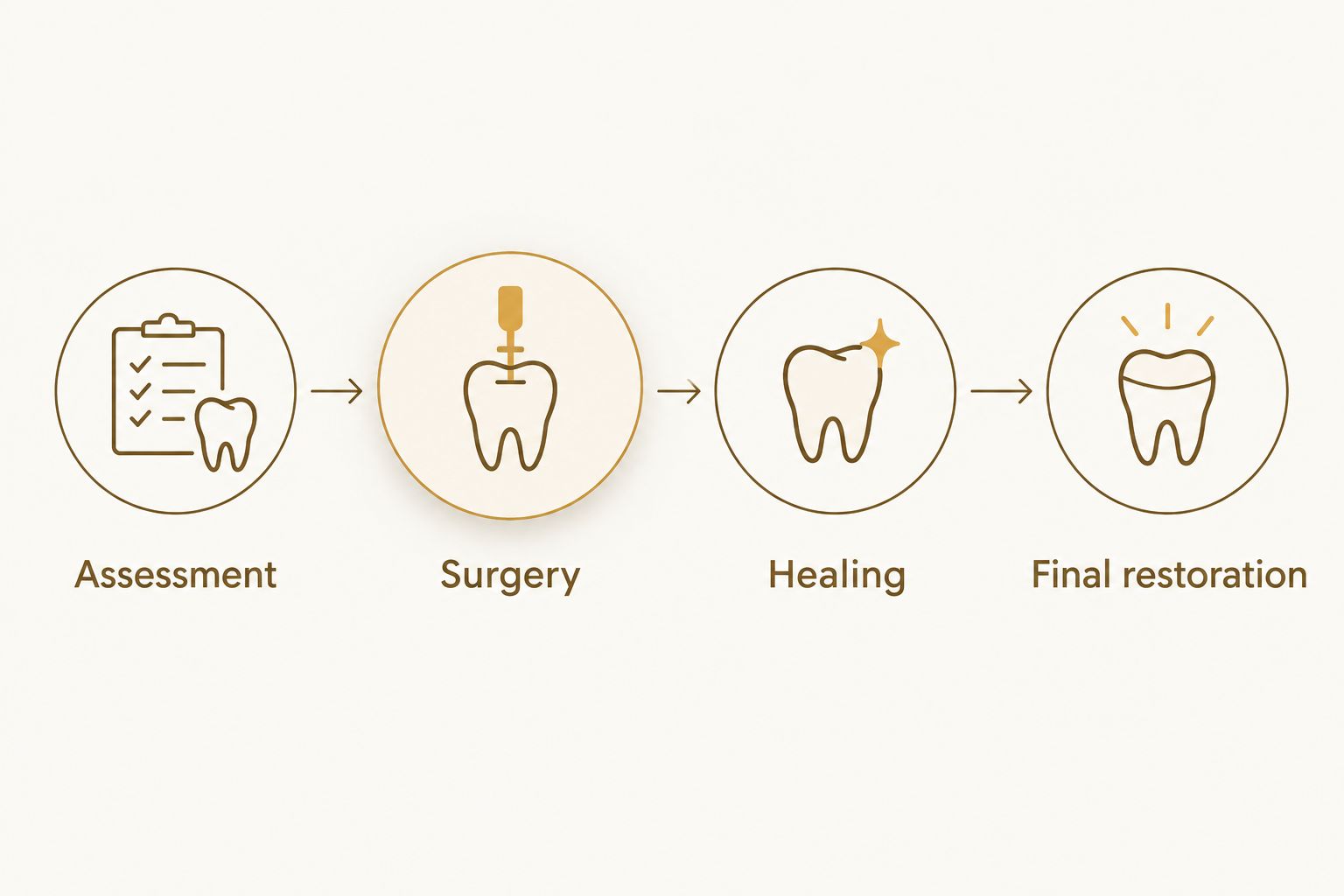
The sequence can change when additional treatment is needed. Ask for a written explanation of your expected stages and the circumstances that would change them, rather than treating a general timeline as a personal commitment.
What should you ask at an implant consultation?
Bring your medication list, relevant medical history, and any existing treatment estimates. Tell the dentist what bothers you most: chewing, loose dentures, discomfort, appearance, or difficulty keeping your teeth clean. Those concerns help frame the discussion without deciding the treatment in advance.
Use these questions to turn a consultation into a clear decision:
- Which of my teeth can be preserved, and why do you recommend removing any others?
- Why is a full-arch bridge appropriate instead of another tooth-replacement approach?
- What does the imaging show about bone support?
- Who will place the implants and provide the final bridge?
- What temporary teeth are planned, and what happens if immediate loading is unsuitable?
- What is included in the written estimate, and what would require a separate agreement?
- How will I clean underneath the bridge, and what professional maintenance will I need?
You do not need to know dental terminology before asking these questions. A useful explanation connects the findings in your mouth to the recommended treatment and its limitations.
Harmony Dental Group offers general, cosmetic, and restorative dentistry for La Jolla patients. For a dental implant consultation, ask for an explanation of your options, candidacy, and treatment scope before discussing a payment arrangement.
Is All-on-4 better than removable dentures?
All-on-4 and removable dentures meet different needs; neither is the right choice for everyone. A fixed implant bridge stays attached during everyday use, while a removable denture is designed for you to take out. Both require cleaning, professional review, and an assessment of your mouth.
| Approach | Best for | Potential benefit | Important limitation |
|---|---|---|---|
| Fixed full-arch implant bridge | Suitable patients who want teeth that stay attached during everyday use | Does not need routine removal by the patient | Requires surgery and careful cleaning beneath the bridge |
| Implant-retained removable denture | Suitable patients who want implant retention with a removable restoration | Can be removed for cleaning | Requires implant surgery and maintenance of attachment components |
| Conventional removable denture | Patients choosing a nonsurgical tooth-replacement approach | Does not require implant placement | Fit and stability require monitoring as the mouth changes |
These are discussion options, not recommendations to replace healthy teeth. Ask which approach fits your anatomy, ability to maintain the restoration, medical history, and priorities.
Does dental insurance cover All-on-4 implants?
Coverage depends on your individual plan and the procedures being proposed. Do not assume that a policy covering some dental care covers implant surgery, a full-arch bridge, or every associated service.
Before scheduling treatment in 2026, ask the dental office and insurer to clarify:
- Which proposed procedures are covered or excluded.
- Whether deductibles, annual maximums, waiting periods, or network rules apply.
- Whether a pretreatment estimate is available.
- Which amounts remain your responsibility if the insurer pays differently than expected.
A pretreatment estimate helps you plan, but it is not the same as a guarantee of payment. Keep the insurer's response alongside your treatment estimate so you can distinguish the clinical plan from the benefits decision.
Can you pay for All-on-4 implants monthly?
Monthly payments depend on the financing arrangements offered and your eligibility. Ask about available arrangements without assuming approval, a particular interest rate, or a specific repayment term.
When reviewing a 2026 financing offer, compare the total amount financed, interest terms, fees, payment schedule, and any promotional conditions. Also ask when payment becomes due relative to surgery and delivery of the final bridge. The treatment estimate and financing agreement answer different questions; read both.
FAQ
What's included in an all on 4 dental implants price?
An all on 4 dental implants price includes only the services identified in that provider's written estimate. Ask specifically about imaging, extractions, implant placement, temporary teeth, the final bridge, anesthesia, and follow-up care.
Does an All-on-4 quote cover my whole mouth?
An All-on-4 quote does not automatically cover both jaws. Confirm whether the estimate addresses the upper arch, lower arch, or both, and request a clear description of each restoration.
Can I get a firm All-on-4 estimate without an examination?
A personalized treatment estimate requires a clinical assessment and appropriate diagnostic records. An advertised figure cannot establish your bone support, necessary extractions, or suitability for a fixed full-arch bridge.
Are same-day teeth the final teeth?
Same-day teeth are not necessarily the final restoration. Ask whether the proposed bridge is temporary, what healing requirements apply, and when the final bridge would be provided.
Can I get All-on-4 implants if I have bone loss?
Bone loss requires individualized implant planning and does not establish candidacy by itself. Your dentist must evaluate the amount and location of available bone and explain whether additional treatment or another approach is appropriate.
Will I still need dental visits after getting a fixed bridge?
A fixed implant bridge still needs professional follow-up and daily cleaning. Ask your dental team to demonstrate cleaning beneath the bridge and set a maintenance schedule for your needs.
Where can I discuss dental implants in La Jolla?
Harmony Dental Group provides dental implant care in La Jolla. Ask whether a full-arch approach is appropriate for your mouth and request a written explanation of the proposed treatment.
One last thing
Ask the dentist to show you how you would clean the proposed bridge before you commit. A restoration needs to fit your daily life as well as your mouth, and cleaning access belongs in the treatment discussion—not just the instructions after surgery.
For your 2026 consultation, bring one written checklist: treatment scope, temporary teeth, final bridge, follow-up, and exclusions. Leave with those points clarified before deciding how to pay. You should feel informed, not rushed.