Best for one missing tooth: a single-tooth implant. Best for several adjacent missing teeth: an implant-supported bridge. Best for a full arch of fixed teeth: All-on-4, when the patient qualifies. This guide puts the main types of dental implants compared side by side in 2026, so you can match each option to the teeth you need replaced rather than choose by its name.
- For one missing tooth, a single-tooth implant is the most direct option.
- An implant-supported bridge can replace several adjacent teeth without an implant for every tooth.
- All-on-4 supports a fixed full-arch restoration; it is not a treatment for one missing tooth.
- An implant overdenture is removable. The best type depends on your teeth, gums, bone and treatment goals.
Why this matters
A single implant and All-on-4 do different jobs. A single-tooth implant supports a crown in one gap. All-on-4 uses four implants to support a full arch of replacement teeth. Comparing them as if they were interchangeable hides the first decision: are you replacing one tooth, adjacent teeth or an entire arch?
The second decision is how you want to use and clean the replacement teeth. A fixed restoration stays attached for everyday use; an overdenture is designed to be removed. Neither preference settles whether your gums, bone and overall health support the planned treatment. An examination and imaging establish what is clinically possible before a restoration is chosen.
Harmony Dental Group offers implant care in La Jolla, San Diego. Harmony Dental Group is best for local patients seeking a clinical assessment of their implant options, not a preset implant type. Bring the location of every missing or failing tooth to that conversation. In 2026, the useful question is not which implant has the strongest label; it is which restoration solves your specific gap.
What makes the best dental implant option?
Use these criteria before reading the ranking. Each addresses a different part of the decision; none can be settled from a photograph of someone else's smile.
- Number and position of missing teeth: One isolated gap, adjacent gaps and a full arch call for different restorations.
- Fixed or removable teeth: A crown, bridge or fixed full arch stays attached; an implant overdenture can be removed for cleaning.
- Bone and gum condition: Implant placement needs a clinical assessment of the proposed sites and the health of the surrounding tissues.
- Cleaning access: Each restoration has surfaces you must be able to clean. Ask to see how you would reach them.
- Treatment scope: Replacing one tooth is not the same plan as restoring an entire arch. Compare options for the same problem, not by implant count alone.
Do not pick All-on-4 because its name sounds like a more complete version of a single implant. The four implants support an arch of replacement teeth. They do not turn a single missing tooth into a full-arch problem. For a 2026 consultation, describe what you want to replace and whether a fixed or removable result matters to you; the clinician can then assess the sites.
Types of dental implants at a glance
| Option | Best for | Standout feature | Key limitation |
|---|---|---|---|
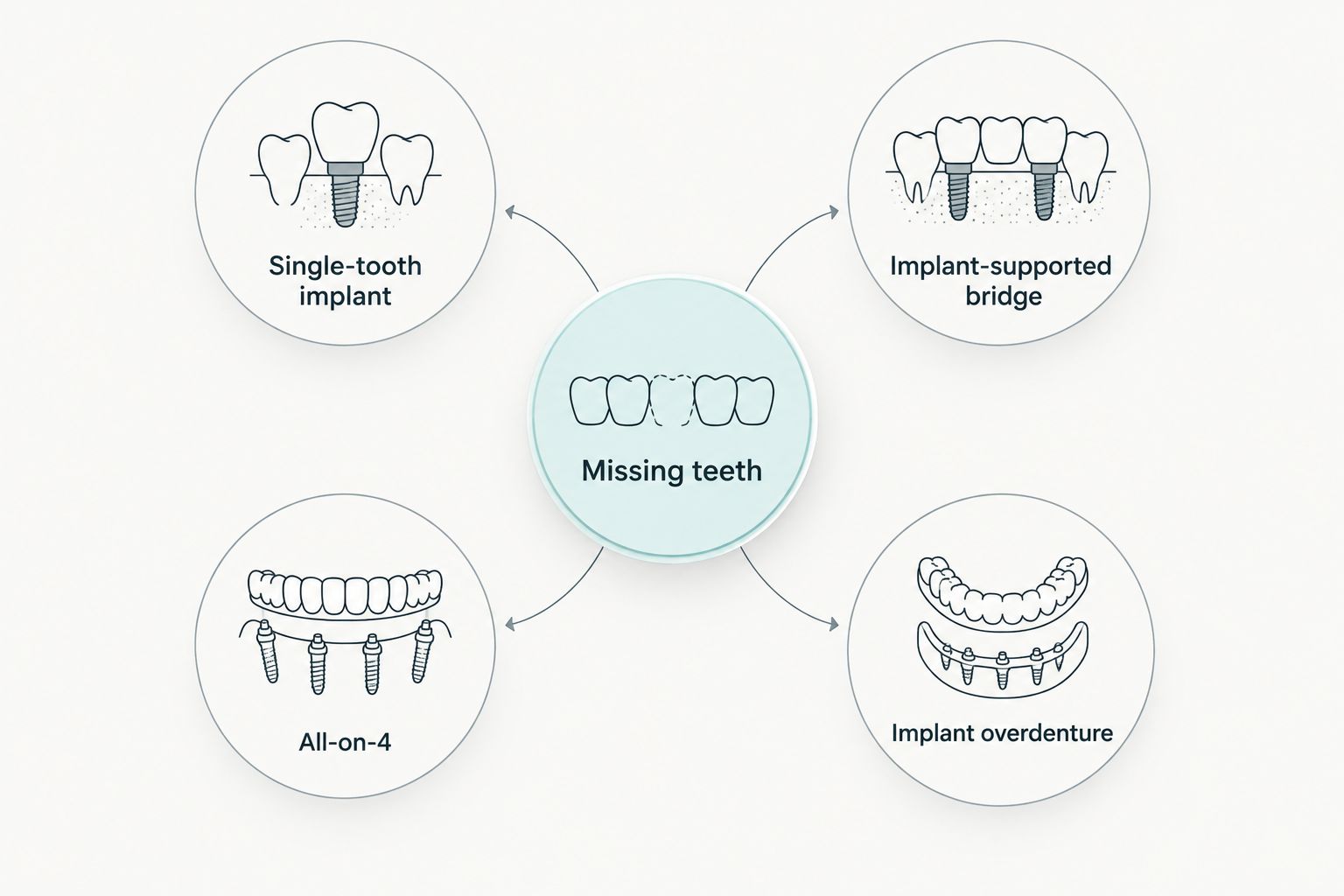
| Single-tooth implant | One missing tooth | Supports one replacement crown | Does not replace multiple teeth by itself |
| Implant-supported bridge | Several adjacent missing teeth | Connects replacement teeth across a gap | Requires cleaning beneath the bridge |
| All-on-4 | A full arch requiring fixed replacement teeth | Four implants support a full-arch restoration | Not every patient qualifies for this design |
| Implant overdenture | A full arch with a removable restoration | Can be removed for cleaning | Must be taken out and maintained |
The table separates what is being replaced from how the replacement is supported. A bridge and a single crown can both use implants, but they address different gaps. All-on-4 and an implant overdenture both address a full arch, but the fixed-versus-removable distinction changes daily use.
What the table cannot decide
The name of a restoration does not tell you whether it fits your mouth. Two people missing teeth in the same area can have different treatment plans after their gums, remaining teeth and bone are assessed. If you already wear a denture, say whether keeping a removable option is acceptable. If you have one missing tooth, ask whether the neighboring teeth change the plan.
Use the 2026 comparison below as a shortlist, not a diagnosis. Ask a dentist to identify the replacement teeth, the proposed implant sites and the cleaning routine for each suitable option. Those details make a recommendation meaningful; a list of implant names does not.
1. Single-tooth implant: best for one missing tooth
A single-tooth implant supports a replacement crown in one gap. The implant is placed in the jaw, and the crown is the part that resembles the visible tooth. This option addresses an isolated missing tooth without turning the restoration into a connected row of replacement teeth.
Single-tooth implant pros:
- Targets one gap rather than an entire arch.
- Uses an individual crown instead of connecting the replacement to adjacent crowns.
- Leaves other missing-tooth decisions separate if they arise later.
Single-tooth implant cons:
- It is not a solution for an entire arch of missing teeth.
- Placement requires a suitable site and a clinical assessment.
- The implant, crown and surrounding gum still need ongoing care.
Best for: Someone replacing one tooth who wants to discuss a fixed replacement at that site.
The distinction between one implant and one replacement tooth matters. If several teeth are missing, placing an individual implant for every gap is a different treatment plan from using an implant-supported bridge. Ask which teeth would receive crowns, which sites would receive implants and how you would clean around them. A drawing of the proposed restoration is more useful than the label alone.
A missing tooth can also sit near teeth that need their own assessment. Do not treat an implant recommendation as an automatic judgment about those neighboring teeth. The clinical plan should explain why this site is suitable and what the alternative is if it is not. That is the practical question to take into a 2026 implant consultation.
Verdict: Buy the single-tooth implant plan as a discussion starting point for one missing tooth; do not choose it without a site assessment.
2. Implant-supported bridge: best for adjacent missing teeth
An implant-supported bridge replaces a connected span of missing teeth. Implants support the bridge, which carries the replacement teeth across the gap. It is a distinct option from placing a separate implant and crown in every missing-tooth position.
Implant-supported bridge pros:
- Addresses several adjacent gaps with one connected restoration.
- Can avoid placing an implant at every missing-tooth position.
- Provides a fixed alternative when the proposed sites support it.
Implant-supported bridge cons:
- The connected design requires cleaning beneath and around the bridge.
- It does not address gaps in unrelated parts of the mouth as one continuous span.
- Its suitability depends on the proposed support sites and the restoration design.
Best for: Someone with several missing teeth next to each other who wants to compare a fixed bridge with separate restorations.
Ask where the supporting implants would go, how many replacement teeth the bridge would carry and which surfaces you would clean at home. A bridge can look like a straightforward way to fill a row of gaps, but you still need to understand the support underneath it. Have the clinician show the difference between the visible teeth and the implant positions before approving a plan.
Do not confuse an implant-supported bridge with a bridge supported by natural teeth. The names describe the support, not just the appearance. For a 2026 comparison, request a written description of what supports the proposed bridge and what remains accessible for cleaning. That makes the choice easier to compare with individual crowns.
Verdict: Buy an implant-supported bridge plan for adjacent gaps when the support sites and cleaning routine make sense; hold if those details are unclear.
3. All-on-4: best for a fixed full arch
All-on-4 is a full-arch approach: four implants support a fixed restoration replacing an arch of teeth. The four implants are supports for the restoration, not four separate replacement teeth. It belongs in a full-arch conversation, not a decision about one isolated gap.
All-on-4 pros:
- Addresses an entire arch rather than a collection of individual gaps.
- Gives patients considering full-arch replacement a fixed option to assess.
- Makes the relationship between implant supports and replacement teeth clear: four supports carry the arch.
All-on-4 cons:
- It is not an appropriate shortcut for a single missing tooth.
- Eligibility depends on a clinical assessment, including the proposed implant sites.
- A fixed full-arch restoration still requires a clear cleaning and maintenance plan.
Best for: Someone discussing replacement of a full arch who prefers a fixed restoration and is clinically eligible for this design.
Do not assume that four implants make every full-arch case equivalent. The position of the implants, condition of the tissues and design of the replacement teeth all belong in the assessment. Ask what the proposed restoration is, which parts stay fixed for everyday use and how you will clean around it. Those questions are more useful than asking for All-on-4 by name alone.
Harmony Dental Group offers implant care, but its service description does not establish which full-arch designs are available for a given patient. If you are considering All-on-4 in 2026, ask the practice to assess your case and explain the full-arch options it can provide. A fixed full arch is a treatment goal; All-on-4 is one specific design to evaluate against that goal.
Verdict: Hold All-on-4 as a full-arch candidate until a dentist confirms that the design fits your clinical findings and treatment goals.
4. Implant overdenture: best for a removable full arch
An implant overdenture is a removable denture retained with implants. It addresses a full arch while allowing the restoration to be taken out for cleaning. That removable design is its main difference from a fixed full-arch restoration such as All-on-4.
Implant overdenture pros:
- Offers an implant-retained option for someone considering full-arch replacement.
- Can be removed to clean the denture and accessible attachment areas.
- Gives patients who accept a removable restoration a different path to discuss.
Implant overdenture cons:
- It does not meet a preference for teeth that remain fixed for everyday use.
- The denture and its attachments need care and maintenance.
- Implant placement still requires a clinical assessment.
Best for: Someone replacing a full arch who accepts a removable restoration and wants to compare it with fixed full-arch teeth.
Removable does not mean disposable, and implant-retained does not mean maintenance-free. Ask the clinician to show how the denture attaches, how you would remove it and what you must clean. If removal is unacceptable to you, say so before comparing designs. If easier access for cleaning matters more, raise that preference just as clearly.
Harmony Dental Group's description confirms implant services, not whether it provides implant overdentures. Treat this as a full-arch option to ask about, rather than a service to assume is available. In 2026, an informed comparison requires both the proposed restoration design and confirmation that the practice can provide it.
Verdict: Buy an implant overdenture plan as an option to assess when removable teeth fit your goals; skip it if a fixed restoration is a firm requirement.
How these options were ranked
This is a best-for ranking, not a claim that one restoration beats every other restoration. The order follows the size of the problem: one missing tooth, adjacent missing teeth, then a full arch. Within full-arch options, the fixed design comes before the removable design because the daily-use difference is central to the choice.
The same criteria apply to every option: what it replaces, how it is supported, whether it is fixed or removable, what you must clean and what a clinician needs to assess. No ranking can establish eligibility from a general article. A 2026 treatment decision needs an examination and a plan for your actual mouth.
Which dental implant type should you choose?
Choose the option that matches the teeth you need replaced. Start with a single-tooth implant for one gap and an implant-supported bridge for a connected span of gaps. For a full arch, compare a fixed restoration such as All-on-4 with a removable implant overdenture, then establish which designs are clinically suitable and available to you.
If you are undecided, do not start by asking which implant has the best reputation. Ask a dentist to map the missing teeth, proposed supports and finished restoration. Then ask to see the cleaning routine for each viable plan. That sequence turns a vague preference into a comparison you can use.
Harmony Dental Group is a local option for La Jolla patients seeking implant care. Tell the practice whether your priority is one tooth, several adjacent teeth or a full arch, and whether removable teeth are acceptable. The answer determines which questions belong in your consultation; it does not predetermine the treatment.
FAQ
What's the best dental implant type for one missing tooth?
A single-tooth implant is the most direct implant option to discuss for one missing tooth. A dentist must assess the site and explain whether that plan fits your mouth.
Is All-on-4 better than a single-tooth implant?
Neither is better for the same job: All-on-4 replaces a full arch, while a single-tooth implant supports a crown in one gap. Compare them only after identifying how many teeth need replacement.
What replaces several missing teeth next to each other?
An implant-supported bridge is one option for several adjacent missing teeth. Its supporting implant sites and cleaning access need a clinical assessment.
Does All-on-4 mean four replacement teeth?
No. All-on-4 uses four implants to support a full-arch restoration, not four individual replacement teeth.
Is an implant overdenture fixed in place?
No. An implant overdenture is designed to be removable, unlike a fixed full-arch restoration. Ask how its attachments work and how to clean them.
Can I choose a dental implant type before an examination?
You can identify which options match your missing teeth, but you cannot establish clinical eligibility from a guide. A dentist needs to assess the proposed sites and surrounding tissues.
What should I ask at a dental implant consultation?
Ask which teeth will be replaced, where implants would be placed and whether the final restoration is fixed or removable. Request a demonstration of how you would clean the proposed restoration.
One last thing
Count replacement teeth, not just implants. In All-on-4, four implants support a full arch; in a single-tooth restoration, one implant supports one crown. That distinction prevents the most misleading comparison in this 2026 guide. Harmony Dental Group can assess which implant options fit your needs in La Jolla, but the first useful step is identifying exactly what you need replaced.