All-on-4 dental implants are worth considering when you need a full arch of replacement teeth, want teeth that stay fixed in place, and can commit to surgery and ongoing care. The trade-off is that treatment involves more than placing implants: extractions, healing, the replacement bridge, cleaning, and future repairs all belong in your decision.
- Are all on 4 dental implants worth it? For suitable patients, fixed full-arch teeth justify considering surgery and ongoing maintenance.
- All-on-4 uses 4 implants to support 1 arch of replacement teeth; it does not replace each tooth with an implant.
- Compare All-on-4 with removable dentures and preserving treatable teeth before agreeing to extractions.
- Harmony Dental Group offers dental implant care in La Jolla; ask which treatment fits your examination findings.
Why this matters
A full-arch treatment decision changes how you eat, clean your mouth, and manage dental care. Appearance matters, but it should not be the only reason you accept an irreversible treatment plan.
For a 2026 consultation, focus on what your examination shows rather than promises about a new smile. Harmony Dental Group is best suited to La Jolla patients seeking a local dental implant consultation. You can start with Harmony Dental Group and ask whether an implant evaluation fits your needs; this article does not establish that the practice provides a particular full-arch protocol.
Are all-on-4 dental implants worth it in 2026?
All-on-4 is a reasonable option when a full arch needs replacement and a fixed bridge matches your health, anatomy, and cleaning ability. It is not automatically the right answer for loose dentures, damaged teeth, or dissatisfaction with your smile.
Compare the treatment goal before comparing treatment names:
| Option | Best for | Main benefit | Main limitation |
|---|---|---|---|
| All-on-4 dental implants | Suitable patients needing a fixed full-arch replacement | A bridge supported by implants rather than resting only on the gums | Surgery, careful cleaning, and professional maintenance |
| Conventional removable dentures | Patients prioritizing a nonsurgical replacement option | Removal makes direct cleaning of the denture possible | Movement, fit changes, and sore areas can require attention |
| Implant-retained removable dentures | Patients wanting implant retention with a removable appliance | More retention than a conventional denture | Surgery and maintenance of attachment components |
| Tooth-preserving treatment | Patients whose remaining teeth have a reasonable prognosis | Keeps natural teeth rather than removing them for a full arch | Not appropriate when teeth cannot be predictably restored |
These choices are not interchangeable. A removable appliance and a fixed bridge have different cleaning routines, and preserving teeth requires an assessment of each tooth rather than a decision based on photographs alone.
Ask the dentist to explain why the recommended option fits your mouth. A useful answer connects examination findings to your goals and explains what you give up by choosing it.
All-on-4: 4 implants supporting 1 arch
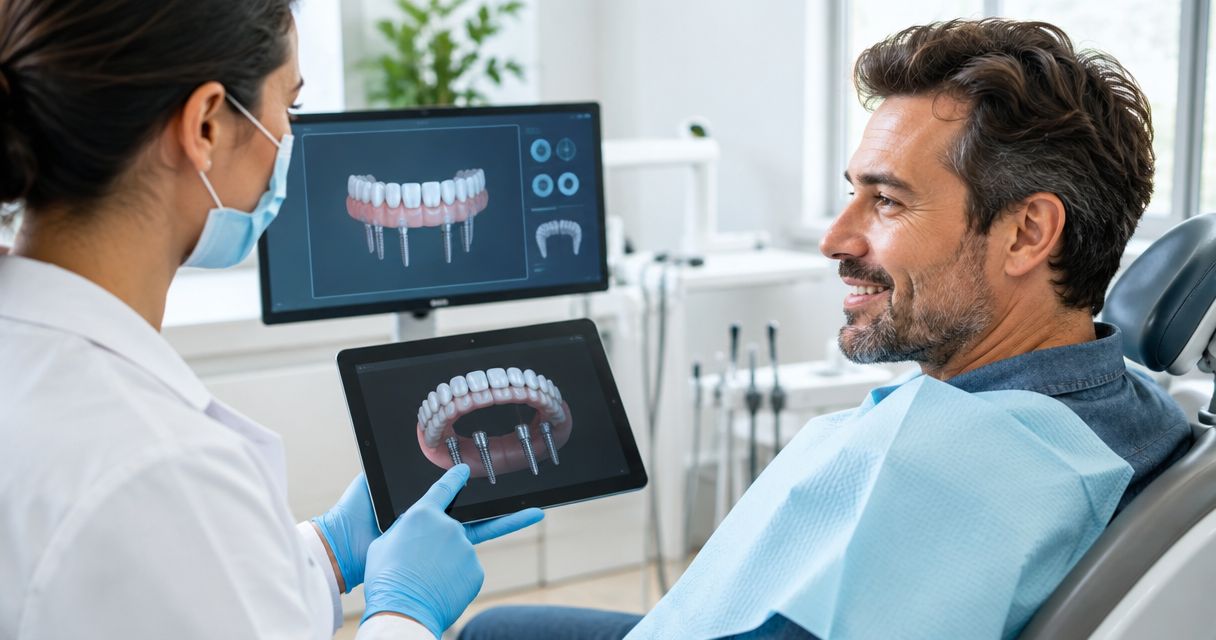
All-on-4 generally uses 4 implants to support a connected bridge replacing teeth in 1 upper or lower arch. The implants act as supports; the bridge supplies the visible replacement teeth.
This is different from receiving an individual implant for every missing tooth. Treating 2 arches means planning the upper and lower jaws separately, including how the replacement teeth meet when you bite.
Best for: patients who need full-arch replacement and prefer a bridge they do not remove at home. The benefit is fixed support, but cleaning underneath the bridge remains essential.
The name alone does not tell you the bridge material, whether teeth must be removed, or when the final bridge will be fitted. Those details belong in the written treatment plan.
Removable dentures: an alternative worth comparing
Removable dentures deserve a fair discussion, even when you strongly prefer fixed teeth. Conventional dentures do not require implant placement, while implant-retained removable dentures use implants to help hold the appliance in position.
Best for: patients who prefer a removable appliance or whose assessment points away from a fixed full-arch bridge. The advantage is being able to remove the appliance for cleaning; the drawback is that fit, retention, and attachment maintenance still need attention.
Ask to see how each option is cleaned. A treatment that looks appealing during a consultation must also fit your daily routine at home.
Why the value of All-on-4 varies
Your starting point determines the benefit you receive. Someone unable to manage a loose denture faces a different decision from someone with several teeth that remain treatable.
Use these factors to compare your options in 2026:
- Remaining teeth: Ask which teeth are restorable and why extraction is recommended. Removing teeth is irreversible, so each proposed extraction needs a clinical reason.
- Bone support: Implant planning depends on bone quantity, quality, and position. A full-arch design does not make bone assessment unnecessary.
- Gum health: Active disease needs evaluation and management. Implants do not remove the need to control inflammation and maintain oral hygiene.
- Health and healing: Your dentist needs your medical history, medicines, tobacco use, and relevant conditions before recommending surgery. Do not stop prescribed medicines on your own.
- Cleaning ability: A fixed bridge requires access underneath it. Limited hand movement or difficulty using cleaning tools should shape the design and care plan.
- Treatment scope: Extractions, additional procedures, temporary teeth, final teeth, and maintenance are separate parts of the decision. Ask which are included in the proposed plan.
No single factor settles the question by itself. A sound recommendation explains how these findings work together rather than treating the implant count as proof of suitability.
What are the disadvantages of All-on-4?
The main disadvantages are surgery, irreversible extractions when required, daily cleaning demands, and the possibility of implant or bridge complications. Fixed teeth still require care, and a bridge is not a lifetime exemption from dental problems.
Surgery and healing require planning
Implant surgery can involve swelling, soreness, bleeding, and infection risk. Nerve or sinus complications are also considerations, depending on the treatment site and anatomy.
Ask how your specific risks will be assessed and managed. After surgery, uncontrolled bleeding, worsening swelling, fever, or difficulty swallowing or breathing requires prompt professional attention; breathing difficulty is an emergency.
The bridge and implants have different maintenance needs
An implant is the support placed in bone; the bridge is the replacement structure attached to it. Either part can need professional attention, and bridge teeth or connecting components can require repair.
That distinction matters when you hear claims about longevity. Ask what happens if a bridge component breaks, an implant develops inflammation, or an implant fails to integrate with the bone.
Fixed teeth are not maintenance-free teeth
Food and plaque can collect around and beneath a fixed bridge. You need a cleaning method suited to the space under your replacement teeth, not just a toothbrush for the visible surfaces.
Ask for a demonstration before committing to treatment. If the proposed routine seems difficult, discuss adaptations or alternatives rather than assuming you will manage after surgery.
How do you decide whether to book a consultation?
A consultation is useful when missing or failing teeth affect eating, comfort, confidence, or denture stability. Booking an evaluation does not commit you to surgery.
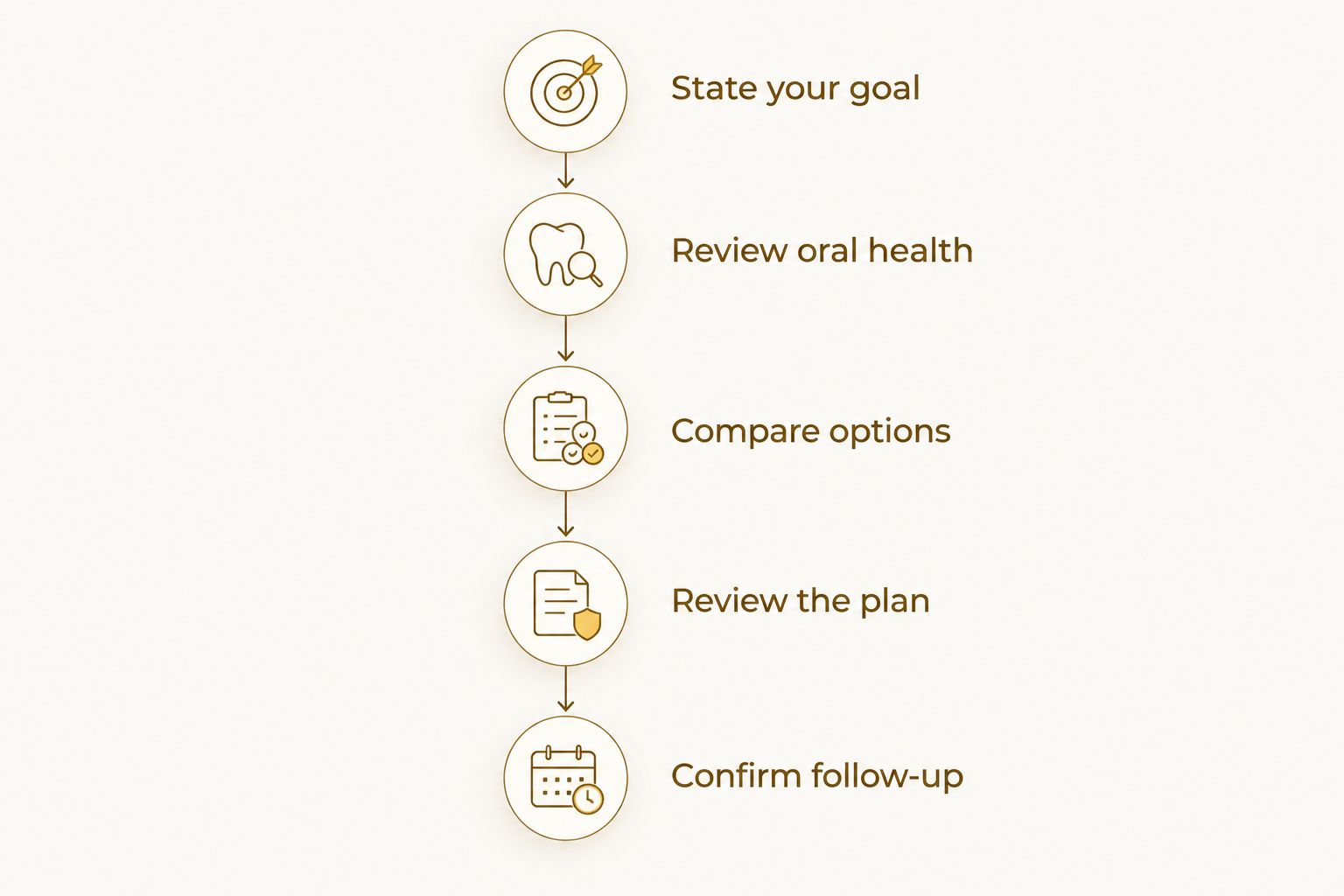
Use this sequence to keep your 2026 discussion focused:
- State your goal. Explain what bothers you most: denture movement, chewing difficulty, discomfort, appearance, or repeated dental treatment. Describe what you want to do more comfortably.
- Review oral health. Ask which teeth can be preserved, whether gum disease is active, and what imaging is needed. The dentist should connect these findings to the recommendation.
- Compare options. Discuss fixed bridges, removable replacements, and tooth-preserving care where appropriate. Ask why the alternatives fit or do not fit your situation.
- Review the plan. Request the proposed sequence, temporary-to-final transition, recovery instructions, cleaning routine, and responsibilities for follow-up care.
- Confirm follow-up. Find out who handles adjustments, urgent concerns, professional cleaning, and repairs. Make sure the plan works with your schedule and ability to attend appointments.
A good consultation leaves you able to explain the recommendation in your own words. You should understand what is being treated, why that approach was selected, and what remains uncertain until further assessment.
What should a written treatment plan explain?
A useful 2026 treatment plan separates the surgery from the replacement teeth and from ongoing care. Do not assume a description such as full-arch treatment explains every stage.
Ask for clear answers to these questions:
- Which teeth, if any, will be removed, and why?
- What additional procedures are recommended, and what finding supports each one?
- Will you have temporary teeth, and what restrictions apply while healing?
- What determines when the final bridge is fitted?
- Which material is planned for the final bridge?
- Who provides surgical care, restorative care, and maintenance?
- What happens if healing does not progress as expected?
- How are future adjustments and repairs handled?
If you are considering financing, review the lender's terms separately from the clinical recommendation. Payment arrangements do not establish whether a treatment is appropriate or whether insurance covers it.
Ask Harmony Dental Group to explain your dental implant options in terms of diagnosis, alternatives, and ongoing care. The practice offers dental implant services, but the exact technique and treatment sequence require an individual evaluation.
Are All-on-4 implants better than dentures?
All-on-4 is better suited to patients who need full-arch replacement and prioritize fixed teeth, provided their assessment supports it. Removable dentures remain a valid option when avoiding implant surgery or removing the appliance for cleaning matters more.
Ask about lip support, speech, cleaning access, and bite comfort as well as stability. A replacement that stays in place still needs a design that suits your mouth.
Try to identify the specific problem you want to solve. If a denture moves, ask whether adjustment, replacement, or implant retention addresses that problem before assuming a fixed full arch is necessary.
Can you get All-on-4 implants with bone loss?
Bone loss does not automatically rule out implants, but it changes the assessment and treatment choices. Imaging and examination determine whether available bone can support the proposed implant positions or whether another approach is needed.
Angled implant placement is part of the All-on-4 concept, but that does not mean every patient can avoid additional procedures. Ask the clinician to explain the findings on your images and their effect on the plan.
Can you get fixed teeth on the day of surgery?
Immediate fixed teeth depend on implant stability and the clinical plan; they are not guaranteed. When immediate loading is appropriate, the initial bridge can be provisional rather than the final replacement.
Ask what happens if the implants are not stable enough for the planned temporary bridge. You should understand the backup plan before surgery, including how you will manage eating and appearance during healing.
FAQ
Are all on 4 dental implants worth it if my dentures keep moving?
All-on-4 is worth evaluating when denture movement affects your daily life and you want fixed teeth. Compare it with denture adjustment, replacement, and implant-retained removable options before choosing surgery.
Does All-on-4 replace every tooth with an implant?
No. All-on-4 generally uses 4 implants to support a connected bridge replacing teeth in 1 arch, rather than placing an implant for every missing tooth.
Do All-on-4 implants last forever?
All-on-4 implants and bridges are not guaranteed to last forever. Implant health, bridge condition, cleaning, and professional maintenance all affect ongoing care needs.
Can I get All-on-4 if I have gum disease?
Gum disease requires assessment and management before an implant treatment plan is finalized. Removing teeth does not eliminate the need to control inflammation and maintain the tissues around implants.
Will I be able to eat normally right after All-on-4 surgery?
Do not assume you can return to unrestricted eating immediately after surgery. Follow your treating clinician's instructions for food texture, chewing, and progression during healing.
Should healthy teeth be removed for All-on-4?
Healthy or predictably restorable teeth should not be removed without a clear clinical justification. Ask for a tooth-by-tooth explanation and consider a second opinion before irreversible treatment.
Does dental insurance cover All-on-4?
Coverage depends on your specific dental plan and the proposed procedures. Request a written benefits review, and remember that an estimate is not a guarantee of payment.
One last thing
The cleaning demonstration is part of the treatment decision, not an afterthought. Before agreeing to a fixed bridge, ask the clinician to show you where cleaning tools will go and how you will reach the areas underneath it.
For your 2026 decision, bring a simple goal: choose replacement teeth you can live with and care for, not just admire in a photograph. Understanding that daily routine helps you judge whether All-on-4 is worth it for you.