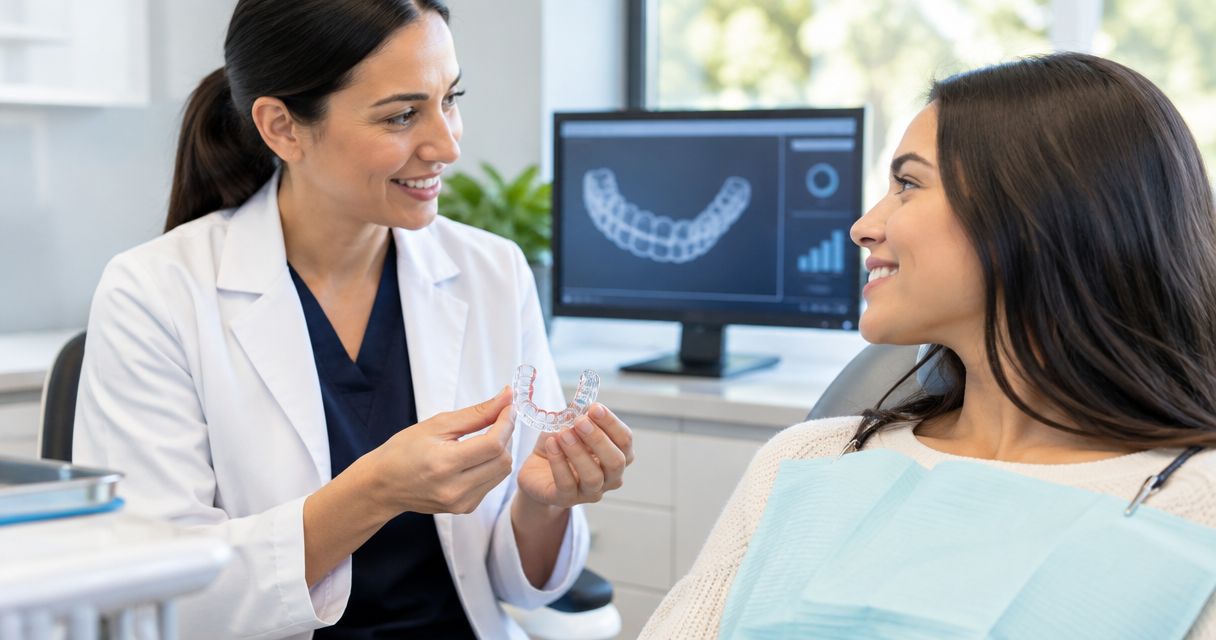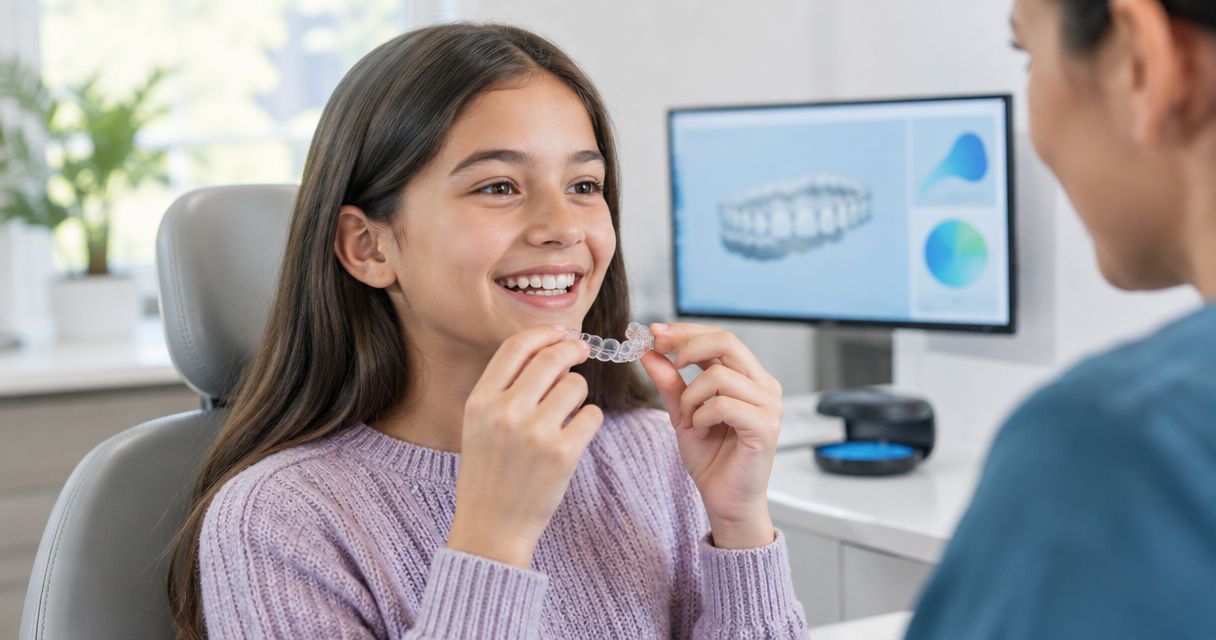
Yes, kids can get Invisalign instead of metal braces when their tooth development, bite, and ability to wear removable aligners make them suitable candidates. Some children can start treatment before all their permanent teeth arrive, but others need braces, a different appliance, or monitoring first. The deciding question is not just whether your child wants clear trays—it is whether those trays can safely deliver the tooth movements your child needs.
- Can kids get Invisalign instead of braces? Yes, when their developing bite and daily habits support clear aligner treatment.
- Invisalign generally requires 20–22 hours of daily wear; removable trays demand consistent family routines.
- Metal braces stay attached, but cleaning around brackets and following food restrictions require extra attention.
- Harmony Dental Group offers Invisalign in La Jolla; ask whether your child needs an orthodontic evaluation before treatment.
Why this matters
A less noticeable appliance is appealing, especially when your child feels self-conscious about their smile. But straight-looking front teeth do not tell you whether the upper and lower teeth fit together properly or whether growing jaws need attention.
Choose the treatment that fits your child's bite and daily habits, not appearance alone. For families exploring Invisalign in La Jolla, Harmony Dental Group offers a local starting point for discussing treatment and the appropriate next evaluation.
Can kids get Invisalign instead of metal braces?
Yes. Clear aligners can treat selected orthodontic problems in children and teenagers, including certain cases of crowding, spacing, and bite misalignment. An examination determines whether removable trays can control the required movements while accounting for teeth that have not yet erupted.
For your 2026 treatment decision, compare the responsibilities as carefully as the appearance:
| Consideration | Invisalign clear aligners | Metal braces |
|---|---|---|
| Best for | Suitable cases where the child can follow a removable-appliance routine | Cases suited to fixed appliances or children who struggle with tray wear |
| Main advantage | Trays come out for eating, brushing, and flossing | Brackets remain attached, so daily treatment does not depend on putting trays back in |
| Main limitation | Missed wear, lost trays, and inconsistent use can interrupt treatment | Brackets and wires complicate cleaning and require food precautions |
| Visibility | Clear trays are less noticeable, although attachments can show | Metal brackets and wires are visible |
| Eating | Remove trays and follow cleaning instructions before replacing them | Avoid foods that can damage brackets or wires |
| Bite correction | Suitability depends on the specific tooth movements and growth pattern | Fixed appliances can provide useful control for demanding movements |
| Family responsibility | Track wear, cleaning, storage, and tray changes | Support cleaning, food choices, appointments, and any prescribed elastics |
Neither option removes the need for supervision. Both require professional monitoring, healthy teeth and gums, and a plan for keeping teeth in position after active treatment.
The practical difference is where the responsibility sits: aligners depend heavily on consistent wear, while braces put more daily emphasis on cleaning around attached hardware.
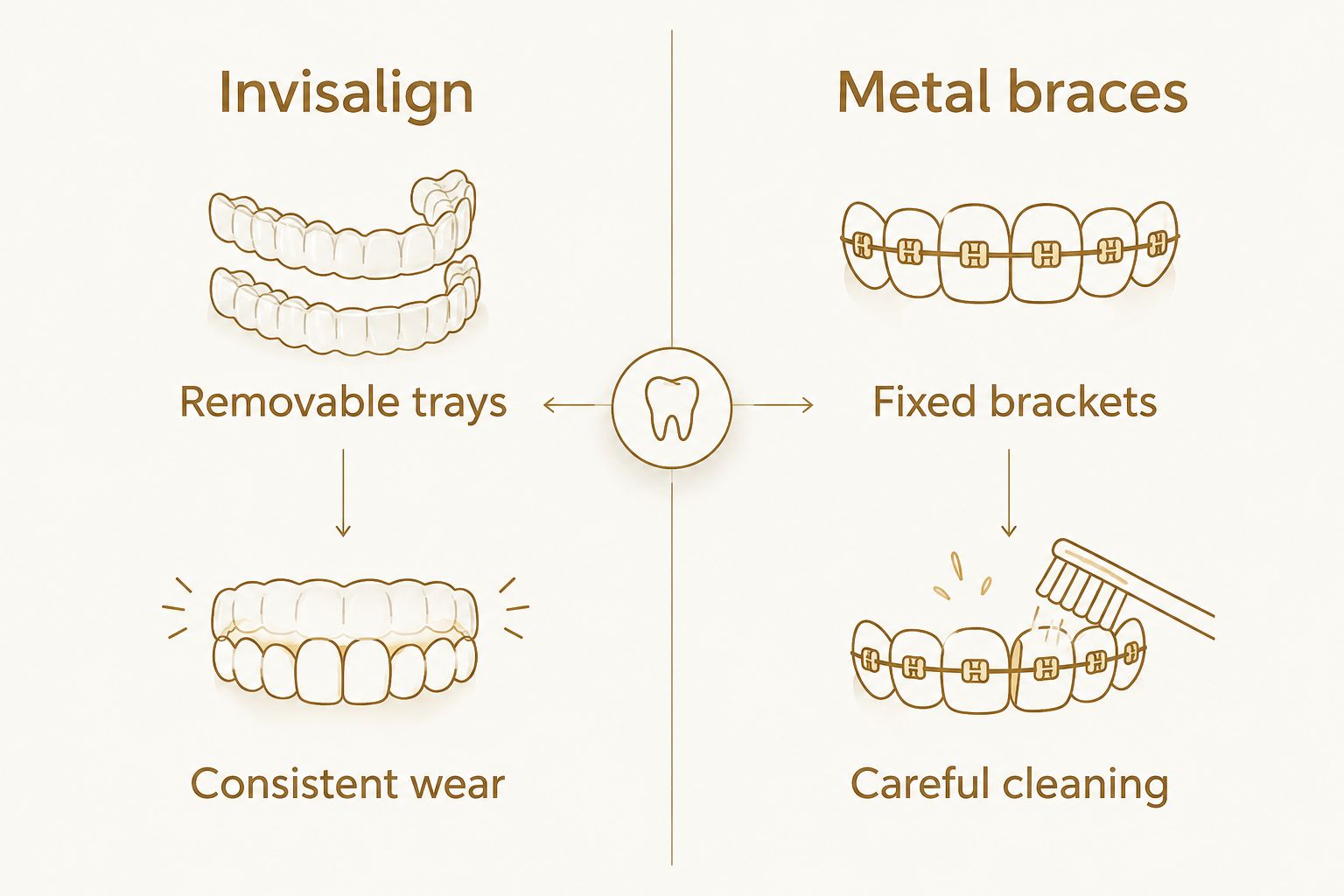
Invisalign: best for suitable bites and consistent routines
Invisalign uses a planned sequence of removable trays to move teeth. Some treatment plans also use attachments—small tooth-colored shapes bonded to teeth—or elastics to help produce particular movements.
The main benefit is flexibility during meals and oral hygiene. Your child removes the trays rather than brushing around a full set of brackets, but that convenience creates a responsibility: the trays must go back in as instructed.
Invisalign's patient guidance generally calls for 20–22 hours of wear per day. Your child's treating clinician sets the actual instructions, including when to change trays and how to handle teeth coming through during treatment.
Before choosing aligners, discuss ordinary situations rather than relying on enthusiasm at the consultation:
- School lunches: Can your child remove the trays, store them safely, and replace them after eating and cleaning?
- Snacking: Will frequent snacks repeatedly interrupt wear?
- Sleepovers: Can your child follow the routine without reminders from home?
- Tray changes: Can an adult help keep the prescribed sequence organized?
Best for: A clinically suitable child whose family can support reliable wear. The trade-off is that a removable appliance only works as planned when it is worn as prescribed.
Metal braces: best when fixed treatment fits the case
Metal braces use brackets attached to teeth and a connecting wire to guide movement. Because the brackets stay in place, children cannot leave the entire appliance in a backpack or forget to put it back after lunch.
That is a meaningful advantage when removable-tray routines are unrealistic. Fixed appliances can also offer useful control for tooth movements that are harder to manage with aligners alone.
Braces still require cooperation. Your child needs to clean carefully around brackets, avoid foods that damage the appliance, and wear elastics if prescribed. Loose brackets or missed instructions can interrupt progress.
Best for: A child whose orthodontic needs favor fixed appliances or whose habits make consistent aligner wear difficult. The trade-off is more demanding cleaning and eating precautions—not an absence of daily responsibility.
What age should a child have an orthodontic evaluation?
The American Association of Orthodontists recommends an initial orthodontic check no later than age 7. That is an evaluation milestone, not a recommendation that every child start braces or Invisalign at that age.
At this stage, a child usually has a mixture of baby and permanent teeth. An orthodontic assessment can identify developing concerns with space, eruption, or the way the jaws meet.
For a parent planning care in 2026, the useful distinction is evaluate early; treat when indicated. Some children benefit from early intervention, while others need observation until their development makes treatment more appropriate.
An evaluation should explain why treatment should begin now or why waiting is reasonable. If early treatment is recommended, ask what specific problem it addresses and whether another treatment phase could still be needed later.
How does the dentist decide whether aligners are appropriate?
A useful consultation connects the diagnosis to the appliance choice. Your child's preference matters, but the recommendation should explain what needs to move, what is still developing, and how progress will be checked.
- Assess dental health. The clinician checks for cavities, gum inflammation, and hygiene problems that need attention before tooth movement.
- Assess development. The examination considers baby teeth, permanent teeth, eruption patterns, and the relationship between the jaws.
- Review records. Photographs, scans or impressions, and clinically indicated X-rays help document the starting position.
- Compare treatment routes. Ask why aligners, braces, another appliance, or observation best addresses the diagnosed problem.
- Agree on responsibilities. Clarify wear instructions, follow-up visits, cleaning, and what to do if an appliance breaks or stops fitting.
For a 2026 consultation, bring your child's questions as well as your own. A child who understands why treatment is needed is better prepared to discuss the routine honestly.
Why Invisalign suitability varies between children
Two children of the same age can need different treatment. Suitability depends on the mouth and the child's habits, not a birthday alone.
- Tooth eruption: Incoming permanent teeth change the space available and how an appliance fits.
- Bite pattern: Crowding, crossbites, open bites, and overbites involve different treatment demands.
- Jaw growth: A developing jaw relationship can require a strategy beyond straightening teeth with trays.
- Required movements: Rotations, vertical changes, and other movements differ in how predictably an appliance can control them.
- Oral health: Active decay, inflamed gums, or poor cleaning need attention before and during treatment.
- Daily cooperation: Wear, storage, appointments, and prescribed elastics all affect whether the plan is practical.
A clear explanation of these factors is more useful than a blanket promise that aligners work for every child. Ask which factors apply specifically to your child's diagnosis.
Will Invisalign work if my child forgets to wear it?
20–22 hours per day is the general Invisalign wear guidance, so a child who repeatedly forgets the trays needs a different routine or a discussion about another appliance. Missed wear can leave teeth behind the planned position and make subsequent trays fit poorly.
Do not force the next tray into place or change the schedule yourself. Contact the treating office for instructions if a tray is lost, damaged, or no longer seats properly.
Does my child need to wait until every baby tooth is gone?
Age 7 is the recommended latest age for an initial orthodontic check, so an evaluation does not need to wait until every baby tooth falls out. Selected children can receive early treatment while baby and permanent teeth are both present.
That does not mean every child needs early aligners. Ask whether treatment now addresses a specific developmental problem or whether monitoring is the better next step.
Is Invisalign faster or more comfortable than braces?
There is no single treatment duration that applies to every child. Timing depends on the diagnosis, required movements, growth, attendance, and cooperation—not simply whether the appliance is clear or metal.
Both treatments can cause temporary soreness as teeth move. Aligners can irritate soft tissue or feel tight; braces can rub cheeks and lips. Ask how to manage expected discomfort and which symptoms require a call rather than assuming one appliance will be pain-free.
How can parents make the daily routine manageable?
Start with your child's real school day, not an ideal weekend at home. Walk through breakfast, lunch, activities, dinner, and bedtime to identify where trays could be left out or cleaning could be skipped.
For aligners, a protective case helps prevent trays from being wrapped in a napkin and discarded. Follow the clinician's cleaning instructions, and avoid exposing trays to heat that could distort their shape.
For either appliance, support brushing twice a day for 2 minutes, consistent with American Dental Association guidance, and follow instructions for cleaning between teeth. Tooth movement does not protect against cavities or gum inflammation.
Use reminders as support, not punishment. If the routine repeatedly fails, tell the treating clinician rather than hiding missed wear or letting your child fall further behind the plan.
What should you ask before booking treatment in La Jolla?
For your 2026 consultation, ask for a plan your family can explain back in everyday language. You should understand both the goal and the limits before committing.
Useful questions include:
- What is the diagnosis, beyond the teeth looking crowded or uneven?
- Why do you recommend starting now rather than monitoring growth?
- Can aligners achieve the needed movements, or is another appliance more appropriate?
- Who will plan and supervise treatment, and is an orthodontic referral appropriate?
- Will attachments, elastics, or additional appliances be needed?
- What happens if my child loses trays or cannot maintain the wear routine?
- What retention will be needed after active treatment?
Harmony Dental Group is a local option for La Jolla families seeking an Invisalign consultation. Its general, cosmetic, and restorative services do not replace the need to confirm whether a child's specific orthodontic needs fall within the proposed treatment plan.
Discuss your child's Invisalign questions
Ask whether clear aligners fit your child's developing bite and daily routine.
FAQ
Can kids get Invisalign instead of braces in 2026?
Yes, selected children can get Invisalign instead of metal braces when their bite, dental development, and ability to follow instructions support aligner treatment. An examination determines whether aligners, braces, another appliance, or monitoring is appropriate.
What's the youngest age a child should see an orthodontist?
The American Association of Orthodontists recommends an initial orthodontic check no later than age 7. This is an evaluation milestone, not a requirement to begin treatment at that age.
How many hours does my child need to wear Invisalign?
Invisalign generally recommends 20–22 hours of wear per day. Follow the treating clinician's specific instructions for your child's plan and tray changes.
Are clear aligners better than metal braces for children?
Clear aligners are not automatically better than metal braces for children. Aligners offer removability, while braces remain attached; the better choice depends on the required movements and the child's daily habits.
Can my child eat while wearing Invisalign trays?
Your child should remove Invisalign trays for eating and follow the clinician's instructions for drinks and cleaning. Store trays in their case rather than wrapping them in a napkin.
Will my child still need a retainer after Invisalign?
Your child will generally need retention after Invisalign to help maintain the corrected tooth positions. The treating clinician selects the retainer and explains the wear schedule.
Does Harmony Dental Group offer Invisalign in La Jolla?
Harmony Dental Group offers Invisalign in La Jolla. Ask whether your child's age, developing bite, and treatment needs are appropriate for evaluation there or require an orthodontic referral.
One last thing
Before choosing an appliance in 2026, ask your child to explain what they would do with aligners during lunch at school. That conversation reveals practical obstacles that a photograph of clear trays cannot show.
The best next step is an evaluation, not a promise to choose Invisalign. Give your child a voice in the decision while keeping the diagnosis and a manageable routine at the center.