Dental insurance generally does not cover teeth whitening because plans usually classify it as cosmetic treatment rather than medically necessary care. A covered exam or cleaning does not make whitening covered, and a network discount is not the same as an insurance benefit. Before scheduling in 2026, check your plan’s cosmetic exclusions and request a written estimate separating whitening from any covered dental services.
- Does dental insurance cover teeth whitening? Usually no: cosmetic exclusions generally apply even when a dentist provides treatment.
- A covered cleaning removes deposits and surface stains; it does not establish coverage for bleaching.
- Harmony Dental Group is a local option for La Jolla patients seeking a cosmetic dentistry consultation.
- Confirm insurance benefits, discounts, and your payment responsibility separately before agreeing to treatment.
Why this matters
A brighter smile and healthier teeth are different treatment goals. Your insurance can cover a service that protects oral health while excluding another service performed at the same appointment solely to change tooth color.
That distinction helps you avoid an unexpected bill. It also keeps insurance from driving the wrong treatment decision: first establish why your teeth look darker, then decide whether whitening suits your teeth and your budget. If sensitivity is part of your concern, start with whether teeth whitening damages tooth enamel.
Does dental insurance cover teeth whitening?
Dental insurance generally excludes teeth whitening, including dentist-supervised whitening, when its purpose is cosmetic. The setting does not change the treatment’s purpose: having a dentist perform a service does not automatically make it an insured benefit.
Your policy documents control the answer for your particular plan. Look for terms such as cosmetic services, bleaching, whitening, exclusions, and limitations rather than relying only on the preventive-care summary.
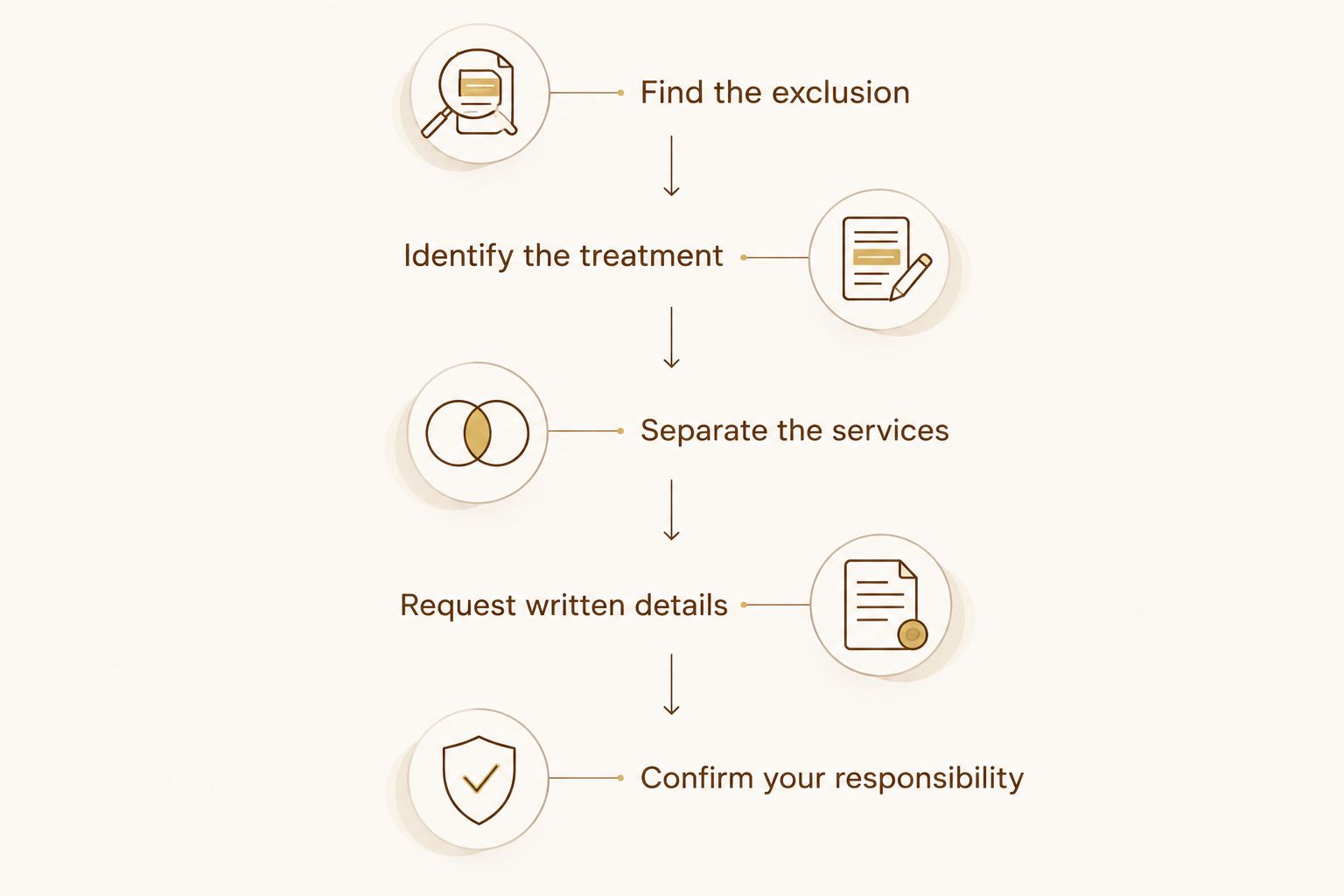
Use this sequence to check your 2026 benefits before committing:
- Find the exclusion. Read the certificate of coverage or benefits booklet. A benefit summary alone might not show every excluded service.
- Identify the treatment. Ask the dental office for the proposed procedure description and any applicable billing code. Give that information to the insurer rather than asking only about cosmetic dentistry generally.
- Separate the services. Confirm whether the appointment includes an exam, cleaning, imaging, or treatment of a dental problem. Ask about each item independently.
- Request written details. Ask the insurer to identify the relevant policy provision and provide a reference for the conversation. Keep the office’s treatment estimate with your benefits information.
- Confirm your responsibility. Establish what you would owe if whitening is excluded or a related claim is denied. Do this before treatment begins.
An eligibility check confirms that a policy is active. It does not, by itself, confirm that whitening is covered.
Cleaning, whitening, and restorative care have different purposes
A dental cleaning removes plaque, hardened deposits, and some surface stains. Bleaching changes the color of natural teeth through a whitening agent. Restorative care repairs or replaces damaged tooth structure; it is not simply another way to obtain insured whitening.
These differences matter when you compare a treatment recommendation with your policy. Coverage follows the service and the plan’s rules, not the general goal of improving your smile.
| Service or approach | Best for | Main benefit | Limitation | Insurance distinction |
|---|---|---|---|---|
| Professional cleaning | Patients with plaque, deposits, and removable surface stains | Supports oral health and removes some external discoloration | Does not bleach the underlying tooth color | Check preventive benefits, frequency limits, and network rules |
| Dentist-supervised whitening | Patients whose natural teeth are suitable for bleaching | Changes natural tooth color with professional guidance | Can cause sensitivity; does not whiten crowns or veneers | Generally excluded as cosmetic treatment |
| Over-the-counter whitening | Patients with suitable natural teeth who can follow product directions | Allows at-home bleaching | No individualized diagnosis or custom treatment oversight | Generally a personal purchase rather than a dental insurance benefit |
| Restorative treatment | Patients with damaged or otherwise clinically affected teeth | Addresses a diagnosed structural or dental problem | Can involve irreversible changes; is not a substitute for appropriate whitening | Coverage depends on the diagnosis, procedure, and policy |
A crown or veneer should not be recommended merely to work around a whitening exclusion. Those treatments have different indications and trade-offs, which deserve a separate conversation.
Why whitening coverage and your responsibility vary
The general exclusion is straightforward, but your paperwork can contain several different kinds of benefits. For a 2026 treatment decision, review these factors separately:
- Policy wording. The exclusion section establishes whether cosmetic bleaching is outside the plan’s benefits. Do not assume that broad language about dental treatment includes whitening.
- The purpose of each service. An exam for pain and elective whitening can appear in the same treatment plan without sharing the same coverage status.
- Network arrangements. Participating-provider rules affect covered services. Network participation alone does not turn an excluded cosmetic procedure into a covered one.
- Discount arrangements. A discount reduces a charge under its terms; insurance pays benefits under a policy. Ask which arrangement is being described.
- Separate benefit limits. Deductibles, frequency restrictions, and annual maximums affect eligible services. They do not remove a cosmetic exclusion.
- Multiple policies. Coordination of benefits determines how applicable plans work together. Having another policy does not establish that either policy covers whitening.
When someone says a service is included, ask what that means: an insured benefit, a discount, or a separate arrangement. Those descriptions are not interchangeable.
Does unused dental insurance pay for whitening?
Unused dental benefits do not override a cosmetic exclusion. An annual maximum is a limit on what the insurer pays for eligible services, not an account you can spend on any dental treatment.
This is especially relevant when you review benefits near the end of 2026. Decide whether you need covered care based on your dental health, and evaluate whitening separately rather than assuming an unused maximum will pay for it.
Does insurance cover whitening a tooth after a root canal?
Coverage for whitening a root-canal-treated tooth still depends on the policy and the proposed procedure. A history of root canal treatment does not automatically convert bleaching into a covered benefit.
A single dark tooth also needs a different assessment from general staining. Ask your dentist to identify the reason for the color change, explain the suitable treatment, and provide its description for an insurer review before you proceed.
Is a whitening discount the same as insurance coverage?
A whitening discount is not insurance coverage. It changes the amount charged under the discount arrangement rather than establishing that an insurer will pay a claim.
Ask for written terms identifying which procedure the discount applies to and what you must pay. Do not assume that a discount applies because a dental office participates in your insurance network.
Can you use an HSA or FSA for teeth whitening?
Teeth whitening for cosmetic purposes is generally not an eligible HSA or health FSA expense. IRS Publication 502 lists teeth whitening among expenses that are not included as medical expenses; paying through a dental office does not change that classification.
For your 2026 spending decisions, distinguish insurance coverage from tax eligibility. A procedure can be excluded by insurance for one reason and ineligible for tax-favored reimbursement under separate rules.
A payment card processing successfully does not establish that an expense qualifies. Confirm eligibility with your account administrator before using those funds, and keep itemized records separating cosmetic whitening from other care.
What should you ask at a cosmetic dentistry consultation?
A useful consultation answers whether whitening matches your concern before discussing how to pay for it. Bring your insurance information, a list of existing crowns or veneers, and details about sensitivity or a recent change in tooth color.
Harmony Dental Group is a local option for La Jolla patients seeking a cosmetic dentistry consultation. The practice offers general, cosmetic, and restorative care; ask which approach fits your teeth rather than assuming every discoloration needs the same treatment.
At Harmony Dental Group, make these questions part of your cosmetic dentistry discussion:
- What is causing the discoloration? Surface staining, natural tooth color, and an isolated dark tooth require different assessments.
- Are my teeth and gums ready? Ask whether decay, gum inflammation, exposed roots, or sensitivity needs attention before cosmetic treatment.
- Which teeth will change color? Existing crowns, veneers, and tooth-colored fillings do not bleach like natural teeth.
- What result is realistic? Ask how your starting shade and existing restorations affect the plan. Avoid treating a particular shade as guaranteed.
- What is included? Request an itemized treatment plan that distinguishes the cosmetic service from exams, preventive care, and other treatment.
- What happens if I become sensitive? Get instructions for pausing treatment and contacting the office rather than continuing through discomfort.
If whitening is not suitable, ask why and what other choices address your concern. A clear explanation is more useful than choosing a treatment solely because you hope insurance will cover it.
Discuss your cosmetic dentistry goals
Ask about discoloration, sensitivity, existing restorations, and an itemized treatment plan.
Before you agree to treatment
Keep the clinical decision and the insurance decision connected but separate. Your dentist explains what is appropriate for your teeth; your insurer explains benefits under your specific contract.
For a 2026 appointment, request an estimate that clearly identifies the proposed services and your expected responsibility. If the estimate assumes an insurance payment, ask what happens if the insurer pays less or denies the claim.
A predetermination or pretreatment estimate can help clarify expected benefits, but it is not a guarantee of payment. Eligibility, policy limits, and the services actually performed still matter when the claim is processed.
There is no need to approve every part of a cosmetic plan immediately. Ask for time to review the treatment explanation and benefit information, especially when the proposal includes changes to existing restorations as well as whitening.
FAQ
Does dental insurance cover teeth whitening at the dentist?
Dental insurance generally does not cover teeth whitening at the dentist because cosmetic exclusions usually apply. Professional supervision does not, by itself, make whitening an insured service.
Will my dental cleaning benefits pay for whitening?
Dental cleaning benefits do not automatically pay for whitening. A cleaning removes deposits and some surface stains, while bleaching changes the color of natural teeth and is generally treated as cosmetic.
Can I use my remaining annual maximum for teeth whitening?
Your remaining annual maximum does not override a whitening exclusion. It limits payment for eligible benefits rather than providing money for any dental service you choose.
Does being in-network make teeth whitening covered?
Being in-network does not make an excluded whitening procedure covered. Ask separately about insurance benefits and any applicable discount arrangement.
Can I pay for cosmetic teeth whitening with my FSA?
Cosmetic teeth whitening is generally not an eligible health FSA expense. Confirm the rules with your account administrator before using account funds.
Will whitening change the color of my crowns or veneers?
Whitening does not change the color of crowns or veneers the way it changes natural teeth. Discuss existing restorations before treatment so you understand the risk of a shade mismatch.
Should I book a consultation if insurance excludes whitening?
A consultation can still help you understand the cause of discoloration and whether cosmetic treatment suits your teeth. Harmony Dental Group offers cosmetic dentistry in La Jolla; ask for a treatment explanation and an itemized estimate before deciding.
One last thing
A brighter smile does not always require bleaching. If removable surface stains are your main concern, a professional cleaning can address some discoloration while serving a separate oral-health purpose. Ask your dentist to assess the cause first, then check coverage for the service actually recommended.