Instead of manually matching every Invisalign payment to your benefit statements, use your HSA or FSA through a documented payment-and-reimbursement workflow: confirm eligibility, coordinate insurance, and keep the records supporting each expense. Invisalign orthodontic treatment generally qualifies, but your account rules determine which expenses you can reimburse and when.
- To use HSA FSA for Invisalign, confirm eligible orthodontic expenses and your account’s timing rules before paying.
- HSA reimbursement requires expenses incurred after the account was established; keep supporting records.
- FSA orthodontic reimbursement follows plan rules, including any special treatment of advance payments.
- Harmony Dental Group offers Invisalign consultations for patients in La Jolla and nearby San Diego neighborhoods.
Why this matters
An HSA or FSA is a tax-advantaged account, not dental insurance. It helps you pay eligible expenses with tax-favored funds; it does not change your treatment needs or guarantee insurance benefits.
Harmony Dental Group is best for La Jolla patients seeking a local Invisalign consultation. Discuss the clinical treatment plan with Harmony Dental Group, then confirm reimbursement requirements with your account administrator before choosing a payment schedule.
For treatment beginning in 2026, separate three decisions: whether Invisalign suits your teeth and bite, what insurance pays, and which remaining expenses qualify for your account. A correct answer to one does not settle the others.
Before you start
- Account access: Have your HSA or health FSA account information, current balance, plan documents, and administrator contact details. Confirm whose expenses your account can cover; dependent eligibility is not identical across all benefit arrangements.
- Treatment records: Request 3 documents: an itemized treatment agreement, a payment schedule, and a statement showing insurance payments or adjustments. These establish what the charges cover and which portion remains your responsibility.
- Timing rules: Get written confirmation of how your FSA handles orthodontic advance payments. Paying before a deadline does not automatically make an expense eligible for that plan year; orthodontia has special rules that require plan-specific review.
You do not need to connect a bank account directly to the dental practice to complete this workflow. Depending on your account and the practice’s accepted payment methods, you can pay an eligible expense with an account card or pay separately and request reimbursement.
HSA and FSA account selection
Start with the account you actually hold, not the account name printed on an old benefits email. A general-purpose health FSA, a limited-purpose FSA, and an HSA have different eligibility and administration rules.
| Account | Best for | Main advantage | Main limitation |
|---|---|---|---|
| HSA | Eligible account holders who want reimbursement flexibility | Unused funds stay in the account; qualified expenses can be reimbursed later if properly documented | Expenses must be incurred after the HSA was established; new contributions require HSA eligibility |
| Health FSA | Employees using employer-sponsored benefits for eligible expenses | The annual elected amount is generally available during the coverage period, less prior reimbursements | Coverage dates, claim deadlines, and forfeiture rules require attention |
| Limited-purpose FSA | Eligible employees with an HSA-compatible dental and vision arrangement | Can cover eligible dental expenses without operating as a general-purpose health FSA | Covered expenses and orthodontic claim procedures depend on the plan |
Choose the payment timing around the account rules, not the other way around. An HSA offers reimbursement flexibility, while an FSA requires closer attention to its coverage period and orthodontic provisions. Neither account makes an otherwise ineligible expense eligible.
For a 2026 benefits review, read the current plan documents rather than reusing instructions from a previous enrollment period. Ask your employer’s benefits team which administrator handles orthodontic claims if the documents are unclear.
Eligibility and timing confirmation
- Identify your account. Read your benefits statement and confirm whether you have an HSA, health FSA, or limited-purpose FSA. If you have both an HSA and an FSA, verify that the FSA arrangement is HSA-compatible before making new HSA contributions.
- Confirm the expense. Tell the administrator that the expense is Invisalign orthodontic treatment. Ask what documentation establishes eligibility and whether any separately billed services require separate review.
- Confirm the relevant dates. For an HSA, establish the account’s opening date and when the expense was incurred. For an FSA, confirm coverage dates, the claim-submission deadline, and how orthodontic payments are assigned to a coverage period.
- Ask about advance payments. If you are considering paying before treatment is complete, request the FSA’s written orthodontia policy. Do not assume an ordinary dental claim rule applies to an orthodontic contract.
Expected result: You have written answers identifying the eligible expense, required documents, and applicable dates. Save 2 confirmations before paying: one for expense eligibility and one for reimbursement timing.
What counts as orthodontic treatment?
Federal medical-expense guidance recognizes treatment that corrects dental problems, including orthodontic treatment. Invisalign’s clear appearance does not, by itself, make orthodontic treatment an excluded cosmetic expense.
The distinction is the purpose of the treatment, not whether the appliance is noticeable. IRS Publication 502 describes qualifying dental treatment and distinguishes it from excluded cosmetic procedures such as teeth whitening; use the current guidance for your 2026 tax planning and ask your administrator about your specific charges.
Treatment and insurance coordination
- Request an itemized agreement. Ask for the patient’s name, provider information, treatment description, total treatment charge, payment schedule, and relevant treatment dates. The administrator determines whether additional documentation is needed.
- Separate insurance from account funds. Ask your insurer about orthodontic benefits, restrictions, and payment timing. A general dental benefit does not establish that Invisalign is covered.
- Identify your unreimbursed responsibility. Match the treatment statement to the insurer’s explanation of benefits. Do not claim account reimbursement for a portion insurance has already paid.
- Choose a documented payment route. Ask the practice which payment methods it accepts. Use an account card only if accepted and appropriate; otherwise, follow your administrator’s reimbursement process after paying an eligible expense yourself.
Expected result: Your treatment agreement, insurance information, and payment schedule describe the same expense without counting an insurer’s payment as your own eligible expense.
An insurance estimate is not a final claim decision. If the insurer’s actual payment differs from the estimate, update your records before requesting reimbursement for the affected portion.
At a Harmony Dental Group Invisalign consultation, discuss your treatment questions separately from your benefits questions. The dental practice addresses clinical suitability; your insurer and account administrator determine their respective benefit and reimbursement requirements.
Payment and reimbursement records
- Keep payment evidence. Save the itemized statement and proof of payment together. A card transaction alone does not explain the treatment or prove that the expense qualifies.
- Follow the correct submission process. Submit FSA claims through the administrator’s stated procedure, supplying the requested treatment and payment records. For HSA distributions, retain records supporting the qualified expense even when the custodian does not request a receipt at withdrawal.
- Create one reimbursement ledger. Record the patient, treatment expense, relevant dates, insurance reimbursement, account used, amount reimbursed, and remaining unreimbursed balance. Use 1 ledger for the treatment rather than separate notes that cannot be reconciled.
- Check the completed transaction. Compare the reimbursement with the supporting statement and your ledger. If a claim is partially approved, read the explanation before resubmitting anything.
Expected result: Every account payment or reimbursement maps to a documented eligible expense, and no expense appears twice across insurance, an HSA, or an FSA.
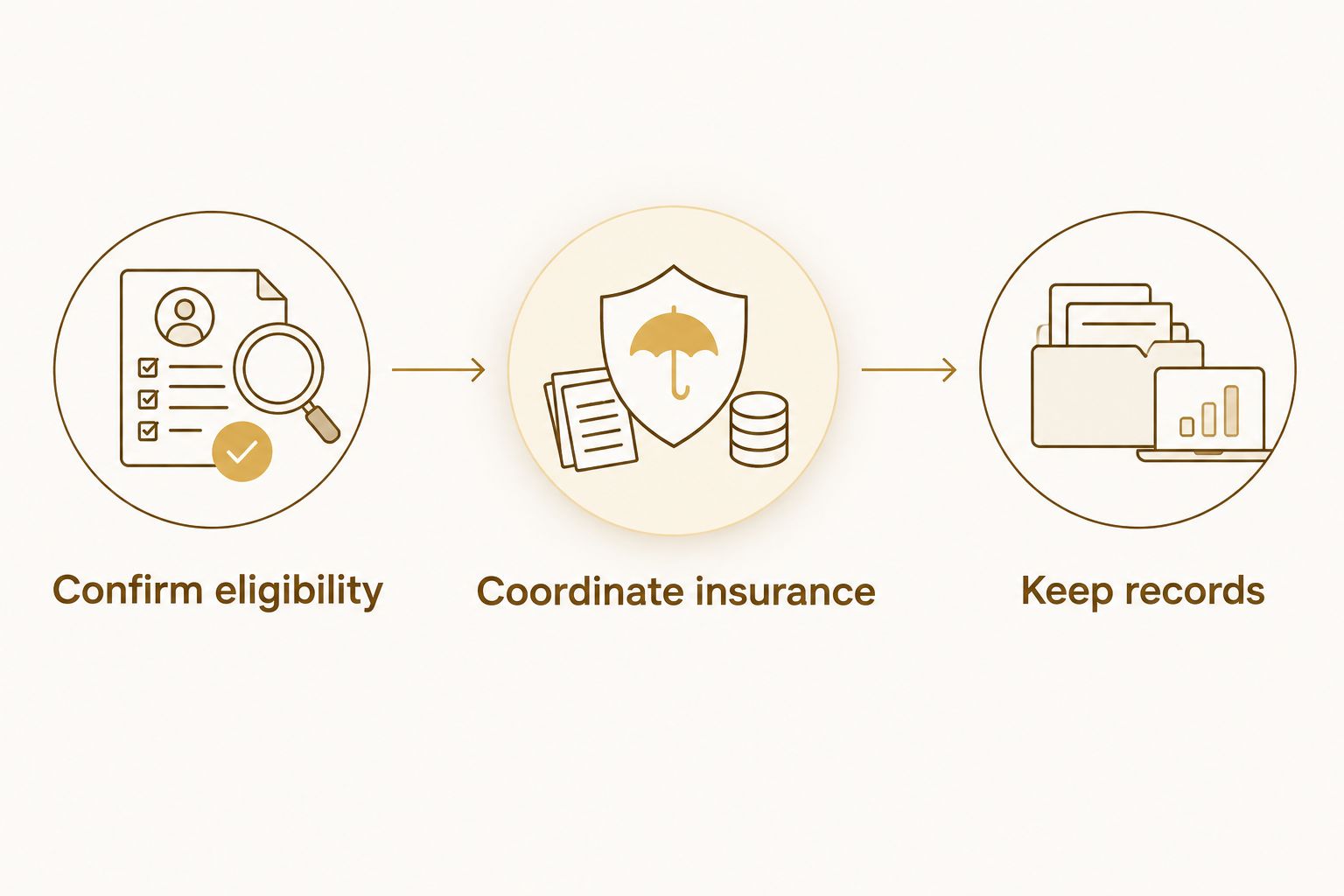
The workflow is Confirm eligibility, Coordinate insurance, and Keep records. That sequence helps you catch a timing problem before submitting a claim rather than after a rejection.
For 2026 expenses, keep the treatment records with your tax documentation. Qualified HSA distributions also require appropriate tax reporting; retaining receipts does not replace that reporting obligation.
When your Invisalign payment schedule changes
Use the same workflow whenever an installment, insurance adjustment, or treatment agreement changes. A revised schedule should trigger a benefits check, not an automatic reimbursement request.
- Recurring installments — best for matching claims to scheduled payments: Reconcile each charge against the treatment agreement and administrator’s orthodontia rules. This keeps records current, but installments still require documentation and do not bypass coverage dates.
- Advance payment — best for patients whose administrator has confirmed the arrangement: Obtain the relevant policy before paying. An advance payment can simplify payment records, but its reimbursement treatment is not interchangeable with ordinary recurring charges.
If you use both an HSA and an eligible FSA arrangement, allocate different eligible portions to each account in your ledger. Never reimburse the same expense from both accounts.
A change of employer or benefits coverage needs another timing review. An HSA generally stays with its owner, while an FSA’s participation and claim rules depend on the employer’s plan; a claim-submission window does not automatically extend eligibility for new expenses.
Troubleshooting
Your benefits card is declined
A declined card does not establish that Invisalign is ineligible. Confirm the balance and card status with the administrator, check the practice’s accepted payment methods, and ask whether a reimbursement claim is the appropriate alternative before choosing another payment route.
The FSA requests more documentation
Read the request before uploading the same receipt again. Supply the missing treatment description, agreement, payment schedule, service dates, or insurance information specified by the administrator; a bank statement alone usually does not establish all claim details.
Your FSA rejects the payment date
Ask which date rule caused the rejection and whether the plan’s orthodontic provisions apply. Provide the treatment agreement and payment evidence, then follow the administrator’s review or appeal procedure rather than changing dates on a claim.
Insurance pays after you receive reimbursement
Reconcile the later insurance payment with your ledger immediately. Contact the account administrator or HSA custodian about correcting any excess reimbursement; do not leave the same expense funded twice or assume an unrelated future charge fixes it automatically.
Treatment began before your HSA was established
Do not assume that paying later makes an earlier expense eligible. HSA eligibility turns on when the expense was incurred relative to account establishment; ask the custodian or a tax professional to review the treatment agreement and payment structure before taking a distribution.
Customize your workflow
Build a small treatment folder with the agreement, insurance statements, receipts, administrator correspondence, and reimbursement ledger. Use filenames that distinguish the patient, payment, and document type so you can retrieve the right record without reopening every file.
Set reminders for your actual FSA deadlines and scheduled payments. A reminder labeled December 2026 is useful only if December is relevant to your plan; some plans use a different coverage year or separate claim-submission dates.
For Harmony Dental Group Invisalign treatment, bring your clinical questions to the consultation and your written account requirements to the payment discussion. Ask what documentation the practice can provide without assuming a particular card, claim process, or payment arrangement is accepted.
FAQ
Can I use HSA FSA for Invisalign treatment?
Invisalign orthodontic treatment generally qualifies for HSA or health FSA funds when the expense meets applicable medical-expense and account rules. Confirm your treatment documentation, coverage dates, and reimbursement procedure before paying.
Do I need dental insurance to use an HSA for Invisalign?
Dental insurance is not required to reimburse an otherwise qualified Invisalign expense from an HSA. The expense must meet HSA rules, including being incurred after the account was established and not being reimbursed elsewhere.
Can I use an FSA for an Invisalign advance payment?
An FSA can have special rules for orthodontic advance payments. Ask your administrator whether your arrangement qualifies and what agreement, payment evidence, and coverage dates it requires before paying.
Can I reimburse myself from my HSA after paying out of pocket?
Yes, qualified expenses incurred after your HSA was established can generally be reimbursed later without a federal reimbursement time limit. Keep records proving eligibility and showing that the expense was not reimbursed elsewhere or claimed as an itemized deduction.
Can I use both dental insurance and an FSA for Invisalign?
Yes, you can use an FSA for an eligible portion of Invisalign treatment that insurance does not reimburse. Reconcile the insurer’s payment with your treatment statement so you do not claim the same expense twice.
Does using an HSA or FSA guarantee Invisalign coverage?
No, a tax-advantaged account does not guarantee insurance coverage or account reimbursement. Your insurer decides insurance benefits, while your account administrator applies the relevant expense, timing, and documentation rules.
Can I pay for my teenager’s Invisalign with my HSA or FSA?
You can use account funds when your teenager meets the applicable dependent rules and the orthodontic expense qualifies. Confirm dependent eligibility with your administrator because benefit-plan enrollment alone does not answer every tax-eligibility question.
One last thing
A successful card payment is not proof of a qualified expense. Keep the same treatment and payment records whether you use an account card or request reimbursement afterward; the payment method does not replace substantiation.
Before committing to a payment schedule, ask one specific question: which dates and documents will establish eligibility for this orthodontic arrangement? A written answer gives you a clearer next step than a general assurance that dental expenses qualify.