Instead of repeating your insurance details at every call, connect your Medi-Cal dental coverage to a new patient exam by confirming eligibility, checking the dentist’s participation, and having the office verify the planned visit before you book. For a San Diego appointment in 2026, keep those checks together so you know which office to visit and what still needs confirmation.
- For a Medi-Cal dentist San Diego new patient exam, verify eligibility, office participation, and the planned services before booking.
- Harmony Dental Group provides general dental care in La Jolla; confirm Medi-Cal participation directly before scheduling.
- An active Medi-Cal record does not establish that a particular dental office participates.
- Report pain or swelling when booking so the office can assess the appropriate appointment.
Why this matters
Finding a dentist and confirming dental benefits are separate tasks. An office can provide the care you need without participating in your coverage arrangement, and eligibility alone does not confirm every service proposed during a visit.
Harmony Dental Group serves La Jolla patients seeking general dental care; confirm Medi-Cal participation before booking. You can start with Harmony Dental Group when considering local care, but do not treat the practice’s website or this guide as confirmation of participation.
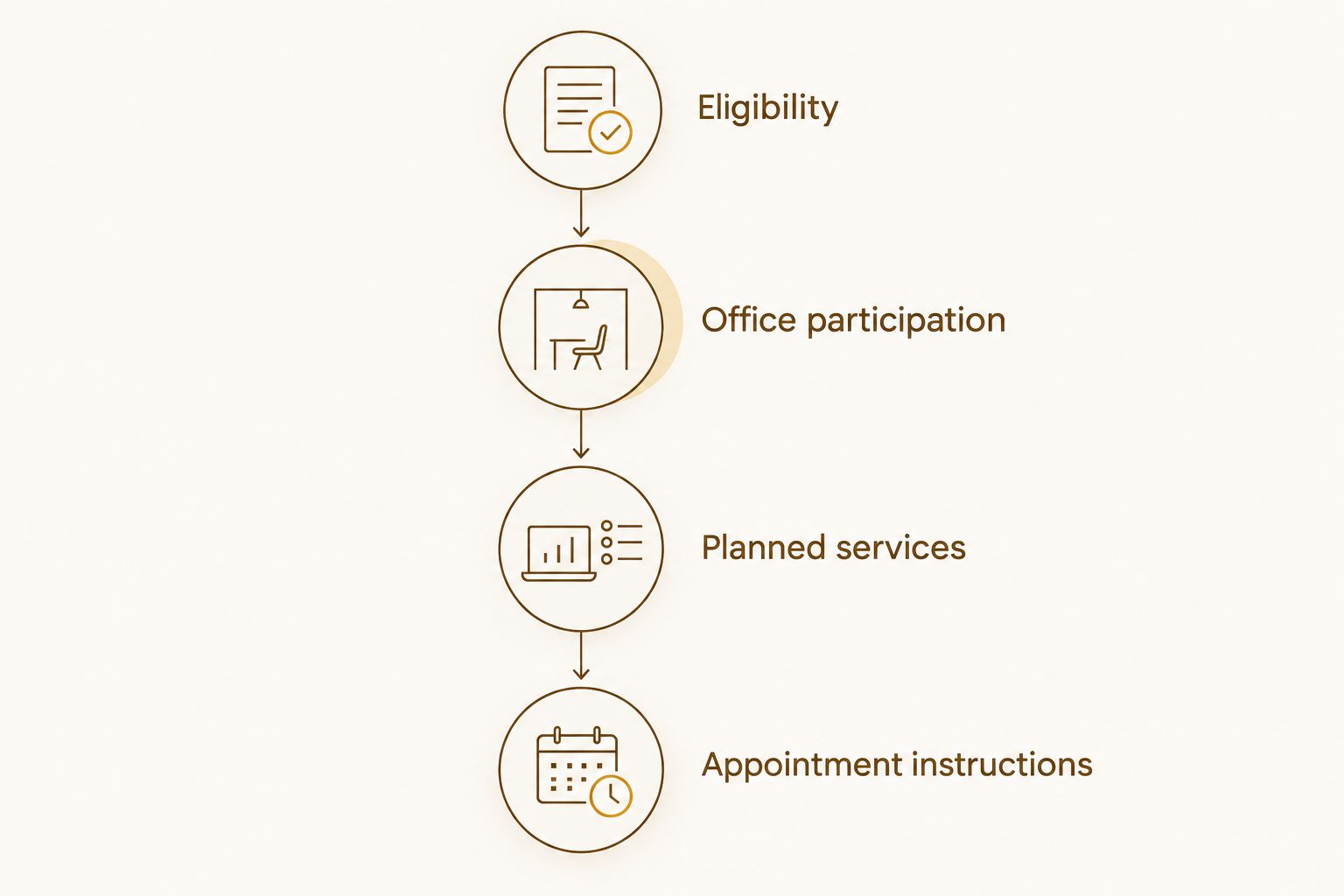
For your 2026 appointment, complete 3 coverage checks: your eligibility, the office’s participation, and the services planned for the exam. This workflow helps you ask specific questions instead of relying on a general statement that an office accepts insurance.
Before you start
- Gather your coverage records. Have your Medi-Cal identification information and any separate dental plan information you received. Keep your date of birth and current contact details ready for identity verification.
- Prepare your health and dental history. List medications, allergies, current symptoms, and the name of your previous dentist. Tell the new office whether recent dental images or records exist; ask how to transfer them securely.
- Check the easily missed detail: the exact office. Participation must match the location and coverage arrangement involved in your visit. Ask specifically about Medi-Cal dental coverage, rather than Medicare or an unrelated dental insurance plan.
Use a verified office or program contact method when sharing identification information. Do not send a photograph of your benefit card through an unverified message or post it in a public review.
Coverage record and eligibility
Establish which dental benefits apply
- Identify your coverage information. Read the notices and cards you received. Medi-Cal dental benefits are administered through fee-for-service and dental managed care arrangements; ask the program which arrangement applies to you rather than guessing from your medical plan’s name.
- Confirm your current eligibility. Contact the program or dental plan using the contact information on your official materials. Ask whether your dental eligibility is active and how an office should verify it for the intended appointment date.
- Resolve record mismatches. Check that your name, date of birth, and identifying information match the program’s records. If something differs, ask the program how to correct it and what the dental office should use while that correction is processed.
- Record the answer. Save the date, the representative’s name if provided, and any reference number. Keep this with your appointment notes, not scattered across separate messages.
Expected result: You can tell a dental office which program or plan to verify, using identifying information that matches your coverage record.
A card identifies your coverage information; it is not a substitute for checking eligibility for the visit. If you have had an enrollment change during 2026, ask which record applies to the appointment date rather than relying on an older confirmation.
Office participation and appointment type
Match your coverage to the dental office
- Ask about the precise coverage. Tell the office you want to use Medi-Cal dental benefits for a new patient exam. If you have a dental managed care plan, give its exact name.
- Verify the location and treating provider. Ask whether the office and the dentist who would examine you participate in your coverage arrangement. A practice name alone does not settle this question.
- Ask whether the office can arrange your initial visit. Explain that you are a new patient and describe your reason for coming. Do not assume that an office’s participation automatically determines the appointment type you need.
- Describe symptoms before choosing the visit. Mention tooth pain, swelling, a broken tooth, or difficulty eating. The office needs this information to assess whether to arrange a routine examination or a problem-focused evaluation.
Expected result: You have an office-level answer about participation and an appointment type matched to your reason for seeking care.
You can use this wording: “I want to use my Medi-Cal dental benefits for a new patient exam. Can you verify participation for this location and the dentist I would see?” This is a suggested question, not a statement about any practice’s participation.
Choose the right examination pathway
These are appointment pathways, not interchangeable packages. Let the dental team determine the appropriate evaluation after you describe your symptoms.
| Pathway | Best for | Strength | Limitation |
|---|---|---|---|
| Routine new patient examination | Establishing care without an urgent complaint | Creates an opportunity to review your overall dental needs | Does not establish that cleaning or treatment will occur during that visit |
| Problem-focused evaluation | A particular painful tooth, broken tooth, or other pressing concern | Directs attention to the concern you report | Does not necessarily replace a broader examination or complete treatment planning |
Choose based on your symptoms, not the appointment label that sounds most complete. Tell the office if symptoms change after scheduling.
Visit details and benefit verification
Connect the planned services to your coverage
- Ask what the appointment includes. Clarify whether the proposed visit involves an examination, dental images, or another service. Ask separately about cleaning; do not assume it is included simply because you are a new patient.
- Request service-specific verification. Ask the office to check the planned services against your dental benefits, including any applicable frequency limits or authorization requirements. Verification should reflect the intended appointment date.
- Disclose recent dental visits. Tell the office when and where you last had an examination or images, as accurately as you can. Ask whether obtaining those records would help the dentist assess what is needed.
- Separate the exam from later treatment. If the dentist identifies additional care, ask for a treatment plan and a separate benefit review. Verification for an initial examination is not approval for every treatment recommended afterward.
- Confirm the appointment instructions. Ask what identification, coverage information, records, and health history to bring. Also ask how the office will notify you if verification remains unresolved.
Expected result: You understand the planned visit, the verification status, and any remaining questions before arriving.
Keep 2 confirmations distinct: the office’s participation and the benefit check for the planned services. Neither replaces the other. For a 2026 visit, ask the office to flag any unresolved item rather than leaving you to interpret a general insurance statement.
Keep one appointment record
Maintain 1 appointment record containing the office location, appointment date, planned visit type, verification notes, and any outstanding question. A short note on your phone or a paper folder works; use whichever you can bring and update easily.
Record what was actually confirmed. “Office participates” and “planned exam benefits checked” are useful, distinct entries; “insurance handled” is too vague to guide your next call.
If your coverage changes after booking
Repeat the same workflow when your coverage information changes before the examination. An earlier verification should not be treated as confirmation under a different enrollment record.
- Tell the dental office that your coverage information changed.
- Provide the updated details through the office’s verified communication method.
- Ask the program which coverage applies on the scheduled date.
- Have the office recheck participation and the planned services before you rely on the earlier answer.
Expected result: The office’s appointment record matches the coverage that applies to your visit.
If the change occurs close to your appointment, contact the office rather than silently cancelling or arriving with unexplained paperwork. Ask what remains unresolved and how the office wants you to proceed. For appointments crossing into another coverage period in 2026, use the visit date as the reference point.
Troubleshooting
Your coverage is active, but the office cannot verify it
Compare the identifying details the office submitted with your program records. Ask the office what response it received, then contact the program to resolve the specific mismatch or eligibility question. Do not repeatedly submit the same information without identifying the problem.
A directory lists the office, but the office gives a different answer
Ask the office to check the exact location, treating dentist, and coverage arrangement. Then contact your program for help identifying a participating office if the mismatch remains unresolved. A directory listing is a starting point, not a substitute for direct confirmation.
You expected a cleaning, but only an examination was arranged
Ask what was scheduled and whether a cleaning requires a separate clinical assessment or appointment. The dentist determines the appropriate care after evaluating your teeth and gums; booking an exam does not establish which cleaning you need.
Previous images or records have not arrived
Contact your previous practice and ask how to authorize a secure transfer. Tell the new office what records exist and when they were taken. Let the dentist decide whether those records are sufficient or additional images are clinically necessary.
You develop pain or swelling while waiting
Call the dental office and describe the change rather than waiting for the original routine appointment. Use the same-day emergency dental insurance workflow to organize coverage questions without delaying clinical advice. Trouble breathing or swallowing requires emergency medical care, not routine appointment scheduling.
Customize your workflow
At Harmony Dental Group, your reason for seeking care can include general dental needs or questions about cosmetic and restorative treatment. Keep the immediate examination request separate from your longer-term goals so both receive clear attention.
If you also want to discuss veneers, implants, Invisalign, or gum recession treatment, mention that when arranging the visit. These are services the practice offers, but that fact does not establish Medi-Cal coverage or your suitability for treatment. Ask for a clinical assessment and a separate explanation of benefits before deciding.
Bring your questions about comfort, medications, and previous difficult dental experiences as well. You do not need to minimize anxiety to explain what would help you feel prepared.
FAQ
How do I book a new patient exam with a Medi-Cal dentist in San Diego?
Confirm your dental eligibility, verify the exact office’s participation, and ask the office to check the planned examination services before booking. Provide your coverage information and describe any symptoms when you call.
Does Harmony Dental Group accept Medi-Cal for a new patient exam?
Confirm Medi-Cal participation directly with Harmony Dental Group before scheduling. Ask about your exact coverage arrangement, the office location, and the dentist who would examine you.
Does an active Medi-Cal card mean any dentist can examine me under my benefits?
No. Active eligibility does not establish that a particular dentist participates in your coverage arrangement or that every planned service meets benefit requirements.
Will my first dental appointment include a cleaning?
Do not assume a cleaning is included with your initial examination. Ask what is scheduled, and let the dentist assess which cleaning or other care is appropriate.
What should I bring to my Medi-Cal dental appointment?
Bring the identification and coverage information requested by the office, plus your medication list, allergies, and relevant dental history. Ask in advance whether previous dental images or records should be transferred.
What if my Medi-Cal information changes before the appointment?
Notify the dental office and ask it to repeat verification using the coverage that applies on your appointment date. Confirm the applicable record with your program if the effective date is unclear.
Should I wait for a routine exam if my tooth starts hurting?
Contact the dental office when pain develops so the team can assess the appropriate appointment. Trouble breathing or swallowing requires emergency medical care rather than waiting for a dental benefits check.
One last thing
An appointment confirmation is not the same as a benefits confirmation. Before your 2026 visit, ask one final question: “Is anything about my eligibility, your participation, or the planned exam still unresolved?” That question gives you a specific next action instead of an assumption.