
Instead of comparing monthly payments before you know what treatment includes, build your all on 4 dental implants payment plan around a written clinical recommendation, insurance review, and repayment agreement. This 2026 workflow helps you prepare for a La Jolla implant consultation without confusing financing approval with treatment suitability.
- An all on 4 dental implants payment plan should follow a written treatment recommendation, not replace one.
- Harmony Dental Group offers dental implant care in La Jolla; confirm the proposed procedure and payment arrangements directly.
- Compare total repayment, interest terms, and treatment scope before signing a dental financing agreement.
- Insurance estimates and financing approvals answer different questions; neither guarantees the other.
Why this matters
A monthly payment does not tell you which teeth are being replaced, what treatment includes, or what happens if the clinical plan changes. Start with those details, then decide whether the repayment arrangement fits your household.
Harmony Dental Group is best for La Jolla patients seeking a local dental implant consultation. You can use the Harmony Dental Group website to begin that conversation. Discuss whether the practice provides the specific full-arch approach recommended for you; offering dental implants does not establish that every implant technique is appropriate or provided.
All-on-4 generally describes a fixed full-arch restoration supported by 4 implants. Replacing 1 arch means replacing the upper or lower set of teeth; replacing 2 arches means treating both. Your dentist must assess your mouth before recommending an implant arrangement.
Before you start
- Gather your clinical information. Bring your medication list, relevant medical history, and details of previous dental treatment. Ask how existing dental records or images should be transferred rather than assuming they replace a new assessment.
- Prepare your financial information. Have your dental insurance details, household budget, and any proposed financing disclosures ready. Decide what you can repay without relying on an unconfirmed insurance benefit.
- Check the scope before applying. A financing approval is not a treatment plan. Confirm whether the proposed agreement covers the intended arch, temporary restoration, final restoration, and any separately planned procedures before authorizing an application.
For your 2026 planning, keep the clinical documents and financial documents together. A simple folder makes it easier to spot a mismatch between the treatment you discussed and the work described in an agreement.
Treatment plan
- Arrange a dental implant assessment. Explain whether your concern is missing teeth, loose dentures, difficulty chewing, or teeth you have been told cannot be restored. Describe what you want to improve without assuming that All-on-4 is the answer.
- Ask which teeth can be preserved. Before agreeing to extractions, understand why each proposed extraction is recommended and what alternatives exist. Ask for clarification whenever the explanation is unclear.
- Confirm the proposed restoration. Ask whether the recommendation is a fixed full-arch bridge, a removable implant-supported denture, or another approach. These terms describe different treatment arrangements and should not be treated as interchangeable.
- Request a written, itemized plan. Ask the office to distinguish assessment, imaging, extractions, implant placement, temporary teeth, final teeth, and follow-up care where applicable. Have the office identify anything excluded or dependent on further findings.
- Separate planned treatment from possible changes. Ask what findings would change the recommendation and how the office would obtain your agreement before additional work. Do not assume the initial document covers every future procedure.
Expected result: You can describe the proposed treatment in plain language, identify the arch being treated, and distinguish included work from unresolved decisions.
For example, knowing that a plan includes temporary teeth does not establish that it also includes the final restoration. Ask explicitly. Likewise, do not assume a full-arch recommendation promises fixed teeth immediately after surgery; timing depends on the clinical plan.
Coverage and payment sources
- Request a benefits review. Give the office your current insurance information and ask which proposed services require clarification with the insurer. Implant-related benefits depend on the policy, not simply on whether you have dental insurance.
- Ask about a pretreatment estimate. Where your insurer provides one, request a written estimate tied to the proposed procedures. Treat it as an estimate rather than a guarantee of payment.
- Identify the remaining responsibility. Ask the office to separate estimated insurance benefits from the amount you would be responsible for under the proposed arrangement. Keep any unresolved coverage questions visible.
- Confirm accepted payment arrangements directly. Ask whether the office accepts the payment method you intend to use and whether any financing is provided by the practice or a separate lender. Do not assume that a financing option described online is accepted by your dentist.
Use this comparison to organize the conversation. These are payment routes to investigate, not a list of arrangements confirmed at Harmony Dental Group.
| Payment route | Best for | Main benefit | Main limitation |
|---|---|---|---|
| Personal funds | Patients who can pay without compromising essential expenses | Avoids borrowing interest | Requires using household funds |
| Dental insurance benefits | Patients whose policies cover parts of the proposed treatment | Can reduce the patient's responsibility for covered services | Exclusions, limits, and claim decisions still apply |
| Practice payment agreement, if offered | Patients seeking a direct arrangement with the dental office | Provides written payment milestones | Availability and terms require direct confirmation |
| Third-party financing, if accepted | Patients who need to spread repayment | Separates repayment timing from the treatment schedule | Interest, fees, credit review, and lender terms require scrutiny |
Combining insurance with borrowing does not remove the need to review each agreement separately. An insurance estimate describes potential benefits; a credit agreement describes your repayment obligation.
Expected result: You know which payment sources are confirmed, which remain uncertain, and who answers questions about each one.
Repayment agreement
- Compare equivalent treatment scope. If you review different financing proposals, confirm that each relates to the same treatment plan. A smaller monthly payment is not a useful comparison when the underlying treatment differs.
- Read the borrowing disclosures. Review the annual percentage rate, repayment term, finance charges, fees, and total repayment where applicable. Ask the lender to explain unfamiliar wording before you sign.
- Check promotional conditions. If a promotional arrangement is offered, establish whether it uses deferred interest or a different structure. Deferred-interest terms can trigger interest charges if the qualifying balance is not paid under the agreement's conditions.
- Ask about the credit inquiry. Before submitting an application, ask whether the eligibility check or application involves a soft or hard credit inquiry. Do not assume that a preliminary check and a final application work the same way.
- Review changes and cancellations. Ask both the office and lender how a revised treatment plan, canceled procedure, refund, or disputed charge would be handled. A change in dental treatment does not automatically explain what happens to a separate credit agreement.
Expected result: You understand when repayment begins, what you must repay, and which conditions affect the agreement.
For a broader comparison, use the guide to payment plan options for dental care. Keep the actual lender disclosures beside it; a general guide cannot replace your contract.
The best payment plan is one you understand and can repay—not simply the one with the smallest advertised installment. In your 2026 comparison notes, record the date of each proposal so you do not mix current terms with an older document.
Treatment and payment schedule
- Match payment milestones to clinical stages. Ask when payments to the office are due and how those dates relate to assessment, surgery, temporary teeth, and final restoration. Keep the lender's repayment schedule separate if it follows different dates.
- Confirm authorization before charges. Establish when an application becomes a binding agreement and when funds are charged or disbursed. Ask for copies of everything you authorize.
- Save the final documents. Keep the agreed treatment plan, insurance correspondence, financing disclosures, and payment schedule together. Check that the patient details and treatment description match across documents.
- Confirm your next appointment. Ask what preparation is required and who to contact if your health, medication, insurance, or financial circumstances change. Follow the treating clinician's instructions rather than a general online timeline.
Expected result: You have a coordinated schedule, not just a credit approval and an appointment date.
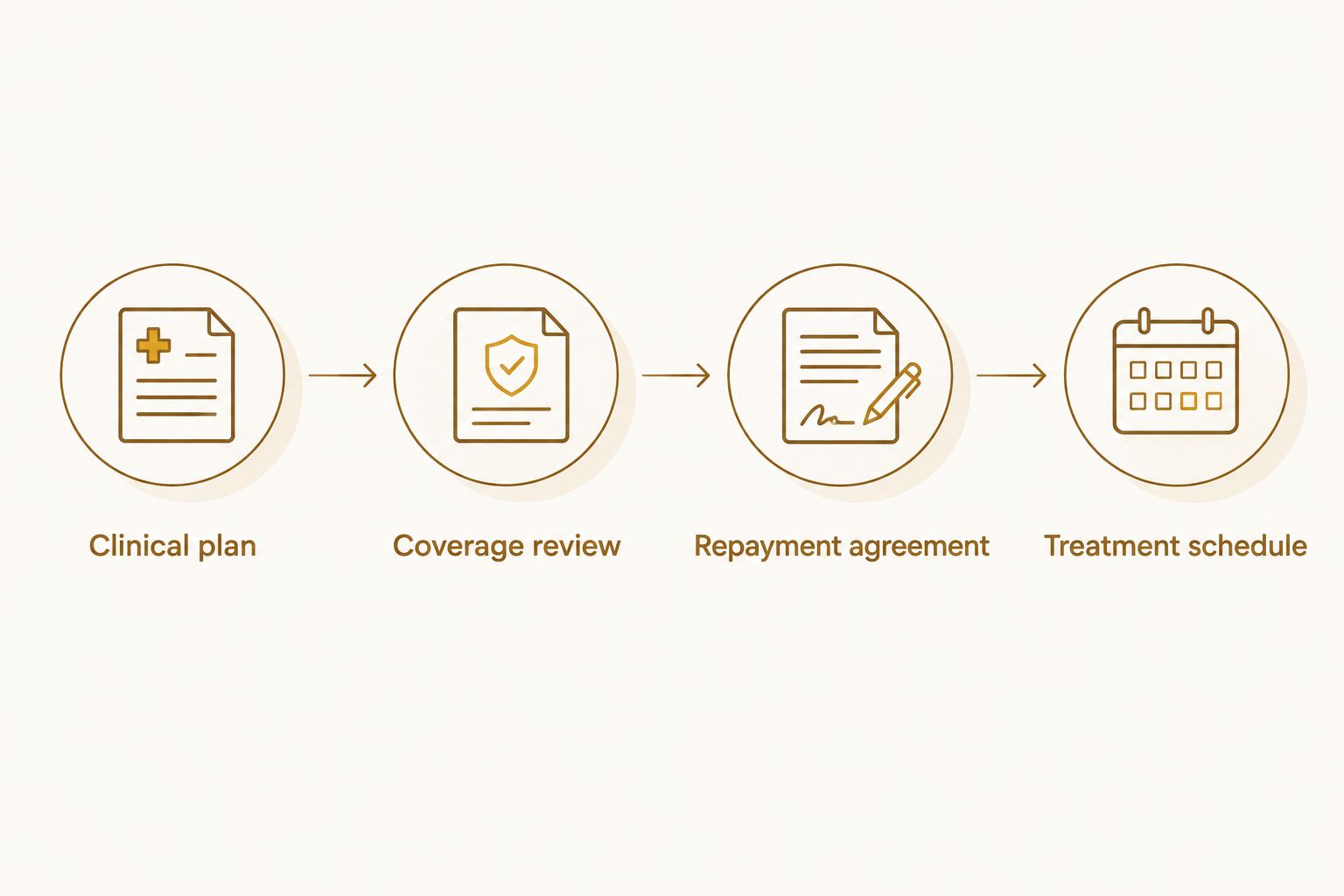
The sequence is Clinical plan, Coverage review, Repayment agreement, then Treatment schedule. Financial questions belong early in the conversation, but the agreement should reflect the treatment you actually authorize.
When your treatment plan changes
A revised clinical recommendation needs a revised financial review. Do not keep using the original repayment assumptions after the underlying treatment changes.
- Ask for an updated written treatment plan showing what changed and why.
- Request an updated insurance estimate when the proposed procedures change.
- Ask the office and lender whether the change requires a new authorization, adjustment, or application.
- Confirm the revised payment and appointment schedules before proceeding.
This variant also applies when you decide to discuss treating the other arch. Do not assume that an agreement for upper teeth includes lower teeth, or that approval for an earlier plan covers additional treatment.
For a revised 2026 plan, compare revised documents—not a new verbal explanation against an old agreement. If something remains unclear, pause the financial decision and ask for clarification.
Troubleshooting
Financing is approved, but treatment is not finalized
Keep the decisions separate. Ask what clinical assessment remains and whether any financial commitment has already been made; approval alone does not establish suitability for implants or authorize a particular procedure.
The insurance estimate differs from the claim decision
Compare the explanation of benefits with the estimate and billed procedures. Ask the insurer to explain the difference, then discuss any correction or appeal process with the office and insurer rather than assuming the remaining balance disappears.
The monthly payment fits, but the agreement is unclear
Request an explanation of total repayment, interest conditions, fees, and the repayment term. Do not sign based only on an installment figure, especially when promotional language obscures what happens after the promotional period.
The plan does not clearly include final teeth
Ask the office to identify temporary and final restorations separately in writing. Resolve that gap before using the document to choose a financing amount or authorize treatment.
Financing is declined
Ask the lender how to obtain the reasons for its decision. Then discuss clinically appropriate alternatives or timing with your dentist; avoid submitting repeated applications without understanding their credit implications.
Customize your workflow
Bring your priorities to the consultation: chewing comfort, confidence when smiling, avoiding removable teeth, or understanding maintenance. Tell the dentist which concerns matter most and ask how the proposed treatment addresses them.
Harmony Dental Group offers dental implant care, but the right procedure and payment arrangement require individual confirmation. Ask about ongoing professional care and home cleaning as well as the initial treatment; financing the procedure does not settle the maintenance discussion.
For your 2026 household plan, keep essential living expenses separate from funds earmarked for dental care. If the proposed repayment would put those expenses at risk, discuss your concerns before committing rather than relying on hoped-for coverage or future borrowing.
FAQ
How do I get an all on 4 dental implants payment plan?
Start with a dental assessment and written treatment plan, then confirm accepted payment arrangements and review any financing disclosures. Financing approval does not establish that All-on-4 is clinically appropriate for you.
Does Harmony Dental Group offer All-on-4 financing?
Confirm the specific full-arch procedure and financing arrangements directly with Harmony Dental Group. The practice offers dental implants, but that does not establish a particular All-on-4 program or lender relationship.
Will dental insurance cover All-on-4 implants?
Coverage depends on your policy and the proposed procedures. Ask for a benefits review and any available pretreatment estimate, while recognizing that an estimate is not a payment guarantee.
Can I combine dental insurance with a payment plan?
Ask the office and financing provider whether the proposed arrangement allows you to combine insurance benefits with financed payments. Confirm how later insurance payments or adjustments would affect your account.
Is the lowest monthly payment the best option?
No, the lowest monthly payment does not establish the lowest total repayment or the best fit. Compare equivalent treatment scope, interest terms, fees, and repayment length.
Can I apply before my implant consultation?
Do not treat an early financing approval as a substitute for a clinical assessment. Ask whether an eligibility check affects your credit and avoid authorizing treatment charges before understanding the proposed care.
What happens to financing if my implant treatment changes?
Ask the office and lender to explain the adjustment process before proceeding with revised treatment. Updated clinical recommendations do not automatically establish revised repayment terms.
One last thing
Your treatment schedule and your repayment schedule are different documents. A delayed clinical stage does not, by itself, establish that a lender's payment deadline has moved.
Before signing, ask who handles each type of change: the dental office for treatment decisions, the insurer for benefits, and the lender for credit terms. Keep those contact details with your agreements. Clear responsibilities make the next conversation easier if your plan changes.