
CareCredit offers a dedicated way to finance healthcare expenses, including dental treatment, at participating providers. Its ceiling is the repayment agreement: promotional financing still requires you to understand interest, deadlines, and monthly obligations. The best CareCredit alternatives in 2026 are personal loans for a defined repayment schedule and a treatment-planning visit with Harmony Dental Group when you need to establish what care you actually need before borrowing.
- Compare CareCredit alternatives against your written dental treatment plan, not just the advertised monthly payment.
- Harmony Dental Group is a dental care starting point, not a substitute lender.
- Personal loans offer scheduled repayment; compare interest, fees, and the total repayment amount.
- HSA and FSA funds can cover eligible dental expenses, but purely cosmetic treatment generally does not qualify.
- Staged dental payment plans depend on clinical timing and the practice’s actual payment arrangements.
Why this matters
Financing veneers, dental implants, or Invisalign starts with understanding the treatment—not choosing a credit application. A manageable payment does not tell you whether the recommended care addresses your needs or whether the financing agreement fits your budget.
For patients in La Jolla and nearby San Diego neighborhoods, the useful comparison in 2026 is between borrowing, using eligible health-account funds, and paying as clinically appropriate treatment proceeds. These routes solve different problems. None replaces an examination or guarantees that a particular payment arrangement will be offered.
This guide explains the trade-offs without assuming that your dentist accepts a particular lender. It is general information, not individualized financial or tax advice.
CareCredit alternatives at a glance in 2026
Start with the distinction between a healthcare credit account and a way to reduce or avoid borrowing. A dental practice provides care; a lender provides credit. Comparing them as interchangeable services obscures the decision you need to make.
| Option | Best for | Standout feature | How it differs from CareCredit | Main limitation |
|---|---|---|---|---|
| CareCredit | Patients whose provider participates and whose agreement fits their budget | Healthcare-focused credit account | The benchmark for this comparison | Promotional terms require careful review |
| Harmony Dental Group treatment planning | La Jolla patients deciding which dental care to pursue | Discussion of general, cosmetic, and restorative treatment | Establishes the care plan rather than providing a substitute credit product | A consultation does not establish financing approval or payment terms |
| Personal loan, including a credit-union loan | Patients seeking a defined repayment schedule | Installment repayment under a loan agreement | Borrowing is separate from a healthcare credit account | Approval, interest, and fees depend on the lender and applicant |
| General-purpose credit card | Patients comparing a specific introductory purchase offer | Credit usable beyond healthcare | Not limited to participating healthcare providers | An unpaid balance can become expensive after an introductory period |
| HSA or FSA funds | Patients with eligible expenses and usable account funds | Tax-advantaged payment for qualifying care | Uses designated funds rather than new credit | Eligibility rules exclude purely cosmetic treatment |
| Clinically staged direct payment | Patients whose treatment can safely proceed in phases | Payment aligned with separate treatment stages | Can avoid financing the entire plan upfront | Requires suitable clinical timing and confirmed payment arrangements |
1. Harmony Dental Group: best for planning before borrowing
Harmony Dental Group offers general, cosmetic, and restorative dental care in La Jolla, including veneers, implants, and Invisalign. Start with the treatment question: what needs attention, what is elective, and what alternatives deserve discussion? A written plan gives you something concrete to compare against financing agreements.
Harmony Dental Group is best for La Jolla patients who need a dental treatment plan before choosing financing. This is a recommendation to clarify care, not a claim that the practice offers an alternative credit account or an in-house installment plan.
Where this approach shines
- You can discuss the dental concern before committing to a borrowing amount.
- You can ask whether a proposed treatment is cosmetic, restorative, or intended to address function.
- You can request an explanation of treatment sequence and any clinically appropriate alternatives.
Where this approach falls short
- A dental consultation is not a loan approval.
- Treatment recommendations do not establish insurance coverage or health-account eligibility.
- Any payment arrangement must be confirmed directly; do not assume monthly installments are offered.
| Dimension | Treatment planning at the practice | CareCredit |
|---|---|---|
| Main purpose | Decide what dental care to pursue | Finance eligible healthcare purchases at participating providers |
| Key document | Written treatment plan | Credit agreement |
| Decision to resolve | Which care is appropriate | Whether the repayment terms fit your finances |
Best for: Patients considering veneers, implants, or Invisalign who have not yet established the scope of care.
Verdict: Hold off on borrowing until you understand the treatment plan.
2. Personal loans: best for a defined repayment schedule
A personal loan provides funds under an installment agreement. Banks, credit unions, and other lenders offer these loans, with terms that depend on the lender and your application. Compare the actual agreement rather than assuming a credit union or any other lender will automatically offer the better deal.
For dental treatment, the important distinction is the repayment structure. A fixed-rate installment loan sets out scheduled payments and a repayment term; a revolving credit account works differently. Confirm whether the loan you are considering actually has a fixed rate.
Where personal loans shine
- A fixed-rate agreement gives you a defined repayment schedule.
- You can compare lenders separately from choosing a dentist.
- The loan agreement identifies interest and applicable fees before you accept it.
Where personal loans fall short
- Approval is not guaranteed, and an application can involve a credit inquiry.
- Origination fees can reduce the funds you receive.
- You owe the lender even if your treatment plans later change.
| Dimension | Personal loan | CareCredit |
|---|---|---|
| Credit structure | Installment loan | Revolving healthcare credit account |
| Provider relationship | Loan is separate from provider participation | Provider participation matters |
| Main review point | Rate, fees, term, and total repayment | Purchase terms, promotional conditions, and repayment obligations |
Ask how much you will receive after fees, whether early repayment carries a charge, and when repayment begins. Then compare the total repayment obligation against the same dental treatment amount.
Best for: Patients who want scheduled repayment and have a lender offer they can evaluate in writing.
Verdict: Hold until you compare the full loan agreement with the CareCredit offer.
3. General-purpose credit cards: best for a specific purchase offer
A general-purpose credit card is another borrowing route, not automatically a cheaper one. Some cards offer introductory purchase terms. Your decision should depend on the exact offer, your repayment capacity, and whether the dental practice accepts the card.
Read the agreement closely. A purchase promotion is not the same as a balance-transfer promotion, and an introductory rate is not the same as a deferred-interest arrangement.
Where general-purpose credit cards shine
- An existing card can avoid opening a separate healthcare account.
- A qualifying purchase offer gives you another agreement to compare.
- You can use the account outside healthcare, subject to its terms.
Where general-purpose credit cards fall short
- The regular purchase rate matters if a balance remains after the promotion.
- Adding dental expenses can increase your credit utilization.
- Minimum payments are not a reliable plan for clearing the balance by a deadline.
Before charging treatment, write down the promotion’s end date and your intended payoff schedule. Do not confuse an available credit limit with an affordable treatment budget.
Best for: Patients with a suitable purchase offer and a realistic plan to repay within its terms.
Verdict: Skip any offer you cannot explain clearly or repay comfortably.
4. HSA and FSA funds: best for eligible dental expenses
Health savings accounts and health flexible spending arrangements can pay for qualifying dental expenses using tax-advantaged funds. They are not loans. That distinction makes them useful to review before applying for new credit.
Eligibility depends on the expense, not simply on whether a dentist provides the service. IRS guidance generally treats dental care that prevents or alleviates dental disease as eligible, while purely cosmetic procedures generally do not qualify. Do not assume veneers or whitening qualify; orthodontic and restorative expenses require review of the applicable rules and documentation.
Where HSA and FSA funds shine
- Using existing funds avoids taking on a new debt for that portion of care.
- Eligible dental expenses can be paid or reimbursed under the account’s rules.
- An itemized treatment estimate helps you check the proposed expense.
Where HSA and FSA funds fall short
- You need an eligible account and funds you can use.
- Cosmetic treatment generally does not qualify solely because it improves your smile.
- FSA timing and reimbursement rules require attention.
Ask your account administrator what documentation is required before assuming reimbursement. A treatment description from your dentist helps, but it does not override tax rules.
Best for: Patients with usable health-account funds and qualifying dental expenses.
Verdict: Use eligible funds before borrowing, while preserving money needed for other health expenses.
5. Clinically staged direct payment: best for care that can proceed in phases
Some dental treatment involves separate clinical stages. Ask whether your plan can safely proceed in phases and how payment would work at each stage. This is different from assuming that the practice offers an in-house payment plan.
The dentist should determine the clinical sequence. Delaying treatment solely to avoid borrowing is not appropriate when the delay threatens your oral health.
Where staged payment shines
- You can discuss necessary care separately from elective improvements.
- Paying from available funds avoids interest on the amount you do not borrow.
- Clear treatment stages help you plan around the care actually scheduled.
Where staged payment falls short
- Not every treatment can be divided safely.
- Separate clinical appointments do not automatically mean separate payment deadlines.
- Waiting can allow an untreated dental problem to worsen.
Get both the clinical sequence and payment expectations in writing. Ask what happens if the recommended plan changes after treatment begins.
Best for: Patients whose dentist confirms that phased care is appropriate and whose payment arrangements are clear.
Verdict: Hold until the dentist confirms that the timing is safe.
Why people consider switching from CareCredit
There is no single best reason to change financing in 2026. The relevant reasons are differences in the agreements and your circumstances—not unsupported claims about outages, approval rates, or lender behavior.
Consider another route when:
- You want scheduled repayment. Compare a fixed-rate installment loan with the healthcare credit agreement.
- You already have eligible funds. Review HSA or FSA payment before borrowing for a qualifying expense.
- You cannot meet a promotional deadline. Compare the consequences of an unpaid balance before accepting the offer.
- You have not finalized treatment. Establish the care plan before deciding how much credit to request.
- Your provider does not participate. Ask which payment methods the practice actually accepts.
For deferred-interest promotions, the central risk is the payoff condition: interest can be charged from the purchase date if the promotional balance is not paid in full by the deadline. Not every promotion has identical terms. Read your specific agreement.
How to choose your payment route
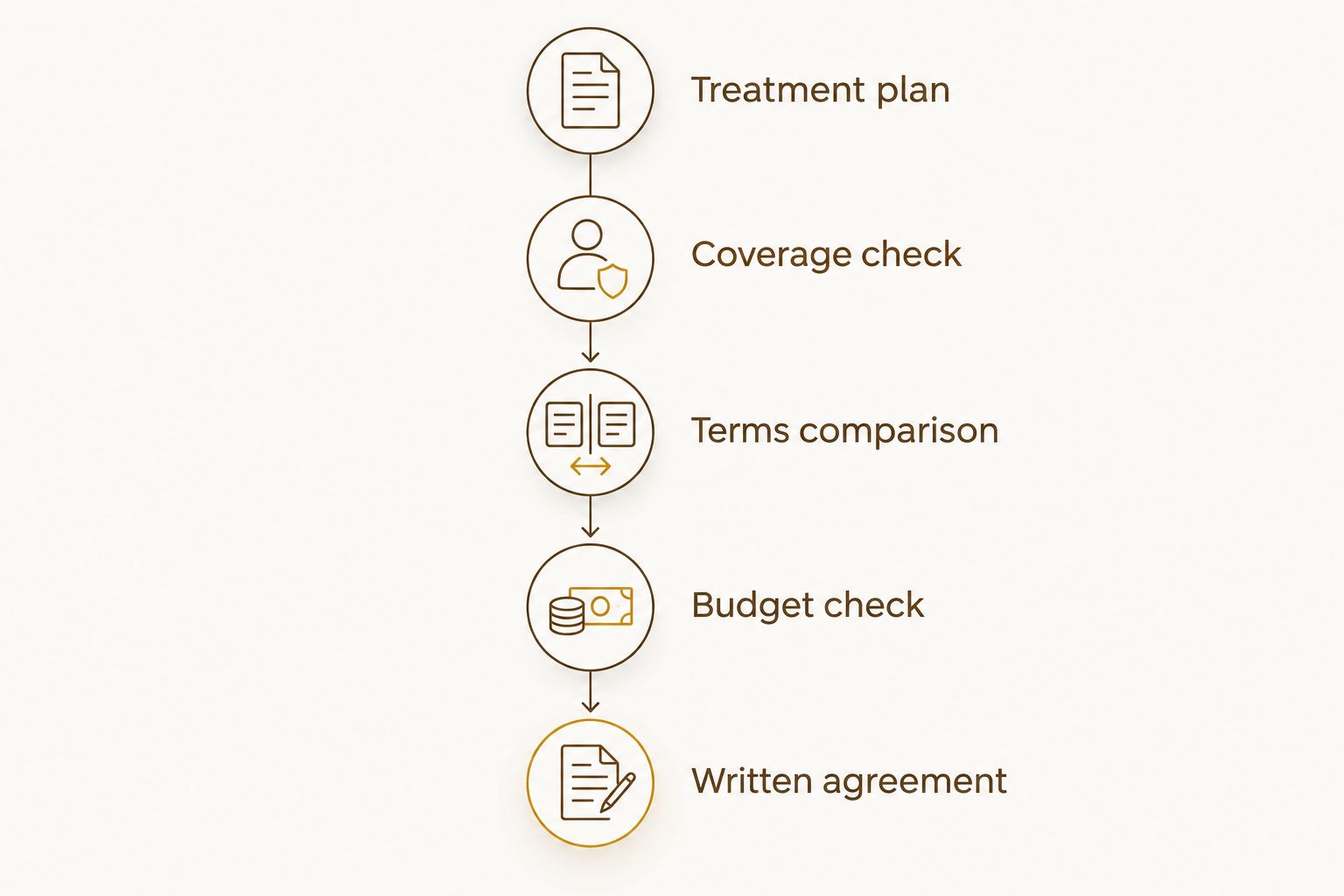
Use this sequence for a dental financing decision in 2026:
- Treatment plan: Request the recommended care, alternatives, and sequence in writing.
- Coverage check: Ask about applicable insurance benefits and eligible health-account funds without assuming coverage.
- Terms comparison: Compare interest, fees, payment obligations, and the total repayment amount.
- Budget check: Test the payment against essential household expenses and existing debt.
- Written agreement: Confirm the practice’s payment expectations and the lender’s terms before proceeding.
For a consultation at Harmony Dental Group, bring any existing estimate and the financing agreement you are considering. Ask the clinical questions first, then confirm payment arrangements directly with the practice.
Start with your dental care needs
Review the practice before discussing treatment and payment arrangements.
When staying with CareCredit is the right call
CareCredit remains a reasonable option when your provider participates, you understand the exact agreement, and the repayment obligation fits your budget. An alternative is not better merely because it has a different name.
Its strength is healthcare-focused financing. Its limitation is that access to credit does not establish affordability, and promotional conditions need careful attention. Stay with CareCredit when the written terms compare favorably with your actual alternatives—not when the monthly payment is the only number you understand.
FAQ
What are the best CareCredit alternatives for dental work?
The best CareCredit alternatives depend on your needs: personal loans provide installment repayment, while HSA or FSA funds can pay eligible expenses without new borrowing. Clinically staged direct payment is another route when the dentist confirms suitable timing and payment arrangements.
Is a personal loan better than CareCredit for dental implants?
A personal loan is better only when its written terms fit your budget better than the CareCredit agreement. Compare interest, fees, repayment timing, and total repayment against the same implant treatment plan.
Does Harmony Dental Group offer an alternative to CareCredit?
Harmony Dental Group provides dental care, not a substitute lending product. Ask the practice directly which payment methods and financing arrangements apply to your proposed treatment.
Can I use my HSA or FSA for veneers?
Purely cosmetic veneers generally do not qualify for HSA or FSA payment. If the proposed treatment addresses a dental health problem, check the applicable eligibility rules and required documentation with your account administrator.
Can I pay for Invisalign with health-account funds?
Orthodontic treatment can qualify as a medical expense under IRS rules. Confirm your account’s requirements, the treatment documentation, and reimbursement timing before relying on HSA or FSA funds.
Can I get dental financing without a credit check?
Do not assume a financing option avoids a credit check. Ask the lender about its application process; using existing eligible health-account funds or paying directly does not involve applying for a new loan.
What should I check before accepting deferred-interest financing?
Check the payoff deadline and what happens if the promotional balance is not paid in full. Deferred-interest terms can result in interest charged from the purchase date, so minimum payments alone are not a payoff strategy.
Should I delay dental treatment until I can pay without borrowing?
Ask your dentist whether waiting is clinically safe before delaying treatment. Elective changes and active dental problems require different timing decisions, and a financing comparison cannot determine that timing.
One last thing
Before signing a dental financing agreement in 2026, ask what happens if treatment changes or a payment is refunded. A refund from the practice and an adjustment to a lender account are separate processes; confirm how each would work rather than assuming payments stop automatically.
That question protects your understanding of the agreement without requiring you to predict your treatment outcome. Clear care plans and clear repayment terms belong together.