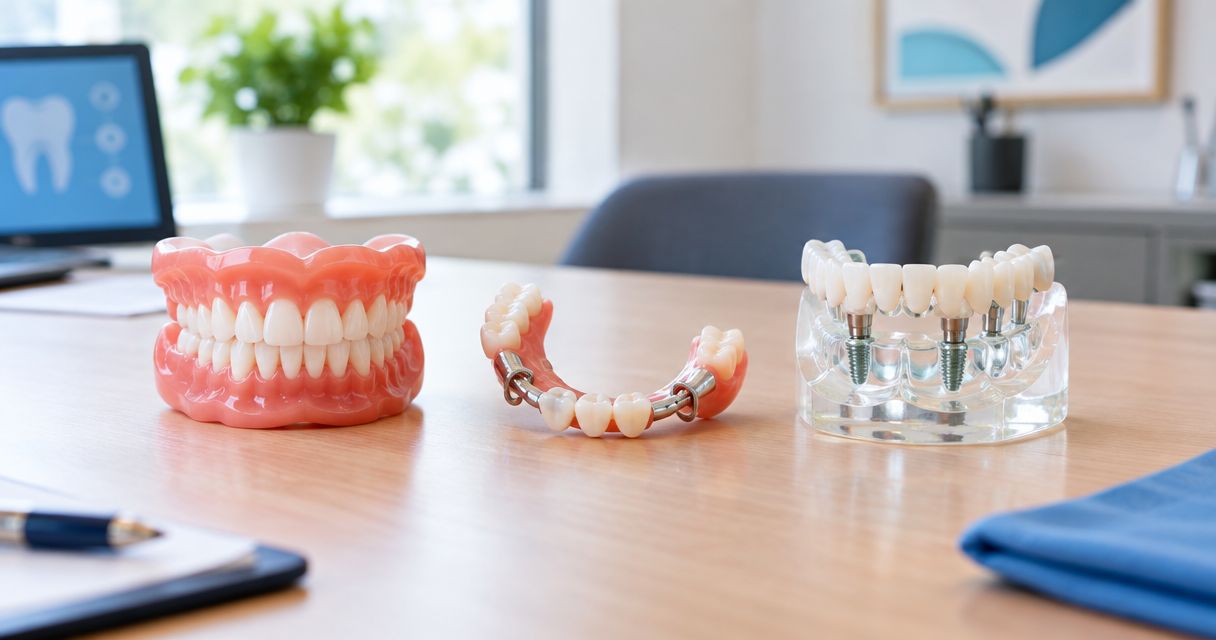
Best for stability: removable implant-retained dentures for suitable implant candidates. Best for keeping remaining teeth: partial dentures. Best for replacing an entire arch without implant surgery: conventional full dentures. This 2026 guide compares those choices; Harmony Dental Group provides restorative dental care in La Jolla, San Diego.
- Best type of dentures compared: implant-retained dentures prioritize retention, partial dentures preserve remaining teeth, and full dentures replace an arch.
- Choose partial dentures when usable natural teeth remain; choose full dentures when an entire arch needs replacement.
- Removable implant-retained dentures require implant assessment, surgery, and cleaning around the attachments.
- Harmony Dental Group offers restorative dental care for local patients in La Jolla.
Why this matters
Full, partial, and implant-retained dentures are not three interchangeable upgrades. Full and partial describe how many teeth a denture replaces; implant-retained describes how the denture stays in place. A full denture can therefore also be implant-retained.
For your 2026 treatment decision, start with the teeth you can keep, then compare support and retention. A partial denture is not appropriate for an arch with no remaining teeth, and an implant-retained denture requires a separate assessment of bone, oral health, and surgical suitability.
Harmony Dental Group is a local option for La Jolla patients seeking restorative dental care. Ask whether your remaining teeth are maintainable before choosing any replacement that assumes they must be removed.
What makes the best denture type?
Judge each option against these criteria before comparing appearances or attachment systems:
- Remaining teeth: The position and health of natural teeth determine whether a partial denture has suitable support.
- Retention: Compare how the denture resists lifting or shifting during speech and eating.
- Tissue health: Gum condition, jawbone anatomy, and healing affect the treatment plan.
- Surgical requirements: Conventional dentures avoid implant placement; implant-retained dentures require it.
- Daily cleaning: Every denture needs cleaning, but implants and partial-denture supporting teeth add specific responsibilities.
- Maintenance: Adjustments, relines, repairs, and attachment replacement are different kinds of follow-up care.
A comfortable result depends on fit and bite as well as denture type. Choosing implants does not remove the need to assess the replacement teeth, the supporting tissues, or your ability to maintain them.
Denture types at a glance: 2026 comparison
| Denture type | Best for | Standout feature | Key limitation |
|---|---|---|---|
| Removable implant-retained dentures | Eligible patients prioritizing retention | Implant attachments help hold the denture in place | Requires surgery and attachment maintenance |
| Partial dentures | Patients with usable natural teeth remaining | Replaces gaps while retaining suitable teeth | Supporting teeth and gum tissues need ongoing care |
| Conventional full dentures | Patients replacing a complete arch without implants | Replaces all teeth in an arch without implant placement | Retention depends on fit, anatomy, and tissue support |
A denture can replace teeth in 1 dental arch, upper or lower. If both arches need replacement, the plan covers 2 dental arches, and the most suitable support system need not be identical for both.
1. Implant-retained dentures: best for added retention
Removable implant-retained dentures attach to dental implants rather than relying only on contact with the gums. You remove the denture for cleaning and clean the implant attachment areas separately. This option combines a removable prosthesis with implanted support.
Implant-retained dentures are the best fit for patients whose priority is retention and who are suitable for implant surgery. Suitability depends on examination findings, bone anatomy, medical history, and the proposed restoration—not preference alone.
Implant-retained denture pros
- Implant attachments help resist denture displacement.
- Removable designs allow access for cleaning outside the mouth.
- Added retention can address movement that persists with a conventional denture.
- The treatment plan can address the upper and lower arches separately.
Implant-retained denture cons
- Implant placement requires surgery and a healing plan.
- Bone and tissue conditions can limit treatment options or require additional treatment.
- Attachments can wear and need maintenance or replacement.
- Implant sites still require daily cleaning and professional monitoring.
What to check before choosing implants
Ask whether the proposed denture is removable or fixed. A removable implant overdenture comes out at home; a fixed full-arch implant restoration generally does not. The cleaning routine and maintenance needs differ, so the word implant alone does not explain the treatment.
Also ask what provides support. Some removable implant-retained dentures still rest partly on the gums, while implant-supported designs transfer support differently. Have the clinician identify the design being proposed rather than assuming every implant denture works alike.
Best for: Patients with an assessed implant treatment plan who prioritize denture retention and accept surgery and ongoing attachment care.
Verdict: Hold until implant suitability and the removable-versus-fixed design are confirmed. Choose this route only after those questions have clear answers.
2. Partial dentures: best for preserving usable natural teeth
Partial dentures replace missing teeth when natural teeth remain in the same arch. They use a framework or base and a retention system designed around the remaining teeth and supporting tissues. You remove a conventional partial denture for cleaning.
A partial denture is the strongest starting point when suitable natural teeth remain and you want a removable replacement. The important distinction is suitable: loose, decayed, or poorly supported teeth need assessment before they become part of the plan.
Partial denture pros
- Replaces missing teeth without requiring removal of suitable remaining teeth.
- Can address gaps in different positions within an arch.
- Removes for cleaning and inspection.
- Conventional designs do not require implant placement.
Partial denture cons
- Clasps or other retention components can be visible, depending on their position.
- Food and plaque can collect around supporting teeth and the denture framework.
- Changes in remaining teeth can affect fit or require redesign.
- The framework or base can feel unfamiliar during adjustment.
What to check before choosing a partial
Ask which teeth will support the denture and why those teeth are suitable. The answer should address their gum support, condition, and position—not simply confirm that they are present.
Then ask where the clasps will sit and how the partial interacts with your bite. Appearance matters, but a less visible attachment is not automatically the better choice if it compromises cleaning or support.
Material names alone do not establish the best design. A flexible base, metal framework, and acrylic base have different design possibilities; your examination determines which is appropriate. Request an explanation of the proposed structure rather than choosing from a material label.
Best for: Patients with maintainable natural teeth who need a removable replacement for missing teeth in that arch.
Verdict: Buy into the partial-denture plan only after the supporting teeth have been assessed. Do not choose a full denture solely because several teeth are missing.
3. Full dentures: best for complete replacement without implants
Conventional full dentures replace all teeth in an upper or lower arch. They rest on the oral tissues, with retention influenced by fit, anatomy, saliva, and muscle control. They do not require implant placement.
Full dentures are the appropriate nonsurgical implant alternative when an entire arch needs replacement. That does not mean all treatment is nonsurgical: any necessary tooth extractions are a separate part of the plan.
Full denture pros
- Replaces a complete arch of missing teeth.
- Avoids the need for implant placement.
- Removes for daily cleaning and tissue rest.
- Can be adjusted or relined when clinically appropriate.
Full denture cons
- Movement can occur during eating or speaking.
- Retention varies with jaw anatomy and tissue conditions.
- Changes in the supporting tissues can alter fit.
- Learning to manage the denture requires an adjustment period.
What to check before choosing full dentures
Ask whether the denture is immediate or conventional. An immediate denture is placed after extractions; a conventional denture is made after the relevant tissues have healed. Healing changes can affect fit, so the follow-up plan matters.
Discuss the upper and lower arches separately. Their anatomy differs, and a result that works in the upper arch does not establish what retention you will get in the lower arch.
If your existing denture rocks or causes repeated sore spots, ask for an assessment of fit and bite before treating adhesive as the solution. Adhesive does not correct an underlying denture problem.
Best for: Patients who need all teeth in an arch replaced and do not choose or qualify for implant retention.
Verdict: Buy into conventional full dentures when complete-arch replacement is necessary and the fit-and-adjustment plan is clear. Skip unnecessary removal of maintainable teeth.
Match the denture to your mouth
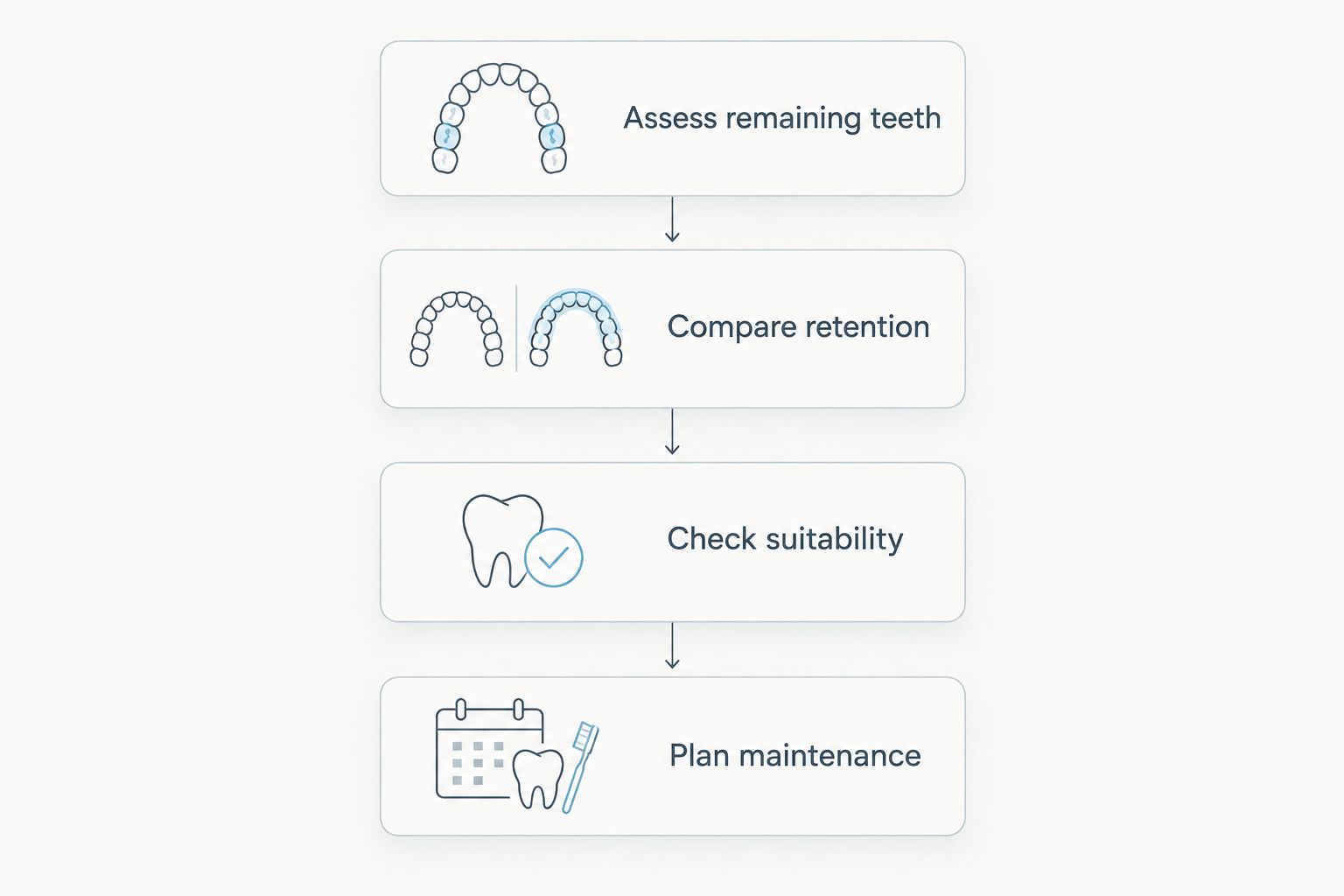
Use this sequence to organize your consultation, not to diagnose yourself. The examination comes before the ranking. A preference for a particular denture cannot establish whether the supporting teeth, gums, or bone are suitable.
- Assess remaining teeth: Identify teeth that can be maintained and teeth that need treatment.
- Compare retention: Discuss whether conventional retention meets your needs or implant assessment is appropriate.
- Check suitability: Review tissue health, bone anatomy when relevant, medical history, and surgical requirements.
- Plan maintenance: Confirm cleaning access, adjustment visits, and care for attachments or supporting teeth.
Bring a description of the problem you want solved: movement while speaking, difficulty managing particular foods, visible gaps, or trouble cleaning. These observations give the clinician a more useful starting point than a request for the newest denture type.
Review your restorative care options
Explore local restorative dental care with Harmony Dental Group in La Jolla.
Daily care is part of the decision
Whichever denture you choose, cleaning responsibilities remain. Remove and clean removable dentures daily using products appropriate for their material; ordinary toothpaste can be too abrasive for denture surfaces. Clean your oral tissues as directed and follow the prescribed overnight removal and storage instructions.
If you retain natural teeth, the standard oral-hygiene recommendation is brushing 2 times daily for 2 minutes with fluoride toothpaste. Clean between the teeth too. A partial denture does not replace care for the teeth beneath and beside its framework.
For implant-retained dentures, ask for a demonstration of cleaning around the attachments. Confirm which tools fit your particular restoration rather than copying a routine intended for a different implant design.
For your 2026 plan, request maintenance instructions before accepting treatment. Difficulty handling a denture, seeing attachment areas, or using cleaning tools belongs in the design discussion—not only in an aftercare leaflet.
How these denture types were ranked
This 2026 ranking prioritizes distinct treatment needs: implant-retained dentures for retention, partial dentures for usable remaining teeth, and conventional full dentures for complete-arch replacement without implants. It is not a claim that one design is right for every patient.
The criteria are remaining teeth, retention, tissue health, surgery, cleaning, and maintenance. Harmony Dental Group offers restorative services; an individualized examination is the step that connects those criteria to your mouth.
Which denture type should you choose?
If you are undecided, start by asking which natural teeth can be maintained. That answer separates partial-denture planning from complete-arch replacement before you consider implant retention.
- Choose partial dentures when suitable natural teeth remain and a removable replacement meets your needs.
- Consider implant-retained dentures when retention is the priority and an implant assessment supports treatment.
- Choose conventional full dentures when an entire arch needs replacement and implant placement is not part of your plan.
Do not accept best overall as a substitute for a clinical recommendation. The right choice must explain what supports the denture, how you clean it, and what happens when its fit changes.
FAQ
What's the best type of dentures compared in 2026?
Implant-retained dentures are the leading choice for added retention in suitable implant candidates; partial dentures suit usable remaining teeth, and full dentures suit complete-arch replacement without implants. The best option depends on an examination, not the ranking alone.
Are implant dentures always better than regular dentures?
No, implant dentures are not always the better treatment choice. They add retention but require surgical suitability, cleaning around implants, and attachment maintenance; conventional dentures avoid implant placement.
Can I get partial dentures if I still have natural teeth?
Yes, partial dentures are designed for arches with natural teeth remaining. The supporting teeth must be assessed for their condition, gum support, and suitability for the proposed design.
What's the difference between full dentures and implant dentures?
Full describes a denture that replaces all teeth in an arch, while implant-retained describes how it stays in place. A full denture can be conventional or implant-retained, so those labels are not mutually exclusive.
Can I take implant-retained dentures out at night?
Removable implant-retained dentures are designed to be taken out at home; fixed implant restorations are not. Follow the clinician's removal, cleaning, and storage instructions for your specific restoration.
Should I use adhesive if my full denture keeps moving?
Have persistent denture movement assessed rather than relying on adhesive to correct it. Fit, bite, and changes in supporting tissues can require adjustment, relining, or a different treatment plan.
Where can I discuss restorative dental care in La Jolla?
Harmony Dental Group is a dental practice in La Jolla offering restorative dental services. Discuss your remaining teeth, replacement needs, and suitability for implants before choosing a denture design.
One last thing
Your upper and lower arches do not have to use the same replacement approach. Suitable remaining teeth in one arch and complete tooth loss in the other create different planning needs.
Before approving a 2026 denture plan, ask for an arch-by-arch explanation. You should understand which teeth will remain, what holds each denture in place, and how you will clean each restoration.